
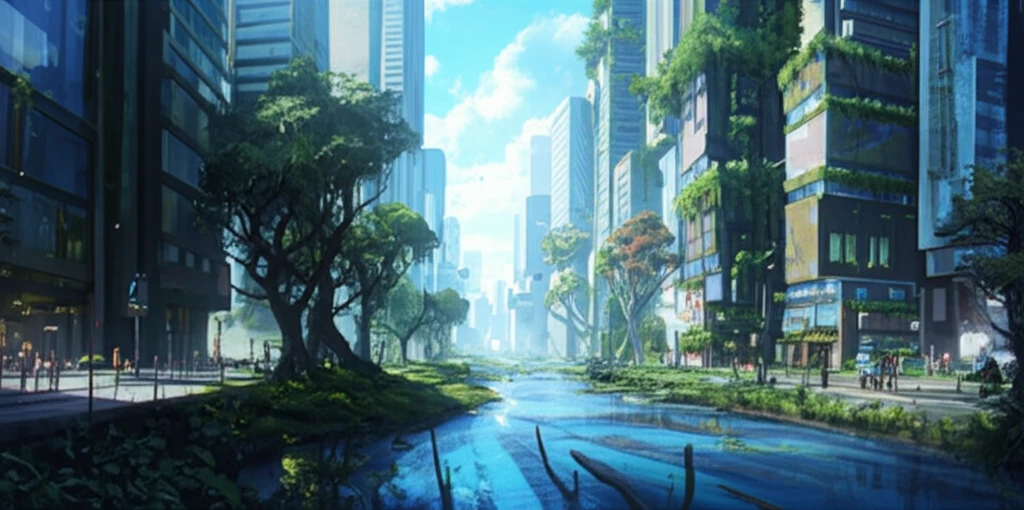
Green Cities: How Urban Planning Can Save Our Planet (and Our Sanity)

"Discover how the green infrastructure concept is transforming cityscapes and promoting eco-friendly urban development for a healthier, more sustainable future."
The world is rapidly urbanizing, placing immense strain on resources and demanding innovative solutions for sustainable living. The concept of the "compact city" has emerged as a powerful approach to address these challenges, aiming to concentrate development and reduce urban sprawl. However, simply packing people together isn't enough. We need to ensure our cities are also green, offering access to nature and its vital benefits.
This is where the concepts of green infrastructure and ecosystem services come into play. Green infrastructure refers to strategically planned networks of natural and semi-natural areas within urban environments, designed to deliver a wide range of ecosystem services. These services include everything from cleaner air and water to recreational spaces and climate regulation.
But how do we integrate these concepts into urban planning effectively? How can we create cities that are both compact and green, balancing the needs of a growing population with the imperative to protect our environment? This article delves into these critical questions, exploring the principles of green infrastructure and ecosystem services, and how they can be applied to create more sustainable, resilient, and livable urban environments.
The Statistical Baseline of Urban Growth
Monitoring the size and growth of cities relies on a network of official statistical agencies. The UK's Office for National Statistics describes itself as the nation's largest independent producer of official statistics, while the U.S. Census Bureau provides a comparable gateway to Census data tables, maps, charts, and profiles. Dedicated global platforms compile population figures for thousands of cities, enabling comparisons of the world's largest cities by population and side-by-side looks at city demographics and country-level statistics. Together these resources supply the quantitative baseline for understanding how much of humanity now lives in urban areas and the scale of the environmental challenge those numbers represent.
Standardizing City Energy Efficiency
A widely accepted route to sustainable cities is to standardize energy efficiency at the municipal level, and researchers have explored frameworks such as task-based modelling to apply it consistently. The smart-city literature notes that city concepts and corresponding standards are still being evolved, even as a range of energy efficiency solutions is developed to address urban sustainability. That evolution is itself the key limitation: because the standards and benchmarks are still being formed, results from different cities are not yet reliably comparable, and the accepted method remains a work in progress rather than a settled practice.
Deep Roots and Mileposts of Urban Greening
Understanding the history of urban green space often begins locally, and the experience of Makassar, on the Indonesian island of Sulawesi, illustrates the point. According to one historical account, gardening practices in the city reach back centuries, giving urban gardening deep roots in its old city and main city long before modern sustainability agendas. Tracing such histories is itself an exercise in milestone-hunting: etymology references document the origin and history of the English word "milestone," showing that the very metaphor of marking progress has a traceable linguistic past. Historians of cities likewise use local records and landmarks to identify the turning points of urban environmental practice.
The Greenprint: Key Strategies for Compact and Green Cities
So, what are the essential elements of a successful compact and green city? Research points to several key strategies:
- Integration: Weave green spaces into the urban fabric. Integrate green infrastructure into existing gray infrastructure like transport networks and buildings.
- Connectivity: Create green corridors. Link separate green spaces to form ecological networks, allowing for the movement of wildlife and the flow of ecosystem services.
- Multi-Functionality: Design for multiple benefits. Ensure green spaces provide a range of services, from recreation and habitat to stormwater management and climate regulation.
Green City Networks and Open Science
The FAO Green Cities Network is a current example of how global institutions are treating cities as the heart of urgent environmental, social, and economic challenges, connecting urban communities working to become greener, healthier, and more sustainable. The research underpinning such initiatives is increasingly accessible through open channels: Frontiers publishes peer-reviewed scientific articles across the entire spectrum of academia, while ResearchGate connects more than 25 million researchers across more than 160 million publication pages. For anyone tracking the field, these platforms make it far easier to follow new research and reviews on urban sustainability rather than relying on secondary summaries.
Metrics Under Fire, Labels Overused
Even well-regarded sustainability metrics attract serious criticism. The Global Footprint Network, which popularized the ecological footprint, openly acknowledges limitations and criticism of its methodology, treating criticism as part of the scientific process and noting that feedback may stem from misunderstandings, new insights, or genuine flaws in the approach. The "green city" label can also diverge sharply from reality: a Russian-language account of a settlement in Bangladesh called Green City describes a guarded compound with barbed-wire fencing and a security checkpoint, a far cry from an open, integrated sustainable community. Such examples show that the term is applied loosely and that measuring real environmental performance, rather than branding, remains contested.
Side-by-Side City Benchmarks
Comparing cities head-to-head has become easier thanks to dedicated digital tools. Numbeo's cost-of-living comparison lets users enter two city names and see how everyday expenses such as groceries, restaurants, and rent differ, while interactive geographic tools allow comparison of the real measured area of cities on a map. Used together, these instruments give planners and residents a practical way to benchmark cities on both affordability and physical footprint before drawing conclusions about greener urban design.
The Greener Tomorrow: Investing in Sustainable Urban Futures
Creating compact and green cities is not merely an environmental imperative, but an investment in our collective well-being. By embracing innovative urban planning strategies, prioritizing green infrastructure, and valuing ecosystem services, we can build cities that are not only sustainable but also healthier, more resilient, and more enjoyable places to live. It's time to reimagine our urban landscapes and pave the way for a greener, more vibrant future.
Expert Consensus and Honest Trade-Offs
Expert opinion on urban green space is genuinely divided. In IELTS-style debates, for instance, one view holds that cities should prioritize creating more public parks and green spaces, while the opposing position insists there are more important priorities for land use; candidates are expected to weigh both sides and form their own opinion. More formal consensus-building relies on methods like the Delphi technique, in which field experts across smart-city domains such as governance, education, healthcare, communication, transportation, security, energy, and sustainability give iterative feedback on possible futures. Such structured deliberation acknowledges that green-city policy is a matter of trade-offs rather than a single best answer.
Digital Twins and Green Flagships
The next frontier for green cities is increasingly digital. Digital twins, virtual replicas of entire cities as piloted in the Virtual Singapore case, are described as the backbone of AI-powered governance and are said to signal a paradigm shift in how municipalities model and manage infrastructure. Alongside these technologies, established leaders show what political ambition looks like: Freiburg, a city of about 230,000 in Germany's Black Forest, adopted the "Green City" title in 2008 and has positioned itself to help the country reach climate neutrality as quickly as possible. Emerging tooling and proven flagship cities together sketch a future in which data and political will drive urban sustainability.
Systemic Problems, Systemic Responses
Greening cities is not only a technical problem but a systemic one. Analyses framed around "systemic challenges, systemic responses" argue that adapting to climate change, including through agroecology, requires responses that match the scale and interconnectedness of the challenges themselves. Similarly, writing on the retrofit ecosystem points to the system-level challenges underpinning current building retrofit efforts, arguing that broad and deep retrofit depends on co-design and trust-building rather than isolated measures. Both perspectives converge on a core point: piecemeal fixes tend to fail, and lasting change needs coordinated, trust-based, system-wide responses.
Vacant Lots and Ancient Mud Cores
The human reality of urban decline is visible in the Rust Belt, where case studies from Detroit, Baltimore, Philadelphia, and Gary, Indiana, show how vacant properties reshape neighborhood dynamics and weigh on surrounding communities. Beyond individual cities, scientists have analyzed long cylinders of soil pulled from wetlands and riverbeds to look back in time at humanity's impact on nature, and the findings have led them to radically rethink earlier assumptions about when that impact began. Both lines of evidence underscore that neighborhood health and planetary health have common roots in how land is used and how people live.