
Fracking and Earthquakes: What's the Real Deal?

"Uncover the science behind hydraulic fracturing and its surprising connection to fault activity."
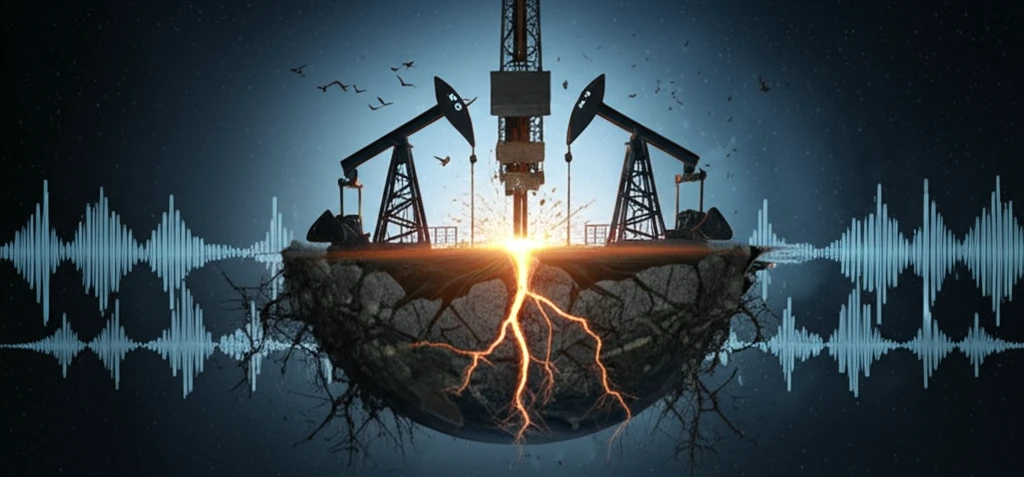
Hydraulic fracturing, commonly known as fracking, is a key method used to extract shale gas. This process involves injecting high-pressure fluids into gas-bearing reservoirs, creating fractures in the rock to release natural gas. While fracking has boosted energy production, its potential impact on the surrounding geology is a growing concern.
The central issue revolves around whether fracking can trigger seismic activity, particularly earthquakes. High-pressure fluid injection can alter the stress field in the subsurface, potentially activating dormant faults. This raises significant questions about the safety and sustainability of fracking operations, especially in areas near populated regions.
Recent research has focused on understanding these risks. By using sophisticated computer models, scientists are simulating how fracking affects fault lines, assessing the likelihood of induced earthquakes, and determining the factors that make certain areas more susceptible to seismic events. These studies aim to provide valuable insights for regulators and industry professionals to mitigate potential hazards.
Current Landscape
The relationship between hydraulic fracturing and induced seismicity remains an evolving area of study. Available data sources on this topic vary significantly in quality and scope, making comprehensive statistical analysis challenging. Understanding the current state of this issue requires careful evaluation of multiple data streams and regional variations.
Methodological Considerations
Standard approaches to studying fracking-related seismicity typically involve monitoring seismic activity near injection sites and correlating it with operational data. However, these methods face inherent limitations in establishing definitive causation due to multiple confounding variables and the complex nature of subsurface geology.
Historical Context
The connection between fluid injection and seismic activity was recognized before the modern fracking era, with historical cases documenting induced earthquakes from various industrial activities. Foundational research in the mid-20th century established basic mechanisms, though the specific relationship to high-volume hydraulic fracturing has been studied more recently as the practice expanded.
How Does Hydraulic Fracturing Really Work?
At its core, fracking is a method to enhance the permeability of shale rock, allowing natural gas to flow more freely. The process involves drilling deep wells into shale formations and then injecting a mixture of water, sand, and chemicals at extremely high pressure. This creates fractures in the rock, which are held open by the sand particles, enabling gas to escape and be collected.
- Pore Pressure Increase: Fluids injected during fracking elevate pore pressure in surrounding rocks.
- Fault Lubrication: Increased pore pressure reduces effective stress on faults, making them easier to slip.
- Stress Field Disturbance: Fracking alters the natural stress balance, which can destabilize nearby faults.
Current Research Landscape
Recent studies have refined understanding of the mechanisms linking wastewater injection (a byproduct of fracking) to seismic events. Scientific reviews generally acknowledge that while fracking operations themselves rarely cause significant earthquakes, the disposal of produced water through deep well injection has been conclusively linked to increased seismic activity in certain regions.
Debates and Limitations
Skeptics of the fracking-earthquake connection point to the relatively low magnitude of most induced seismic events compared to natural earthquakes. Some argue that improved monitoring and detection capabilities may create an illusion of increased seismicity rather than an actual increase in events. These perspectives highlight the complexity of attribution in induced seismicity research.
Regional Comparisons
The incidence of fracking-related seismicity varies considerably by region, with some areas experiencing notable increases while others show minimal impact. Geologic factors, injection well characteristics, and regulatory frameworks all contribute to these regional differences, making broad generalizations about the fracking-earthquake relationship problematic.
Balancing Energy Needs with Environmental Responsibility
The debate around fracking and induced seismicity highlights the need for a balanced approach. While hydraulic fracturing can provide access to valuable energy resources, it's crucial to minimize the potential risks to communities and the environment. Ongoing research, improved regulations, and responsible operational practices are essential to ensure that fracking is conducted safely and sustainably. The future of energy depends on finding solutions that protect both our planet and our society.
Expert Perspectives
Expert consensus generally supports that deep wastewater injection from oil and gas operations can induce seismic activity under certain conditions. However, opinions vary on the magnitude of the problem relative to natural seismic hazards and the effectiveness of mitigation strategies. Most experts emphasize the importance of site-specific risk assessment rather than blanket conclusions.
Emerging Research Directions
Future research is likely to focus on improved predictive models for induced seismicity and development of real-time monitoring systems. Advances in subsurface imaging and machine learning applications may enhance the ability to forecast and mitigate seismic risks associated with subsurface injection activities.
Wider Implications
The fracking-seismicity debate exists within broader discussions about energy policy, environmental protection, and climate change. Addressing induced seismicity requires balancing economic considerations with public safety concerns and environmental stewardship, presenting complex challenges for policymakers and industry stakeholders alike.
Community Impacts
For communities experiencing induced seismicity, even low-magnitude earthquakes can cause anxiety and property concerns regardless of their scientific classification. The perception of risk and quality of life impacts remain important considerations that extend beyond purely scientific measurements of seismic activity.