
Flooded Lung Breakthrough: A New Pathway for Liver Ultrasound Therapy?

"Could a technique using flooded lungs revolutionize how we treat liver tumors with High-Intensity Focused Ultrasound (HIFU)?"
In recent years, High-Intensity Focused Ultrasound (HIFU) has emerged as a promising, non-invasive method for treating liver malignancies. This innovative approach allows doctors to target and destroy tumors without the need for traditional surgery, reducing risks and recovery times for patients.
However, there are challenges. Tumors located in the liver dome, the uppermost region of the liver, are difficult to treat with HIFU due to the presence of the adjacent lung. The air-filled lung acts as a barrier, blocking ultrasound waves and preventing them from reaching the tumor effectively. This limitation has spurred researchers to find creative solutions to overcome this acoustic obstacle.
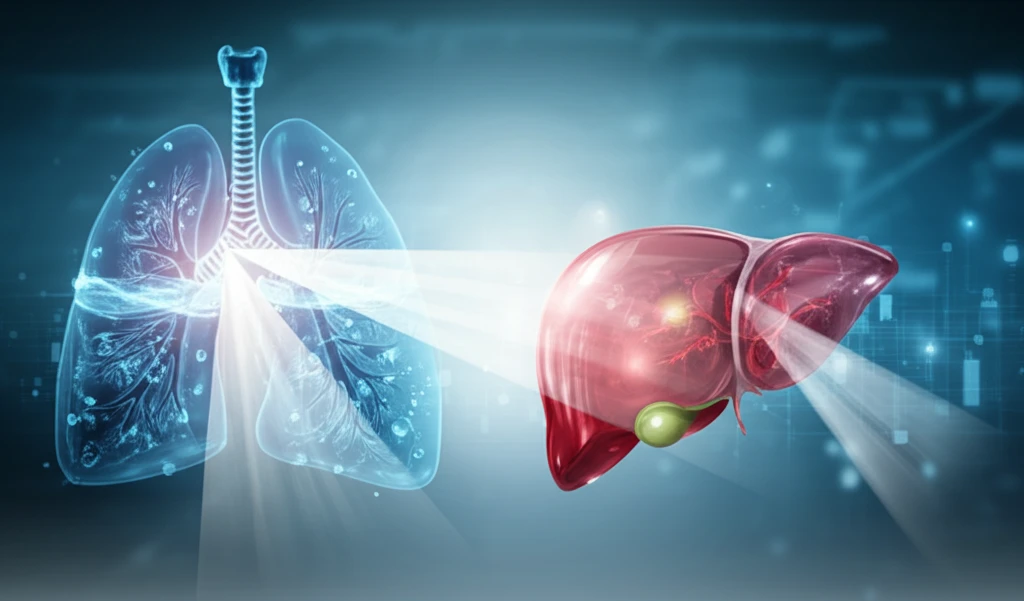
One such solution is 'one-lung flooding' (OLF), a technique that involves filling one lung with a saline solution. This enables complete sonography of the lung and adjoining organs, including the liver. Filling the lung with fluid creates a clear pathway for ultrasound waves, allowing for more precise and effective HIFU ablation of liver tumors. In this study, we explore the feasibility of ultrasound-guided transthoracic, transpulmonary HIFU ablation of the liver using OLF.
The Challenge of Liver Disease
Liver disease remains a significant global health burden, with conditions such as hepatocellular carcinoma and liver fibrosis affecting millions worldwide. Non-invasive treatment options for liver conditions have been an area of active investigation, as traditional approaches often carry substantial procedural risks. Advances in therapeutic ultrasound have opened new avenues for targeted, minimally invasive interventions in liver tissue.
Established Therapeutic Ultrasound Methods
Current therapeutic ultrasound techniques for liver treatment include high-intensity focused ultrasound (HIFU) and radiofrequency ablation, both of which aim to destroy diseased tissue through controlled energy delivery. These approaches, while effective in certain contexts, can face challenges related to precise targeting and the potential for collateral damage to surrounding healthy tissue. The quest for improved safety and efficacy has motivated researchers to explore novel physical mechanisms for ultrasound-based liver therapy.
Early Foundations of Ultrasound Therapy
The use of ultrasound in medical therapy has evolved over several decades, building on early principles of acoustic energy interaction with biological tissue. Foundational discoveries in acoustic streaming and cavitation phenomena provided the scientific basis for therapeutic applications beyond diagnostic imaging. These milestones set the stage for more targeted approaches, including the recent exploration of unconventional physical pathways for enhancing ultrasound effects in specific organ contexts.
One-Lung Flooding: A Novel Approach to Liver Tumor Treatment
Researchers are exploring one-lung flooding (OLF) as a way to enhance the effectiveness of High-Intensity Focused Ultrasound (HIFU) for treating liver tumors located in challenging areas. This method involves temporarily filling one lung with saline solution to create a clear acoustic pathway for the ultrasound waves.
- Lung Preparation: The right lung was carefully filled with a degassed and tempered isotonic saline solution, matching the functional residual capacity and tidal volume of a pig lung.
- HIFU Application: After carefully preparing and positioning the animal, the researchers used a diagnostic imaging system to visualize the flooded lung and liver. A specialized HIFU applicator was then used to deliver targeted ultrasound energy to create thermal lesions in the liver tissue.
- Lesion Creation: The HIFU focus was carefully positioned within the liver under constant imaging control, ensuring a direct pathway through the flooded lung and diaphragm. The liver tissue was exposed to HIFU for five seconds, with breath-holding periods to minimize movement.
Emerging Research on Flooded Lung Pathways
Recent research has begun to investigate the concept of a flooded lung as a potential acoustic pathway for delivering ultrasound energy to the liver. This novel approach suggests that fluid-filled lung tissue may serve as an unconventional transmission medium, potentially altering how ultrasound interacts with the liver in therapeutic contexts. While still in early stages, this line of inquiry represents an innovative departure from conventional transabdominal or intercostal delivery methods.
Challenges and Skepticism
The concept of using a flooded lung as an ultrasound pathway faces significant scientific and clinical hurdles, including concerns about patient safety and the feasibility of inducing controlled lung fluid accumulation. Critics have raised questions about the reproducibility of such approaches and whether the theoretical acoustic advantages translate into meaningful clinical benefits. Additionally, the invasiveness required to create a flooded lung environment may outweigh potential therapeutic gains compared to existing methods.
Comparing Pathway Approaches
When compared to established transabdominal or intercostal ultrasound delivery methods, a flooded lung pathway presents a fundamentally different acoustic interface that may offer unique advantages in certain anatomical configurations. However, direct comparisons are complicated by the nascent state of this research, with limited head-to-head data available. The relative merits of each approach likely depend on the specific clinical indication, patient anatomy, and treatment goals.
The Future of Liver Tumor Treatment
The study concludes that flooded lung provides a suitable pathway for applying HIFU to the liver, enabling a transthoracic, transpulmonary approach. The enlarged acoustic window could enhance the ablation speed for targets in the hepatic dome. The one-lung flooding technique may pave the way for more effective and less invasive treatments of liver tumors.
Integrating Novel Pathways into Practice
The exploration of unconventional acoustic pathways such as the flooded lung concept highlights the ongoing innovation in therapeutic ultrasound for liver conditions. Expert commentary from the field suggests that while intriguing, such approaches must undergo rigorous preclinical and clinical validation before consideration for widespread adoption. A balanced perspective acknowledges both the creative potential of this idea and the substantial evidence still required to demonstrate its safety and efficacy.
Next Steps for Research
Future research directions may include advanced computational modeling of ultrasound propagation through fluid-filled lung tissue, as well as controlled animal studies to assess feasibility and safety. The development of real-time imaging guidance could play a critical role in enabling precise targeting if this pathway proves viable. Ultimately, the translation of such concepts into clinical practice will depend on overcoming significant technical and regulatory barriers.
Systemic Barriers to Innovation
Innovative therapeutic concepts like the flooded lung pathway face broader systemic challenges, including securing research funding for unconventional ideas and navigating regulatory frameworks designed around established technologies. The medical device development pipeline favors incremental improvements over radical departures, which can slow the translation of novel acoustic pathway research into clinical tools. Addressing these systemic factors is essential for ensuring that promising early-stage concepts receive adequate evaluation.
Patient-Centered Considerations
From a patient perspective, any new therapeutic approach must ultimately demonstrate meaningful improvements in outcomes, safety, and quality of life compared to existing options. The concept of inducing a flooded lung for therapeutic purposes raises important questions about patient experience and acceptance that must be addressed through careful clinical research. Real-world impact will depend not only on technical feasibility but also on whether patients and clinicians view the approach as a desirable alternative to current standards of care.