
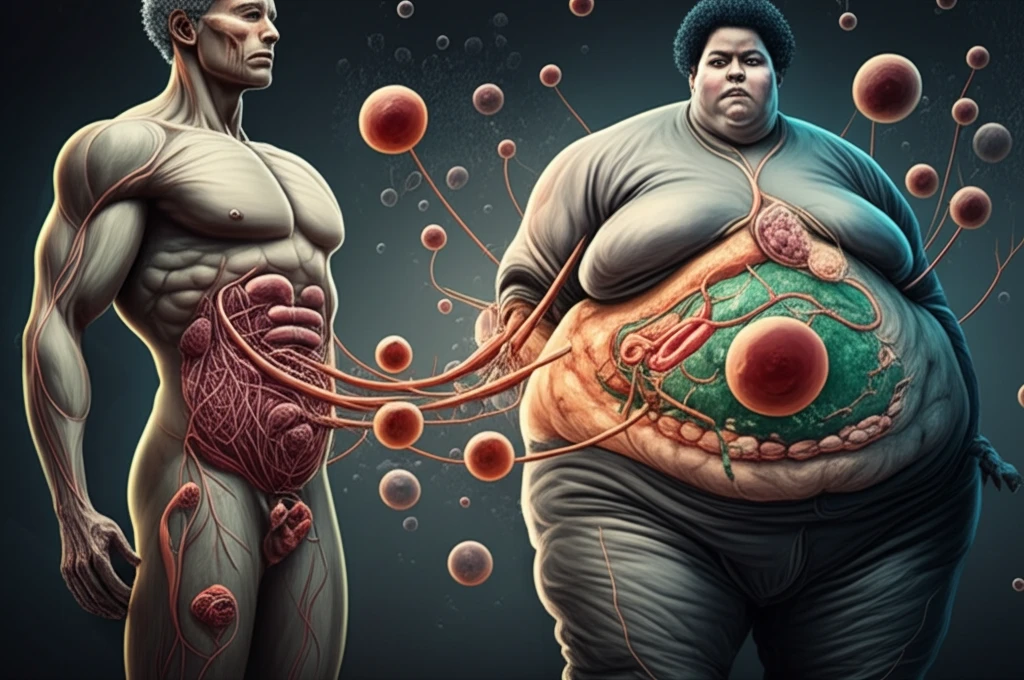
Fat and Cancer: Is Your Adipose Tissue Fueling Tumor Growth?

"Unveiling the link between adipose tissue, stem cells, and cancer progression, and what you can do to mitigate the risks."
The relationship between our bodies and cancer is complex, with ongoing research continuing to reveal intricate connections. Among the surprising discoveries is the potential role of stem cells and progenitor cells in cancer development. These cells, which can differentiate into various tissue types, are normally involved in repair and regeneration.
However, in the context of cancer, recruitment of these stem cells and progenitor cells may actually facilitate tumor growth and progression. This is especially relevant in conditions like obesity, where the excess accumulation of white adipose tissue (WAT), or white fat, creates a unique environment that might foster cancer development.
This article examines the surprising connection between adipose tissue, stem cells, and cancer. It explores how progenitor cells, particularly those found in WAT, can influence cancer progression, offering potential insights for prevention and treatment. This knowledge can empower you to make informed decisions about your health and lifestyle.
Current Impact
The relationship between adipose tissue and cancer is an active area of health research. Fat tissue may influence tumor biology through its location, cellular composition, and effects on the body's wider environment. However, the strength and meaning of these relationships can vary by cancer type and individual circumstances.
Current Approaches
Assessment of adipose tissue and cancer risk generally requires consideration of overall health, body-fat distribution, and established clinical evaluation. These approaches can help identify relevant patterns but do not by themselves prove that adipose tissue directly causes tumor growth. Interpretation is also limited by differences among individuals and cancer types.
Historical Perspective
Scientific understanding of adipose tissue has expanded from viewing it mainly as an energy store to recognizing it as biologically active tissue. This shift has encouraged researchers to examine how fat tissue may interact with surrounding cells and disease processes. The history of this field remains an evolving progression rather than a single definitive discovery.
Adipose Tissue and Stem Cells: A Hidden Connection to Cancer
Adipose tissue isn't just inert storage; it's an active endocrine organ, secreting various molecules, including adipokines. These substances can influence a range of bodily processes, including inflammation, insulin sensitivity, and even cancer development. The precise mechanisms by which obesity and WAT affect cancer risk are still under investigation, but recent research points to a key player: adipose stem cells (ASCs).
- Promoting Angiogenesis: ASCs can secrete factors that stimulate angiogenesis, the formation of new blood vessels. Tumors require a blood supply to grow and spread, and ASC-driven angiogenesis can fuel this process.
- Modulating the Tumor Microenvironment: ASCs can release trophic factors that support tumor cell survival and proliferation. By influencing the surrounding environment, they create a niche that favors cancer growth.
- Potential for Direct Differentiation: While less clear, some research suggests ASCs may directly differentiate into cells that contribute to the tumor stroma, the connective tissue surrounding cancer cells.
Emerging Research
Recent research continues to investigate how adipose tissue may interact with tumors and the surrounding biological environment. Studies are examining mechanisms that could connect fat distribution, cellular signaling, inflammation, and cancer behavior. These findings are still developing, so research results should not automatically be treated as established clinical guidance.
Limits and Uncertainty
Evidence linking adipose tissue with cancer does not necessarily show a simple cause-and-effect relationship. Associations may differ according to tumor type, fat distribution, health status, and other factors. As a result, broad claims that body fat uniformly fuels tumor growth would oversimplify the available evidence.
Types and Locations
Adipose tissue, also called body fat, is a loose connective tissue composed mostly of adipocytes, or fat cells. It also contains preadipocytes, fibroblasts, vascular endothelial cells, and immune cells such as adipose tissue macrophages. Body fat occurs in several locations, including under the skin, between internal organs, and in bone marrow; adipocytes primarily store energy, while adipose tissue also provides cushioning and structural support.
Practical Implications and Future Directions
While the research connecting adipose tissue, stem cells, and cancer is still evolving, it highlights the importance of maintaining a healthy lifestyle to mitigate cancer risk. Managing your weight through a balanced diet and regular physical activity can help reduce the amount of WAT in your body, potentially limiting the number of ASCs available to fuel tumor growth. Understanding the relationship between adipose tissue and cancer is a crucial step towards developing more effective prevention and treatment strategies. By staying informed and proactive, you can empower yourself to live a healthier, cancer-free life.
Overall Interpretation
Taken together, adipose tissue should be understood as biologically active rather than as a passive energy reservoir alone. Its possible relationship with cancer is complex and may depend on tissue location, cellular interactions, and the specific disease involved. Careful interpretation is therefore more appropriate than reducing the topic to a single universal explanation.
Future Directions
Future research may clarify how different fat depots and cell populations influence cancer biology. Better distinctions between types and locations of adipose tissue could improve the precision of scientific and clinical discussions. Until that work matures, conclusions should remain appropriately cautious.
Wider Context
The adipose-tissue and cancer question sits within a broader network of metabolism, immunity, tissue structure, and individual health. This complexity makes it difficult to isolate one biological factor from all others that may affect tumor development or progression. It also underscores the need to avoid simplistic explanations of cancer risk.
Human Relevance
For individuals, discussions of body fat and cancer can carry important emotional and practical consequences. Scientific uncertainty means that general findings should not be interpreted as a personal diagnosis or prediction. Individual concerns are best considered in the context of a person's overall health and qualified medical advice.