
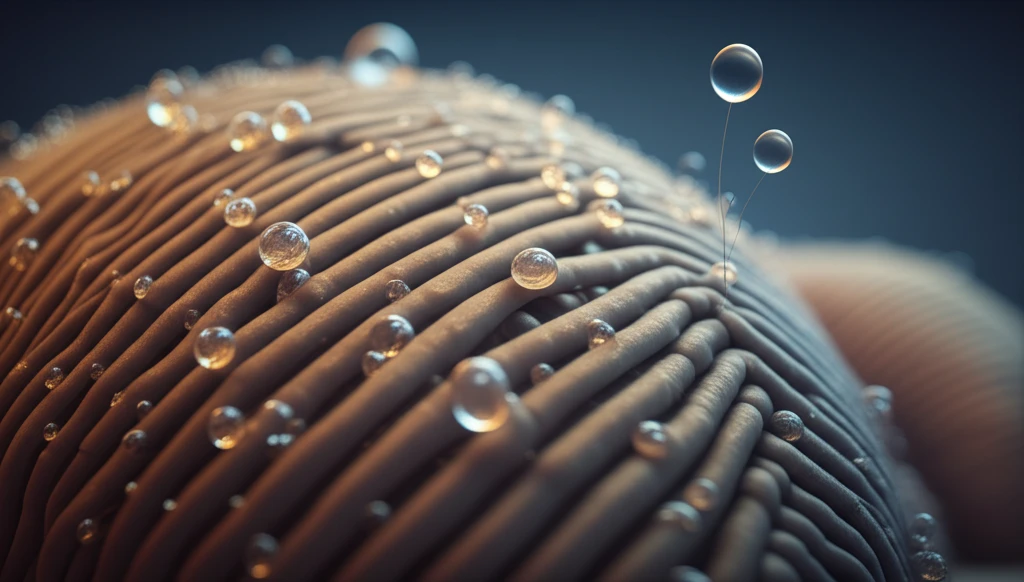
Fabric's Hidden Secret: How Understanding Moisture Can Transform Your Comfort

"Unlock the science behind fabric hydric behavior and discover how smart textiles are revolutionizing comfort in clothing."
Ever wondered why some clothes feel amazing while others leave you feeling damp and uncomfortable? The secret lies in a fabric's 'hydric behavior' – its ability to interact with moisture. This seemingly simple interaction is a complex dance between fibers and water vapor, and understanding it is key to creating truly comfortable clothing.
For years, scientists and textile engineers have been working to unravel the mysteries of fabric and moisture. Their goal? To design textiles that not only look good but also respond intelligently to our bodies and the environment around us. This research is leading to exciting innovations in sportswear, everyday wear, and even medical textiles.
In this article, we'll explore the fascinating science behind fabric hydric behavior, delving into the models and research that are shaping the future of the textile industry. Get ready to discover how understanding moisture can transform your comfort and well-being.
Textile Comfort and Thermo-Hydric Properties
Research has demonstrated that the thermo-hydric behavior of textiles, particularly underwear, has a measurable impact on wearer comfort. Studies have employed the Pearson correlation method to establish statistical relationships between the physical properties of fabrics and their thermo-hydric characteristics. This research underscores that moisture management is a critical factor in textile performance and comfort. Understanding these correlations provides a foundation for developing more comfortable fabrics.
Modeling Fabric Hydric Behavior for Comfort
Current methodological approaches focus on understanding the hydric behavior of fabrics during moisture sorption and desorption processes. By modeling how fabrics absorb and release moisture, researchers can modify fiber blends to improve wearer comfort. This understanding allows fabrics to be adapted for different climatic conditions based on their hydric and thermal properties. The modeling approach represents a systematic method for optimizing fabric performance.
Innovations in Warp Knit Fabric Technology
Advances in fabric technology have included innovations such as warp knit fabrics with specialized structures. The Hydra collection, for example, features a columnar structure that provides light stretching and elasticity widthwise, allowing it to conform better to furniture shapes. Such developments represent milestones in textile engineering that address both aesthetic and functional requirements. These structural innovations demonstrate how fabric design has evolved to meet specific performance needs.
The Science of Sorption: How Fabrics Interact with Moisture
At the heart of fabric hydric behavior lies the process of sorption – the way a material absorbs and releases moisture. This isn't just about how much water a fabric can hold; it's about how quickly it absorbs, how well it distributes moisture, and how efficiently it releases it back into the environment. These factors all contribute to how comfortable a fabric feels against your skin.
- Sorption Isotherms: These graphs depict the equilibrium moisture content of a material at various relative humidity levels.
- Dynamic Vapor Sorption (DVS): This technique measures how quickly a fabric absorbs and releases moisture.
- Moisture Regain: This is the percentage of moisture a dry fabric will absorb from the air at a standard temperature and humidity.
Analyzing Textile Hydric Behavior for Climate Adaptation
Recent research aims to analyze the hydric behavior of textiles and its significant impact on wearer comfort. Studies indicate that fabrics can be adapted for different climates if their hydric and thermal behaviors are well understood. In controlled studies, fabrics are submitted to hydric variations to evaluate their performance under different moisture conditions. This research direction emphasizes the importance of moisture management in textile design for various environmental contexts.
Hydric Behavior Studies in Construction Materials
While fabric moisture research focuses on comfort, parallel studies in construction materials reveal broader challenges in hydric behavior management. Research on adobes stabilized with quicklime, cement, and other binders demonstrates that moisture-related behaviors like clay swelling can affect material performance. These studies highlight that hydric behavior is a universal concern across material types, not just textiles. The stabilization techniques used in construction materials offer insights into moisture control strategies that may inform textile research.
Cross-Material Hydric Behavior Research
Comparative analysis of hydric behavior extends beyond textiles to various material types. Research on earth materials examines how stabilization affects moisture behavior, with implications for material durability and performance. These cross-material studies provide a framework for understanding how different substances interact with moisture. The methodologies developed for analyzing hydric behavior in earth materials could potentially inform textile research approaches.
The Future of Comfortable Clothing
As our understanding of fabric hydric behavior deepens, we can expect to see even more innovation in the textile industry. From self-regulating sportswear to clothing that responds to environmental conditions, the possibilities are endless. By embracing the science of moisture, we can create garments that not only look good but also enhance our comfort, performance, and overall well-being.
Multi-Study Perspectives on Fabric Moisture
Synthesis of multiple research efforts reveals consistent findings about fabric moisture behavior. Studies on cashmere fibers have analyzed states of water within the material, while other research has evaluated moisture transfer properties of waterproof breathable fabrics under low-temperature conditions. These investigations collectively demonstrate that fabric hydric behavior significantly impacts wearer comfort and can be modeled to improve textile performance. The convergence of research from different approaches strengthens the evidence base for moisture management in textiles.
Thermal Exposure Effects on Material Hydric Behavior
Emerging research explores how thermal exposure can alter the hydric behavior of materials, with implications for damage susceptibility. Studies on carbonate stones demonstrate that thermal changes can substantially affect moisture dynamics, potentially informing textile research about heat-moisture interactions. This line of investigation suggests that future fabric development may need to consider thermal-moisture coupling effects. The findings could lead to more durable and performance-optimized textiles for various environmental conditions.
Bio-Based Materials and Thermo-Hydric Variability
Research on bio-based building materials highlights the systemic challenge of thermal conductivity variability and its impact on thermo-hydric behavior. These studies reveal that natural materials often exhibit variable moisture and thermal properties that affect performance. While focused on construction materials, these findings provide context for understanding similar challenges in textile applications. The research underscores the importance of characterizing material variability for predicting hydric behavior.
Multi-Scale Modeling of Hygrothermal Behavior
Multi-scale investigation approaches have been applied to understand hygrothermal behavior in various contexts. Research combines experimental and numerical modeling to characterize mechanical, hydric, and thermal properties of materials from the micro to macro scale. This comprehensive methodology provides insights into how material characteristics at different scales influence overall performance. Such multi-scale approaches could be valuable for understanding fabric behavior in real-world wearing conditions.