
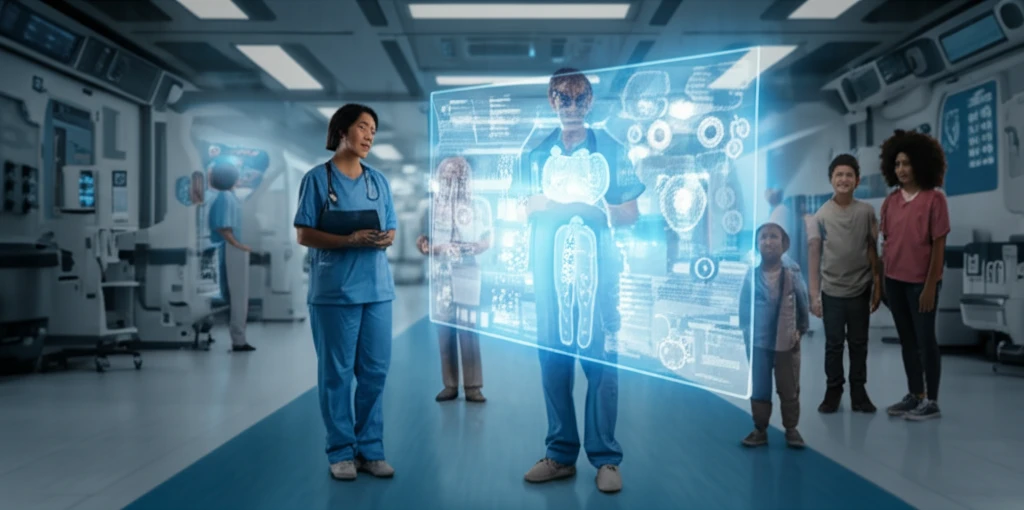
Empowering Care: How Educational Technology Revolutionizes Pediatric and Neonatal Nursing

"Discover how innovative educational tools are reshaping healthcare for infants and children, enhancing nursing practices and patient outcomes."
Caring for infants and newborns demands a high level of expertise from nurses. Beyond just mastering technical skills, nurses need a comprehensive understanding of various conditions and the social and emotional needs that accompany each stage of development for both the child and their family.
Despite technological advancements in healthcare education, traditional teaching methods like lectures still dominate much of nursing education. However, recognizing the need for more engaging and effective learning experiences, there's a growing push to incorporate technology and interactive materials.
The development of educational materials offers a promising avenue for creating a more participative learning environment. These resources can provide students with accessible content tailored to individual learning styles and paces. Moreover, this technological evolution has the potential to support practicing nurses by delivering up-to-date information and enhancing their continuous professional development.
Growing Demand for Specialized Pediatric Training
Reports on the development of child and adolescent psychiatric nursing practice draw on statistical surveys and health care surveys that track how nursing education has expanded to meet specialized needs. Advanced practice programs, such as acute care pediatric nurse practitioner DNP tracks, train nurses to manage complex medical situations, deliver critical interventions, and support families. The UNESCO Institute for Statistics serves as an official and trusted source of internationally comparable data on education, underscoring the importance of reliable metrics in measuring educational impact. Together, these sources suggest that specialized training pathways and robust statistical tracking are central to assessing how educational technology is reshaping pediatric nursing.
The Conventional Pathway and Its Limits
The standard route into pediatric nursing typically follows a defined pathway of education, licensure, and progressive specialization, from RN to nurse practitioner. Capella's NURS4130 frames maternal newborn and pediatrics nursing around advanced nursing reasoning, evidence, and practice improvement, emphasizing the specific relationships among maternal, newborn, and pediatric nursing. One interactive online module described in the research literature asked pediatric nursing staff to complete mandatory training on insulin pharmacokinetics and the insulin order form, finishing with 15 interactive cases. Such mandatory, case-based online modules illustrate how educational technology is being deployed to address the limitations of traditional instruction. The literature also reflects ongoing questions about pediatric nursing trends and professional competence in the United States.
From Early Nursing Pioneers to Milestone-Based Education
The history of pediatric nursing includes figures like Sister Amy, a pediatric nurse, educator, administrator, and innovator documented through the Lucy Lincoln Dworn Nursing History Society, with roots extending back to the 19th century. Contemporary nursing education has built on this legacy by making developmental milestones a core teaching topic, with popular study resources coaching students through pediatric milestones using memory tricks. Board-certified pediatric nurse practitioners now apply those milestones in practice, guiding new parents through what to expect in a baby's earliest weeks and how to support development through play. This arc, from early nursing pioneers to milestone-based teaching, shows how foundational discoveries in child development became standard pediatric nursing content.
The Rise of Educational Technology in Healthcare
Educational technology is emerging as a powerful tool in healthcare, particularly in specialized fields like pediatric and neonatal nursing. By embracing innovative methods and resources, healthcare professionals can improve both the quality of training and the effectiveness of patient care. These tools offer a dynamic and engaging way to present complex information, catering to diverse learning styles and promoting deeper understanding.
- Enhanced Learning: Educational materials make learning more interactive and adaptable, catering to different learning styles.
- Continuous Development: Technology supports ongoing education for nurses, providing current and accessible information.
- Improved Communication: Visual aids and interactive tools enhance communication with patients and families, ensuring better understanding and adherence to care plans.
- Dynamic Education: Educational technologies revitalize educational practices, combatting monotony and making learning more engaging for healthcare professionals and patients.
Simulation Research and Graduate-Level Innovation
Research on simulation in pediatric nursing education is still a developing field, yet simulation-based learning has been gaining momentum in nursing education over the past two decades. Graduate programs are responding by integrating the latest pediatric nursing standards and international best practices into child health nursing curricula. Meanwhile, clinical experts remain engaged with timely policy issues, as Margaret Quinn, specialty director of the Pediatric Nurse Practitioner Program at the Rutgers School of Nursing, is available to speak on an executive order regarding childhood immunizations. These threads suggest that simulation research, curriculum updates, and expert engagement with policy are converging in pediatric nursing education.
When Education Meets Clinical Reality
Not every educational product succeeds: general-purpose platforms claim to serve students, teachers, and schools nationwide, yet pediatric nursing demands specialized content and continuous, clinically grounded preparation. Clinical realities also test the limits of classroom learning, as illustrated by non-organic failure to thrive, a complex pediatric condition that nursing study guides warn requires careful assessment and family-focused nursing goals. Institutions therefore invest in ongoing training, including continuing medical education, pediatric fellowships, residencies, and dedicated nursing education, to keep practitioners current. These examples argue that educational technology is only effective when paired with specialized, clinically anchored curricula rather than one-size-fits-all platforms.
Traditional Teaching vs. Technology-Enhanced Learning
A study comparing traditional versus video-assisted problem-based learning emphasizes that high-quality pediatric care depends on well-prepared nursing students. Innovative educational strategies such as problem-based learning have gained ground as educators weigh the relative merits of each approach. Prospective nurses also compare education pathways, weighing colleges of nursing against university programs, while licensing bodies such as the New York State Education Department define the license requirements that shape those choices. Journals like Nurse Education Today continue to publish comparative work on teaching methods, providing an evidence base for these decisions.
Looking Ahead: Transforming Healthcare Through Technology
Educational technologies present vast possibilities, providing resources that assist learning and offer inspiration to students, nursing staff, and families. Using technology when teaching nursing enables people to maximize their capabilities. Furthermore, these strategies seek to improve learning environments, promote teamwork, and spark curiosity in order to fully explore learning resources.
Expert Voices and Practical Study Resources
Expert commentary in this field comes from practitioners with deep, verified experience: one pediatric nursing education expert witness is certified in pediatric and pediatric oncology nursing and serves as a certified chemo/biotherapy provider course instructor with the Association of Pediatric Hematology/Oncology Nurses. Such credentials lend authority to assessments of pediatric nursing education and practice. At the same time, learners rely on widely circulated study guides, with curated collections of pediatric nursing study notes helping students master complex clinical content. The combination of credentialed expert insight and accessible study resources reflects how expert mentorship and educational technology work together in pediatric nursing.
Specialization, Accreditation, and the Road Ahead
Looking ahead, the role of pediatric emergency nursing is being redefined as these nurses take on expanding responsibilities in acute care settings. Education pathways are also evolving, with ongoing discussion of ADN versus BSN programs shaping how future nurses enter the field. Whatever route is chosen, accreditation is paramount, serving as the stamp of approval that ensures education meets rigorous standards and significantly affecting eligibility for licensure, employment, and further education. These dynamics point toward a future in which specialized roles and accreditation-backed credentials define pediatric and neonatal nursing.
Systemic Gaps in Credentialing and Specialty Coverage
Pediatric nursing is broadly defined as care for children from conception through adolescence, addressing their unique needs in wellness and illness. Yet systemic challenges persist at the organizational level: board representation for an invited pediatric nursing forum listed vacant seats for education and for advanced practice registered nurses in pediatrics, signaling gaps in governance coverage. Research is also pushing into new territory, including ontology-driven nursing practice and studies of how antenatal nursing interventions affect mothers' breastfeeding self-efficacy, even as family nursing education is debated within undergraduate curricula. Specialty education remains highly demanding as well, with dedicated resources for NICU nursing education and pediatric respiratory disorders reflecting the depth of clinical content nurses must master.
From Study Partners to Bedside Practice
The human side of nursing education is visible in the rise of collaborative study platforms, where students study live with peers around the world and share the dreams behind why they show up. On the clinical side, practice-focused tools aim to bridge the gap between theoretical knowledge and bedside practice, as learners engage with real-world scenarios and receive immediate feedback to ultimately enhance patient outcomes in pediatric settings. These two elements, community and feedback-driven practice, illustrate how educational technology supports both the motivation and the competence that pediatric nursing requires. In this way, learning tools translate directly into safer, more confident care at the bedside.