
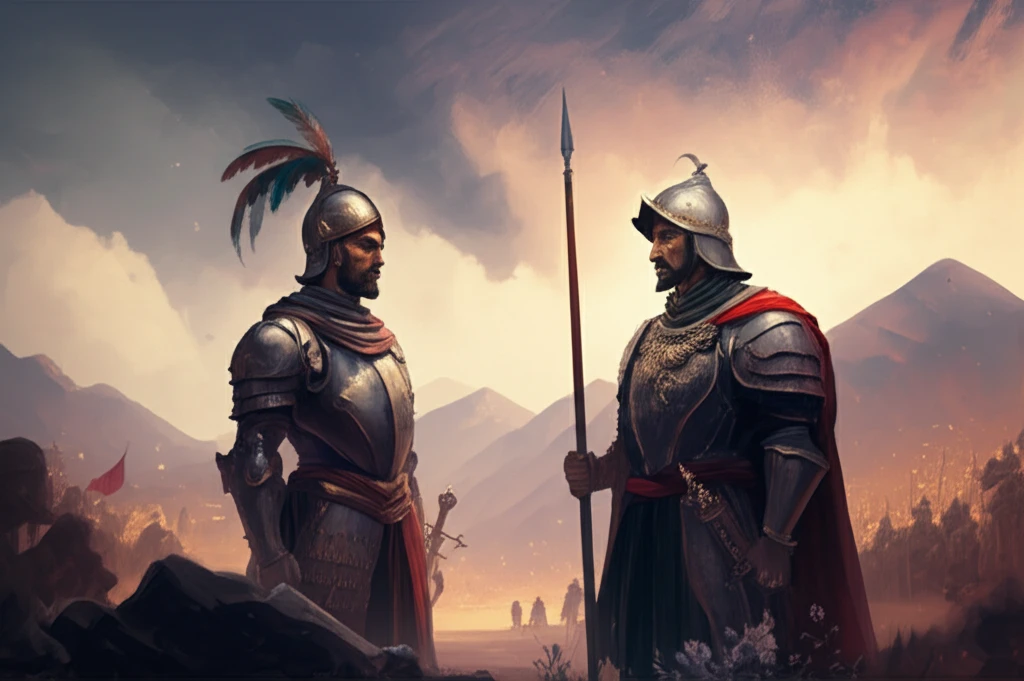
Echoes of Conquest: Unpacking the Pizarro-Atahualpa Encounter

"Journey back to the heart of the Inca Empire and understand how a fateful meeting reshaped history. Delve into the hidden layers of conquest."
The clash of civilizations often resonates through history, leaving behind echoes of both triumph and tragedy. Among the most poignant of these encounters is that between Francisco Pizarro and Atahualpa, an event that marked the beginning of the end for the Inca Empire. Poet Cyril Dabydeen captures the weight of this encounter in "Pizarro Meets Atahualpa Again,” inviting us to reflect on the deeper implications of conquest, identity, and cultural loss.
In 1532, Pizarro's small band of Spanish conquistadors met Atahualpa, the Inca Emperor, near Cajamarca. What followed was a brutal betrayal: Atahualpa was captured, held for ransom, and ultimately executed, despite the Inca's fulfilling the Spanish demand for a room filled with gold and silver. This act, driven by greed and a thirst for power, set the stage for the Spanish colonization of the Inca lands.
Dabydeen's poem delves beyond the historical facts to explore the psychological and emotional dimensions of this encounter. It touches on themes of cultural misunderstanding, the burden of conquest, and the struggle to retain identity in the face of overwhelming force. The poem also explores the profound sense of loss experienced by the indigenous population, whose world was irrevocably altered.
An Empire's Collapse in Numbers
The Inca Empire ruled over 10 million subjects before being conquered by a few hundred Spanish conquistadors in the mid-16th century. At its peak, the empire stretched more than 2,500 miles in Peru and ranked among the largest empires in history.
The Ransom as Method
The accepted account holds that with Atahualpa as a captive, Pizarro began demanding payment from the Inca for their leader. These ransom notes requested rooms full of gold and silver, and at first the Inca complied, giving the Spanish one room of gold.
From Cajamarca to Lima
Pizarro met Atahualpa just outside Cajamarca, a small Incan town tucked into a valley of the Andes, sending his brother Hernan as an envoy to invite the emperor back for a feast in his honor. After executing Atahualpa in 1533, Pizarro established the city of Lima in 1535 as the new capital of Spanish colonial rule in Peru.
A Meeting of Worlds, A Clash of Destinies
The opening lines of the poem, "Meeting you eye to eye / as nothing else matters, but / the ocean: a dreamer's maze / with more than ruins," immediately establishes the sense of disorientation and impending doom. The ocean, a symbol of the unknown and the vastness of the world, separates the two figures, Pizarro and Atahualpa, representing not only physical distance but also the immense cultural and perceptual gulf between them.
- Cultural Misunderstanding: Highlighting the deep chasm between the Inca and Spanish cultures.
- Loss of Identity: Expressing the indigenous struggle to retain their identity.
- Burden of Conquest: Exploring the heavy psychological and moral weight on both sides.
Revisiting the Encounter in Modern Media
Educational and documentary-style content continues to revisit the encounter, including a short explainer on the remarkable rise and tragic fall of the Inca Empire and a dedicated video on Atahualpa as the last Inca emperor. These accessible retellings keep the Cajamarca meeting at the center of public understanding of the conquest.
A Ransom Fulfilled, Yet a Life Taken
The central failure of trust in the encounter was that Atahualpa was captured during a meeting and held for ransom, and the Inca complied with the Spanish demand for gold and silver. Despite fulfilling the demand, Atahualpa was executed by the Spanish in 1533, and his death marked a significant turning point in the conquest.
A Few Hundred Against Ten Million
A few hundred Spanish conquistadors overcame an empire that ruled over 10 million subjects in the mid-16th century. The stark disparity between the Inca Empire, which at its peak stretched more than 2,500 miles, and the small Spanish force underscores how the capture and execution of Atahualpa decisively shaped the conquest.
Enduring Echoes of a Lost World
Dabydeen’s poem serves as a poignant reminder of the complexities inherent in historical encounters. It urges us to look beyond the traditional narratives of conquest and consider the human cost of such events. By giving voice to the silenced perspectives of the Inca people, Dabydeen enriches our understanding of history and prompts us to reflect on the enduring legacy of colonialism. The poem is not just a historical reflection but a call for empathy and a deeper appreciation of the diverse tapestry of human experience.
A Turning Point for Two Worlds
Atahualpa's death marked a significant turning point in the Spanish conquest of the Inca Empire. Following the execution, Pizarro's conquests resulted in immense wealth for Spain through the plundering of gold and silver, and Lima was established in 1535 as the capital of Spanish colonial rule in Peru.
Continuing to Reconstruct the Encounter
Retellings of the Pizarro-Atahualpa encounter range from student-produced dramatizations to short-form podcasts exploring the empire's rise and fall. These projects suggest that public interest in the encounter remains strong and that new formats will continue to bring the Cajamarca meeting to broader audiences.
From Coaque to the Andes
Pizarro's campaign built momentum in 1531, when he landed on the coasts near Ecuador, in the province of Coaque and the region of Esmeraldas, where some gold, silver, and emeralds were procured. These early acquisitions foreshadowed the ransom demands at Cajamarca, where rooms full of gold and silver were requested for Atahualpa's release.
A Feast Invitation That Became a Trap
Pizarro met Atahualpa just outside Cajamarca and, sending his brother Hernan as an envoy, invited the emperor back to town for a feast. Instead of a celebration, the meeting became the moment of Atahualpa's capture, and despite the ransom of gold and silver, he was executed in 1533.