
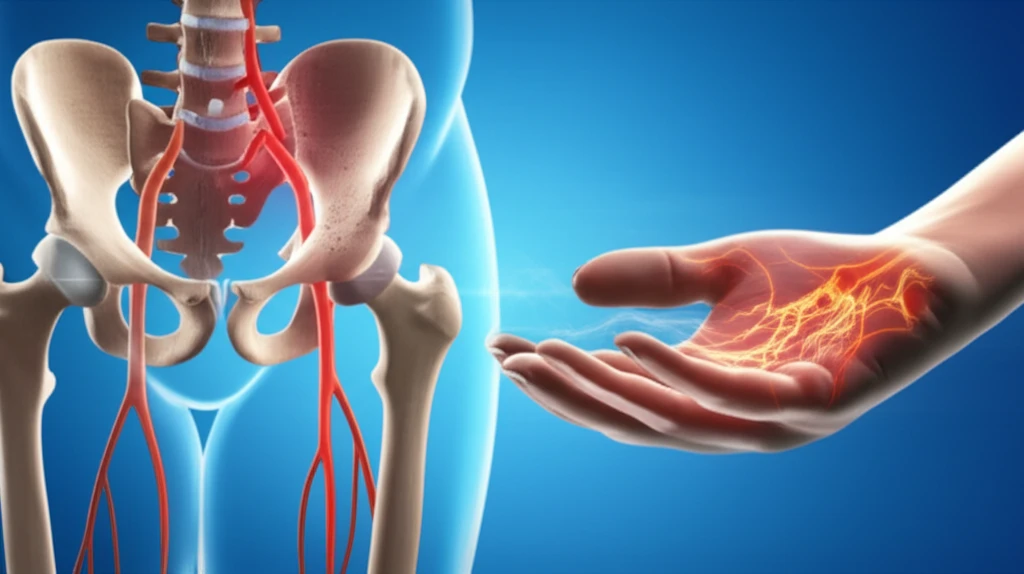
Illustration comparing pain relief in hip fracture with nerve blocks.

Easing Hip Fracture Pain: Is a Fascia Iliaca Block Better Than a Femoral Nerve Block?

"A new study compares two nerve blocks for pain relief during hip fracture surgery prep."


Hip fractures are a common and serious injury, especially among older adults. When someone breaks their hip, getting them ready for surgery often involves a procedure called a subarachnoid block (SAB). This numbs the lower body, but positioning a patient with a hip fracture for this procedure can be incredibly painful. Doctors often use strong painkillers like opioids, but these can cause unwanted side effects, especially in elderly patients who may already have other health issues.

To tackle this challenge, doctors have been exploring nerve blocks, specifically the fascia iliaca compartment block (FICB) and the femoral nerve block (FNB). These blocks use local anesthetics to numb the nerves in the hip area, reducing pain and the need for high doses of opioids. While both techniques have shown promise, a recent study directly compares their effectiveness in easing pain during positioning for SAB.

This article dives into the findings of that study, exploring whether FICB or FNB provides better pain relief, improves the ease of positioning, and enhances the overall experience for patients undergoing hip fracture surgery. Understanding these nuances can lead to improved pain management strategies and better outcomes for individuals facing this challenging injury.

AI Search Multiple angles on this topic

Fascia Iliaca Block in Practice

Fascia iliaca compartment block (FICB) has become an appealing option for pain relief in patients with hip fractures. The technique involves delivering a large volume of low-concentration local anesthetic dorsal to the fascia iliaca and lateral to the femoral vessels. It aims to anesthetize the femoral, obturator, and lateral cutaneous nerves by injecting local anesthetic beneath the fascia iliaca above the iliacus muscle. However, a 2026 systematic review noted that whether reductions in postoperative pain and opioid consumption translate into clinically meaningful benefits remains uncertain.

From Early Technique to Hip-Fracture Care

Fascia iliaca block is a regional technique in which local anesthetic is delivered within the fascia iliaca region. The technique was first proposed by Sharrock et al. in 1980, according to the cited review of its history, technique, and efficacy. A supra-inguinal approach was later described by Hebbard in a 2011 cadaveric study, allowing a more cephalad injection where nerves originate from the lumbar plexus. In emergency departments, FICB emerged as an alternative to commonly used systemic opioids for pain relief in hip-fracture patients, particularly because opioids carry a high risk of side effects in older adults.

FICB vs. FNB: Which Block Provides Superior Pain Relief?

Illustration comparing pain relief in hip fracture with nerve blocks.

The study, published in the Kathmandu University Medical Journal, directly compared FICB and FNB in patients undergoing proximal femoral fracture fixation. Researchers aimed to determine which block was more effective in reducing pain associated with positioning for a subarachnoid block. Thirty patients were divided into two groups: one receiving FICB and the other receiving FNB.

In the FICB group, patients received an injection of 30 ml of 1.5% lignocaine with adrenaline into the fascia iliaca compartment. The FNB group received 15 ml of the same solution injected around the femoral nerve. Visual analog scale (VAS) scores, which measure pain intensity, were recorded before the block and during positioning for SAB. Time taken to perform SAB, quality of positioning, and patient acceptance were also assessed.

  • VAS Scores: The FICB group reported significantly lower pain scores during positioning for SAB compared to the FNB group (1.0±1.1 vs. 2.1±0.8; P<0.05).
  • Time to Perform SAB: The FICB group also had a shorter time to perform SAB (109.6±28.2 seconds vs. 134.8±31.9 seconds; P<0.05).
  • Quality of Positioning: While the quality of patient positioning was comparable between the groups, patient acceptance was higher in the FICB group (P<0.05).
AI Search Multiple angles on this topic

Recent Comparisons With Femoral Nerve Block

Recent randomized comparisons have generally reported better positioning comfort or analgesia with FICB than with femoral nerve block in patients with proximal or neck-of-femur fractures. One study reported faster pain relief and better comfort during positioning for subarachnoid block with FICB, with NRS scores of 3.00 versus 4.28 (P = 0.001). Another randomized controlled trial concluded that FICB provided significantly better pain relief during positioning and prolonged postoperative analgesia compared with femoral nerve block. A 2026 review also reported reduced early postoperative pain, opioid consumption, and opioid-related adverse events with FICB, while cautioning that the clinical relevance of these benefits appeared limited.

Benefits Are Not Uniform

Evidence evaluating perioperative FICB in elderly patients with hip fractures has examined both pain relief and functional improvement, rather than assuming that analgesia automatically produces better recovery. A systematic review assessed whether preoperative FICB reduces pain, the need for systemic analgesia, and delirium, while also examining adverse effects in adults with hip fractures. These sources indicate that FICB has been studied as a way to reduce analgesic burden and complications, but they do not establish that every proposed functional or delirium benefit is consistently achieved.

Evidence From a Combined Nerve-Block Approach

A report on subtrochanteric femoral nerve block combined with sciatic nerve block examined anesthesia effects in lower-extremity operations. Its results stated that there was a significant difference in anesthesia effect between the two groups, with the cited result reported as P 0.05. The available source snippet does not identify which group performed better or provide enough detail to establish a direct FICB-versus-femoral-nerve-block conclusion for hip-fracture pain.

These results suggest that FICB provides better analgesia and facilitates optimal positioning for subarachnoid block in patients undergoing proximal femoral fracture fixation. The improved pain relief and ease of positioning associated with FICB can contribute to a more comfortable and efficient procedure for both patients and medical staff.

The Takeaway: FICB as a Preferred Option

Based on the findings of this study, fascia iliaca compartment block appears to be a more effective analgesic technique than femoral nerve block for patients undergoing subarachnoid block prior to hip fracture surgery. The reduced pain scores, shorter procedure time, and improved patient acceptance make FICB a valuable tool in optimizing patient comfort and procedural efficiency. However, the study also notes limitations such as the use of landmark techniques instead of ultrasound guidance, suggesting areas for further research and refinement of these pain management strategies.

AI Search Multiple angles on this topic

A Practical, Fracture-Type-Agnostic Option

FICB is described as an effective preoperative treatment for pain relief in both intracapsular and extracapsular hip fractures. In the reported patient group, there was no statistically significant difference in pain reduction or opioid use between those two fracture types. This supports considering FICB across both major hip-fracture patterns, while the absence of a difference between fracture types does not by itself prove superiority over femoral nerve block.

How this comparison fits later hip-fracture research

This study compared fascia iliaca compartment block with femoral nerve block specifically for pain during positioning for subarachnoid block in proximal femoral fracture fixation.[1]

What was actually done in proximal femoral fracture fixation

PopulationPatients undergoing proximal femoral fracture fixation procedures[1]
DurationAt least 20 minutes before shifting to the operation theatre[1]
ComparisonFemoral nerve block compared with fascia iliaca compartment block[1]
Main outcomePain associated with positioning for subarachnoid block[1]
Effect sizeVAS during positioning: 1.0±1.1 versus 2.1±0.8; time to perform SAB: 109.6±28.2 versus 134.8±31.9 seconds[1]
p-valueP< 0.05[1]
Times cited15[1]

What the findings add, and what they leave unsaid

The evidence supports a narrower conclusion than a claim that one block is universally better: in this setting, the fascia iliaca approach was associated with easier positioning and a more acceptable experience than the femoral approach.[1]

Because the study examined preparation for spinal anesthesia, its findings do not by themselves establish differences in later recovery, postoperative analgesia, rehabilitation, or adverse effects.[1] [2]

Where the finding is weakest

  • Block placement methods and timing have varied across the broader evidence base, making comparisons between studies less uniform.[3]

What a follow-up would need to show

  • Do differences during spinal-anesthesia preparation extend to postoperative pain, opioid use, satisfaction, or adverse effects?[2]

Words worth knowing for this paper

Subarachnoid block
A spinal-anesthesia procedure for which patients with femoral fractures may need painful positioning.[1]
Visual analog scale
A pain-rating measure used before the block and during positioning for subarachnoid block.[1]

About this Article -

Written with AI assistance from published research, and reviewed by the Mystum team. See our About page for more information.

This article is based on research published under:

DOI-LINK: 10.3126/kumj.v13i2.16789, Alternate LINK

Title: Analgesia Before Performing Subarachnoid Block In The Sitting Position In Patients With Proximal Femoral Fracture: A Comparison Between Fascia Iliaca Block And Femoral Nerve Block

Subject: General Medicine

Journal: Kathmandu University Medical Journal

Publisher: Nepal Journals Online (JOL)

Authors: A. Ghimire, B . Bhattarai, S. Koirala, A. Subedi

Published: 2017-02-25

Everything You Need To Know

1

What is the difference between a fascia iliaca compartment block (FICB) and a femoral nerve block (FNB)?

A fascia iliaca compartment block (FICB) is a regional anesthesia technique where a local anesthetic is injected into the fascia iliaca compartment, numbing the nerves that supply the hip and thigh. The femoral nerve block (FNB) is another regional anesthesia technique where the anesthetic is injected around the femoral nerve. Both techniques aim to reduce pain, but the study found that the FICB was more effective for pain relief during the subarachnoid block (SAB) positioning in the context of hip fracture surgery.

2

Why are the study findings about fascia iliaca compartment block (FICB) important?

The study's findings are important because they suggest that using the fascia iliaca compartment block (FICB) can lead to better pain management for patients with hip fractures. It showed that patients who received FICB reported significantly lower pain scores during positioning for the subarachnoid block (SAB) compared to those who received the femoral nerve block (FNB). This is significant because it can lead to reduced opioid use, fewer side effects, and a more comfortable experience for the patient. The improved quality of positioning, time to perform SAB and patient acceptance also contributes to a more efficient surgical process for the medical staff.

3

What are the potential implications of using a fascia iliaca compartment block (FICB) instead of a femoral nerve block (FNB)?

The implications of using fascia iliaca compartment block (FICB) over femoral nerve block (FNB) are considerable for patients undergoing hip fracture surgery. A more effective pain management approach, such as FICB, could mean less reliance on strong painkillers like opioids, potentially reducing the risk of side effects such as nausea, constipation, and respiratory depression, especially in elderly patients. This translates into a better overall experience for the patient, improving their comfort and potentially aiding in their recovery process. For the medical staff, a shorter procedure time and better patient acceptance, as noted with the use of FICB, could lead to a more efficient surgical process and improved patient outcomes.

4

How were Visual Analog Scale (VAS) scores used in the study?

The Visual Analog Scale (VAS) scores were used in the study to measure the pain intensity reported by patients before and during the positioning for the subarachnoid block (SAB). The study found that the patients who received a fascia iliaca compartment block (FICB) had significantly lower VAS scores compared to those who received a femoral nerve block (FNB). This indicates that the FICB provided better pain relief. Lower VAS scores signify less pain, thus showcasing the efficacy of FICB in managing pain related to hip fractures during this specific phase of the surgical preparation.

5

What was the main comparison made in this study?

The study compared the fascia iliaca compartment block (FICB) and the femoral nerve block (FNB) techniques. The study found that the FICB group reported significantly lower pain scores during positioning for the subarachnoid block (SAB) compared to the FNB group. The study also found that the FICB group had a shorter time to perform SAB and had higher patient acceptance. This comparison helped to establish that FICB is a more effective analgesic technique than FNB in the context of hip fracture surgery.

Newsletter Subscribe

Subscribe to get the latest articles and insights directly in your inbox.