
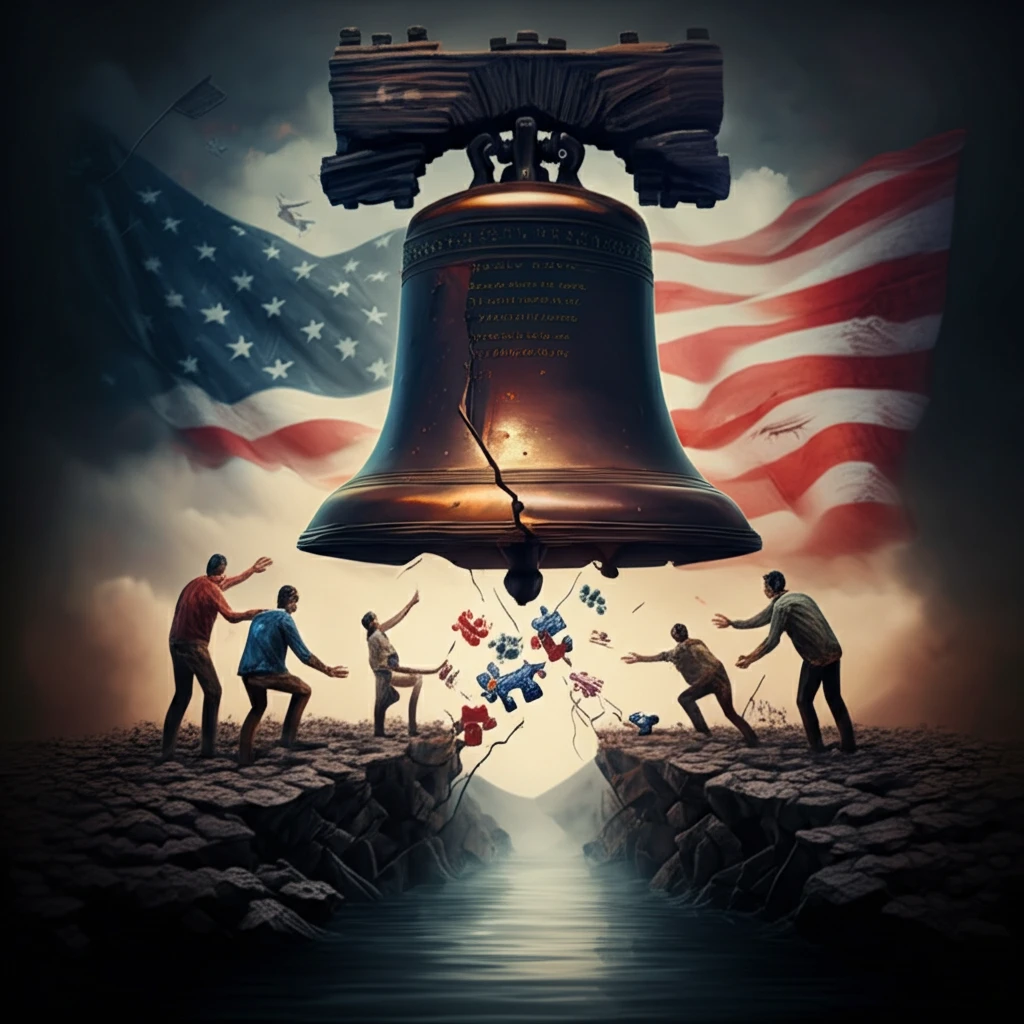
Divided We Stand: Unpacking Patriotism, Populism, and the Future of American Unity

"Can a fractured nation rediscover common ground? Examining the forces that pull us apart and the paths toward a more unified future."
The landscape of American patriotism has transformed dramatically since the events of September 11, 2001. What once appeared to be a unifying force has become a battleground of ideologies, fueled by political polarization, economic anxieties, and cultural clashes. Understanding these shifts is crucial to navigating the complex challenges facing the nation today.
In the wake of 9/11, the administration of President George W. Bush significantly shaped the narrative of patriotism, calling for unity while simultaneously launching military interventions abroad. This era witnessed a surge in flag-waving displays and unquestioning support for authority, yet it also sparked dissent and anti-war movements, revealing deep divisions within American society.
Today, America grapples with increasingly divergent forms of patriotism, often intertwined with populism and reactionary politics. This article examines the historical roots of these divisions, explores the key players and ideologies driving them, and considers potential pathways toward a more unified and inclusive national identity.
Patriotism and National Sentiment Today
Public opinion data reveals a complex portrait of American patriotism. A 2024 SSRS poll found that 60% of U.S. adults believe patriotism has a positive impact on the country, while 24% view it negatively and 16% see no impact. Independence Day polling in 2026 showed 68% of Americans are proud to be American, yet only 31% believe the country is on the right track—suggesting pride and satisfaction with national direction are decoupled. These figures indicate that patriotic sentiment remains prevalent but does not translate into broad optimism about the nation's trajectory.
Studying Populism: Methodological Frameworks
Scholars have developed multiple approaches to studying populism, with four frameworks identified as particularly influential in the academic literature. Researchers employ diverse methodologies including survey methods, computational text analysis, and experimental research to measure populist attitudes and movements. These approaches draw on cultural sociology to analyze politics in the United States and Europe, with particular focus on nationalism, populism, and radical-right parties. The American party system presents unique constraints and opportunities for populist movements, requiring scholars to adapt comparative frameworks developed for European contexts.
The Roots of American Populism
Populism in the United States traces back to Andrew Jackson's presidency in the 1830s and the formation of the People's Party in the 1890s. The concept underwent significant transformation: Progressive historians initially treated the US People's Party favorably, but mid-1950s revisionist American scholars recast populism into a social scientific term carrying negative connotations. After declining for much of the 20th century, populism resurged in 2010s–2020s politics, not only in the United States but across democracies worldwide. This recurring political theme has inspired reform movements while also being used to redirect citizen anger toward perceived scapegoats.
The Patriotism of American Exceptionalism and its Discontents
One dominant narrative of American patriotism centers on the concept of "American exceptionalism," the belief that the United States holds a unique and divinely ordained place in the world. This view often emphasizes a covenant with God, a commitment to Christian values, and a sense of global responsibility to spread democracy and freedom.
- Economic inequality and the decline of the middle class
- Cultural anxieties and the fear of losing traditional values
- The rise of social media and echo chambers that reinforce existing beliefs
- A decline in trust in government and institutions
Contemporary Research on Populism and Patriotism
Recent research indicates that mass-level populism in the United States aligns predominantly with right-wing issues rather than left-wing ones, reinforcing ideological divides around conservative policy positions. Survey data from the Archbridge Institute's Human Flourishing Lab reveals that most Americans maintain a positive national identity, though notable differences exist across demographic groups. Scholars are examining the complex interplay between populism, polarization, social media, and identity politics to understand current and future challenges facing American democracy. One synthesis of contrasting accounts of American democracy in crisis proposes 'better democracy' as a pathway to escaping democratic deterioration.
Limitations and Critiques of Populism Frameworks
While populism is often framed as a threat to democratic governance, the evidence for this claim remains contested and context-dependent. Some scholars argue that populist movements can serve as corrective mechanisms, amplifying voices excluded from mainstream political representation. The label 'populist' is frequently applied selectively, with similar policy positions receiving different evaluations depending on which political faction advances them. Critics note that focusing exclusively on populism's dangers may obscure legitimate grievances about institutional failures and elite unresponsiveness that fuel anti-establishment sentiment in the first place.
Patriotism, Nationalism, and Populism Compared
Scholars distinguish between patriotism, nationalism, and populism as related but distinct political orientations. Moderate statist nationalism connects well with mainstream right-wing populism, while transnational communitarian belonging—rooted in shared religion or confession—represents the primary populist alternative to nationalism. American political ideologies conventionally align along a left-right spectrum, with most Americans identifying as conservative, liberal, or moderate. These ideological distinctions shape how different groups interpret patriotic expression and populist appeals, creating divergent understandings of national identity and political legitimacy.
Finding Common Ground: A Path Forward
Despite the deep divisions that plague American society, there is still hope for a more unified future. By acknowledging the legitimate grievances of all Americans, promoting civil dialogue and understanding, and working towards a more just and equitable society, it is possible to bridge the divides that threaten to tear the nation apart. The path forward requires a renewed commitment to the values of inclusivity, tolerance, and mutual respect, ensuring that all Americans feel a sense of belonging and shared purpose.
Integrating Perspectives on American Division
The evidence suggests that American political divisions reflect not a single cause but intersecting dynamics: patriotic sentiment persists alongside declining institutional trust, while populism channels frustration across ideological lines. Scholars increasingly recognize that simplistic narratives of democratic decline miss the complexity of how citizens engage with political institutions. The challenge for analysts and policymakers lies in distinguishing between healthy democratic contestation and genuinely erosive polarization. Understanding these nuances requires moving beyond binary frameworks that categorize all populist expression as either legitimate representation or authoritarian threat.
Patriotism, Trust, and Institutional Legitimacy
The long-term decline in patriotism has coincided with a collapse of public trust in institutions—including government, media, churches, and corporations—that traditionally undergirded national cohesion. Most Americans maintain a positive national identity, but this sentiment may be increasingly detached from faith in institutional performance. Political analysts project that the intersection of demographic change, economic disruption, and technological transformation will reshape how Americans conceptualize patriotism and national belonging. The question for the coming decade is whether civic identity can be sustained without the institutional foundations that historically supported it.
Populism, Polarization, and Democratic Resilience
Post-9/11 patriotism initially exhibited patterns characteristic of wartime national unity, revolving around fear and solidarity. However, research indicates that populism's impact on democracy is mixed: only a combination of institutional weakness and conjunctural opportunities giving populist leaders overwhelming support proves fatal to democratic systems. Affective polarization has contributed to a divided America where both sides perceive elections as existential threats to their values and way of life. Central features of liberal democracy—including voting rights, checks and balances, and presidential transitions—face strain but have not yet collapsed, suggesting both vulnerability and resilience.
Populism's Effects on People and Institutions
Case studies reveal that extreme forms of populism have endangered basic civil liberties and spawned intolerant rhetoric in various national contexts. Research validates that nationalism increases support for anti-immigration and protectionist policies, while patriotism tends to decrease such support—highlighting important distinctions between these related concepts. Comparative analyses across Europe, Latin America, and the United States show populist movements reshape democratic governance through both formal institutional channels and informal norm erosion. The international effects of populism extend beyond domestic politics, influencing foreign policy-making and diplomatic relationships in countries governed by populist leaders.