
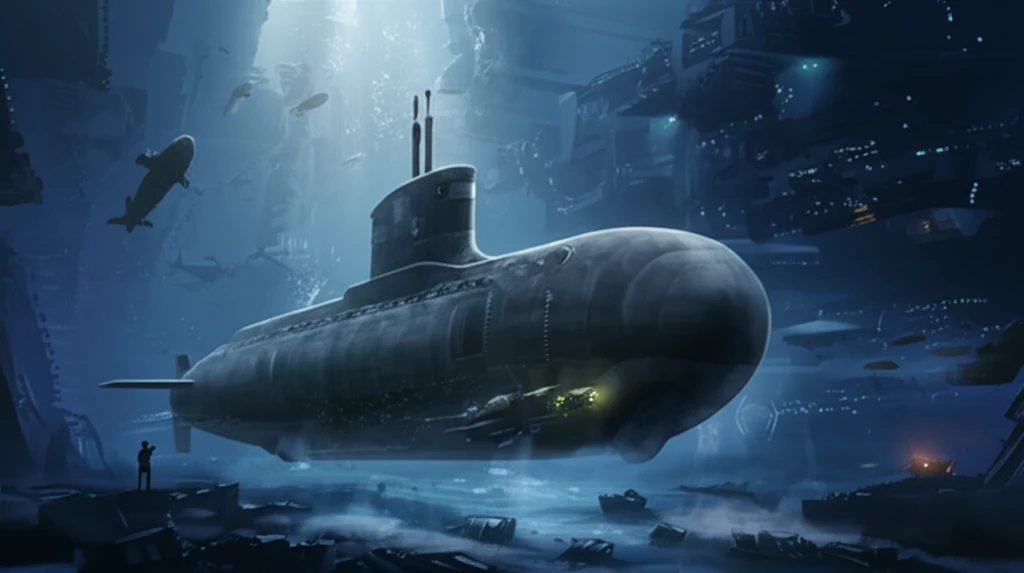
Dive Deep: How Enhanced Underwater Simulations Are Revolutionizing Naval Training

"Discover the cutting-edge advancements in underwater confrontation simulation that are reshaping naval amphibious operations, making training safer, smarter, and more effective."
Naval amphibious training systems are a cornerstone of modern military command and control, providing a virtual, yet realistic, environment for combat training. These systems allow personnel to engage in tactical command and equipment operation, honing self-defense skills and promoting effective co-training. The ability to simulate real-world scenarios is crucial for preparing naval forces for the complexities of underwater confrontations.
Traditional underwater training methods often fall short in accurately replicating the complexities of actual battlefield environments. Limitations in forces deployment, launching condition determination, and hit detection of torpedoes can lead to significant errors in spatial targeting. Moreover, the focus on singular offensive or defensive procedures neglects the comprehensive training needed for diverse combat situations. These shortcomings highlight the urgent need for advanced simulation techniques.
Recent research introduces an innovative underwater confrontation simulation method, integrating five critical components: initial enemy submarine position generation, dynamic training situation updates, torpedo emission simulation, precise target hit detection, and realistic confrontation behavior simulation. By enhancing each of these elements, this approach promises a more thorough and effective training experience, equipping naval commanders with the skills and knowledge necessary for underwater superiority.
Market Growth and Training Transformation
The global naval vessel simulation market is experiencing significant growth, driven by expanded facilities for training navy personnel across surface combatants, submarines, and uncrewed platforms. Simulation systems now replicate ship operations, navigation, combat scenarios, engineering functions, and command decision-making processes. Within this scope, submarine underwater warfare simulation systems serve naval defense applications, submarine crew training, unmanned underwater vehicle simulation, and sonar analytics. Virtual simulation systems are anticipated to shape the future of naval training by offering highly detailed and adaptable solutions to the armed forces.
Traditional Training Paradigms
Naval training has historically relied on a progression from classroom instruction to on-platform experience, supplemented by increasingly sophisticated simulation tools. While live-at-sea training remains the gold standard, its high cost and logistical constraints have made synthetic alternatives an accepted complement. Standard methods typically involve part-task trainers for individual systems before advancing to full-mission simulators. However, integrating these disparate elements into a cohesive training pipeline continues to present integration and standardization challenges.
Evolution of Naval Simulation
Early naval simulation was limited to basic bridge and engine room mockups that provided procedural familiarity rather than tactical immersion. The introduction of computer-generated imagery and networked systems in the late 20th century marked a milestone, enabling multi-unit exercises in virtual environments. Foundational work in hydrodynamic modeling and acoustics laid the groundwork for today's high-fidelity submarine and surface vessel simulations. These developments have progressively closed the gap between synthetic training and real-world operational conditions.
Key Enhancements in Underwater Simulation
The strength of this improved simulation method lies in its sophisticated approach to several key areas. Let's examine these enhancements in detail:
- F(i, j) = ω₁D(i, j) + w₂B(i, j) + w3W (i, j): This formula balances the influence of depth (D), seabed sediment (B), and hydrological environment (W), each weighted by factors (ω₁, ω₂, ω₃).
- Optimized Initial Placement: The system employs linear programming to pinpoint the most suitable initial locations for enemy submarines, ensuring challenging and varied training scenarios.
- Dynamic Updates: The positions are continuously updated based on real-time factors, mirroring the fluidity of actual underwater combat.
Advances in Fidelity and Realism
Recent research emphasizes high-fidelity modeling of hydrodynamics, visual rendering, and realistic underwater phenomena such as turbidity, wave interactions, and marine habitat dynamics. A 2026 review evaluated simulators' effectiveness for operator training, technology validation, and multi-robot mission planning. The U.S. Naval Academy is actively simulating maritime threats using autonomous systems, with insights informing curriculum updates aligned with evolving fleet priorities. Digital simulation platforms are now closing the costly gap of training autonomous underwater vehicles, which was previously prohibitively expensive and logistically complex.
Modeling Vulnerabilities and System Failures
Research has identified critical vulnerabilities in underwater sensor networks, particularly cascading failure propagation under weak communication conditions. Survivability analyses have prompted mitigation strategies to enhance operational continuity of undersea networks. Improved confrontation simulation methods have been developed for amphibious training, addressing limitations in traditional torpedo launch condition judgments by incorporating kinematics-based models. Engineering-based simulations are also being used to analyze sonar detection performance and resolve adjacent targets, ensuring simulation cores accurately reflect real-world specifications.
Evaluating Simulation Platforms
Modern naval training products are increasingly judged by their ability to compress learning curves, improve team coordination, and increase repetition without consuming scarce live assets. Sophisticated submarine warfare simulation tools replicate strategic scenarios with remarkable fidelity, honing operational skills and tactical assessment. Advances in virtual reality, computer-based simulators, and full-mission platforms now play a crucial role in preparing sailors for complex undersea environments. Systems like SAES simulators allow for both individual specific training and simulation of joint missions among various navies, recreating any scenario.
- AttackingDistanceMax(k) = √((Vtrop_max cos αtrop - Vstream cos γ)2 + (Vtrop_max sin αtrop - Vstream sin γ)2) Twtrop: Determines the maximum range, factoring in torpedo and current speeds.
- AttackingDistanceMin(k) = √((Vtrop_min cos αtrop - Vstream cos γ)2 + (Vtrop_min sin αtrop - Vstream sin γ)2) Twtrop: Calculates the minimum range, ensuring realistic engagement parameters.
Future Implications
The advancements in underwater confrontation simulation represent a significant leap forward in naval training. By providing more realistic and comprehensive training environments, these methods enhance the preparedness and strategic decision-making of naval commanders. As technology continues to evolve, further innovations in simulation will undoubtedly play a crucial role in maintaining maritime superiority and ensuring the safety and effectiveness of naval operations. The next step involves integrating surface and air confrontations for comprehensive joint simulations.
Adaptive Systems and Analytical Tools
Recent studies compare adaptive versus non-adaptive simulation trainers, such as the Rules of the Road Adaptive Fleet Training system (RAFT), for learning nautical rules. Simulation has long been a critical tool for developing tactics and evaluating system performance within the U.S. Navy submarine force. The Object-oriented, Rule-Based Interactive System (ORBIS) has provided key insights into critical submarine capabilities for over 15 years. Additionally, wargaming is being explored as a concept exploration, analysis, and assessment tool by NATO specialist teams.
Unmanned Systems and AI Integration
Unmanned naval vessels simulation has become a cornerstone of modern maritime defense, enabling the safe development of autonomous surface and underwater systems. These platforms combine physics-based modeling, artificial intelligence, digital twins, and cybersecurity testing with realistic environmental simulation. The military simulation training market is projected to reach over $20 billion by 2033, reflecting significant growth across airborne, naval, and ground applications. Opportunities are expanding in training and skill development, research and development, and testing and validation markets.
Operational Readiness and Infrastructure Security
High-fidelity naval simulators provide realistic performance in complex training scenarios, accurately simulating real-world operational challenges across all proficiency levels. Advanced simulation systems enable realistic, repeatable training that enhances strategic decision-making and technical proficiency, strengthening national security. This is particularly integral for diesel-powered submarines navigating complex underwater threats. The broader context now includes securing critical undersea infrastructure against growing threats, requiring adaptation of naval training and simulation approaches.
Building Confidence Through Realistic Recreation
The U.S. Navy's Naval Undersea Warfare Center (NUWC) is advancing undersea weapon technology through sophisticated research and simulation, requiring highly deterministic computing environments. New simulation technologies are recreating real-world mishaps to build confidence for Navy surface mariners on different career paths. Vietnam is integrating Autonomous Underwater Vehicles into naval training in response to maritime challenges in the South China Sea. These efforts demonstrate how simulation bridges the gap between theoretical knowledge and operational preparedness.