
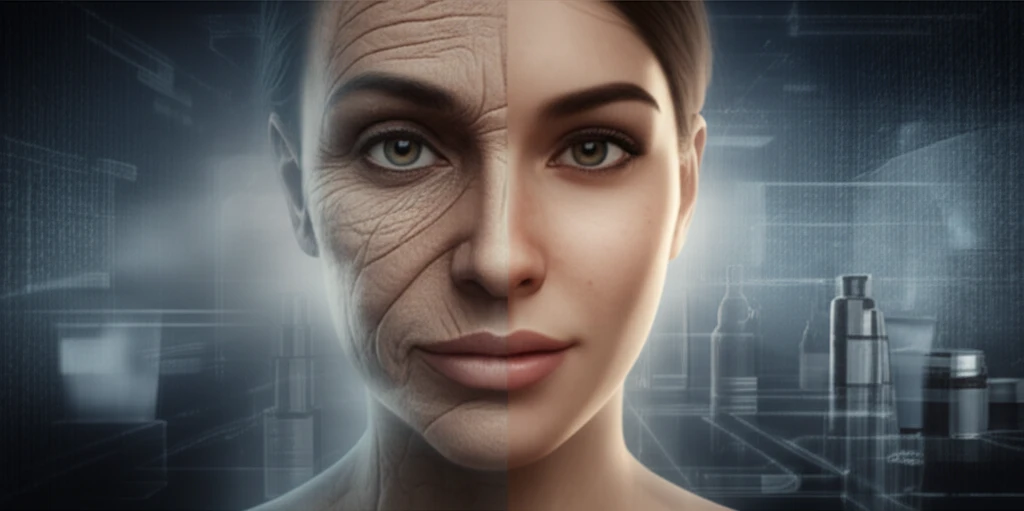
Decoding Your Skin's Age: How to Take Control of Facial Aging

"A groundbreaking study reveals how personalized education empowers you to make informed decisions about age-related skin changes."
As we age, the skin on our face undergoes various changes, from the appearance of fine lines and wrinkles to shifts in texture and volume. Navigating the myriad of available treatments and understanding which are best suited for your unique skin can be overwhelming. Often, patients rely solely on the expertise of practitioners, but what if you could play a more informed and active role in the decision-making process?
A 2011 study published in the Clinical, Cosmetic and Investigational Dermatology journal explores the effectiveness of a new patient education software program called "Home Of Younger Skin" (HOYS). This innovative program aims to empower individuals by providing a structured and personalized assessment of age-related skin changes, ultimately leading to more satisfying treatment outcomes.
This article will delve into the key findings of the study, explaining how HOYS works, what benefits it offers compared to standard education methods, and why understanding your skin's 'esthetic age' is crucial for making informed choices about cosmetic procedures.
The Scale of Facial Rejuvenation
The global cosmetic surgery market was valued at US $63.4 billion in 2021, according to a 2024 review of facial rejuvenation. Reported annual procedure volumes include approximately 1 million skin-resurfacing treatments and 260,000 skin-tightening treatments. Facial rejuvenation remained prominent in 2025, when facial fat grafting recorded a 39 percent increase, according to the American Society of Plastic Surgeons. These figures reflect sustained interest in procedures intended to address visible facial aging.
Choosing Among Rejuvenation Options
Facial rejuvenation commonly involves selecting among procedures intended to address the ways facial skin changes with age. The appropriate approach can vary according to the specific concerns being treated and the individual's goals. Because procedures differ in their intended effects, consultation with a qualified medical professional is important before treatment. No single method should be assumed to address every aspect of facial aging.
From Skin Excision to Multilayer Care
The original concept of a facelift was introduced in the early twentieth century and involved the simple excision of excess skin. Modern understanding recognizes that facial aging is not limited to wrinkles: skin, fat, muscles, and bones all change, each at a different rate. Facial rejuvenation treatments now address concerns including fine lines and wrinkles, sagging or loose skin, and loss of volume. This reflects a shift from treating excess skin alone toward considering multiple components of facial aging.
HOYS: A Personalized Approach to Understanding Skin Aging
The HOYS program moves away from the traditional, often subjective, methods of assessing skin aging. Instead, it utilizes a database of digital images depicting various aspects and degrees of aging across seven key geographic regions of the face, neck, décolletage and hands. These regions are further divided into 35 subregions, each represented by a five-point photonumeric scale.
- Self-Assessment: Patients, while looking in a mirror, compare their own appearance to the images on the photonumeric scale for each of the 35 subregions.
- Scoring: Patients select the image that best matches their current appearance, effectively assigning a score to each subregion.
- Skin Age Calculation: The HOYS software then uses a proprietary algorithm to calculate the patient's overall 'skin age,' as well as individual skin ages for each of the seven regions.
- Treatment Prioritization: Based on the difference between the patient's chronological age and esthetic age (skin age), the program generates a personalized treatment prioritization list, highlighting areas where intervention may be most beneficial.
An Evolving Evidence Base
Recent work on facial rejuvenation continues to examine how different interventions affect the visible features of aging skin. Reviews and clinical research may help clarify which approaches improve particular concerns, but findings should be interpreted in light of each study's design and scope. The field remains active rather than settled, with ongoing attention to treatment effectiveness, safety, and durability.
Limits and Uncertainty
Facial rejuvenation does not guarantee the same result for every person or every aging concern. Outcomes can vary with the treatment selected, the feature being addressed, and individual circumstances. Claims that a single intervention can comprehensively reverse facial aging should therefore be treated cautiously. Careful consultation and realistic expectations remain important when weighing potential benefits and limitations.
Comparing Nonsurgical Treatments
A 2025 review reports that traditional microneedling, radiofrequency microneedling, and nano-needling produced marked improvements in skin quality by promoting rejuvenating changes. Other nonsurgical options include Botox, dermal fillers, biostimulation, microneedling, and platelet-rich fibrin, with each intended to address different concerns. Combining treatments may be useful because separate procedures can target different layers or aspects of aging; for example, neuromodulators can relax forehead lines. The available options therefore differ in mechanism and target rather than representing interchangeable treatments.
Empowerment Through Knowledge: The HOYS Advantage
The study compared the HOYS program to standard education methods, which typically involve providing patients with general information sheets on age-related skin changes. The results demonstrated a significant advantage for patients using HOYS.
Personalized Rejuvenation Strategies
A review of nonsurgical facial rejuvenation identifies four key age-related changes: diminished skin quality, increased soft-tissue laxity, and the formation of rhytids, along with another associated facial change discussed in the review. Expert commentary also rates retinol highly among anti-aging treatments, giving it a 10/10 rating in one assessment. A 2025 review emphasizes personalized regimens based on biological age, phototype, and lifestyle factors. Together, these sources support matching treatment choices to both the dominant facial changes and the individual's characteristics.
Where the Field May Go Next
Future progress in facial rejuvenation may depend on better matching interventions to the specific biological features of aging. Research is likely to continue evaluating how treatments affect skin quality, laxity, wrinkles, and volume-related changes. As evidence develops, individualized treatment planning may become more important than relying on a single universal anti-aging method.
Access, Expectations, and Evidence
Facial rejuvenation sits at the intersection of medical care, appearance-related expectations, and consumer decision-making. People may face difficulty comparing procedures when evidence, risks, costs, and expected durability differ between options. Broader challenges include communicating uncertainty clearly and ensuring that treatment decisions remain informed, individualized, and medically appropriate.
Patient Experience and Visible Change
A 2024 real-world report associated reduced inflammation, erythema, and visible signs of facial aging with improved skin health and patient satisfaction. A 2026 study aimed to assess the efficacy and safety of long-term, regular IPL therapy for facial erythema, pigmentation, and wrinkles. Other reports describe human skin cells being rejuvenated by approximately 30 years in a laboratory-related finding and present a 7.5-year full-face filler case study focused on natural-looking results. These examples illustrate that real-world impact may involve both measurable skin changes and how patients evaluate their appearance and experience.
Key findings included:
Patients in the HOYS group reported a greater understanding of age-related skin changes, felt more empowered to participate in treatment decisions, and were more satisfied with the recommended treatments. They also valued the skin age scores generated by the program and were more likely to recommend the program to a friend. By providing a structured, personalized assessment of skin aging, HOYS empowers patients to take control of their cosmetic journey, leading to more informed decisions and ultimately, more satisfying results.