
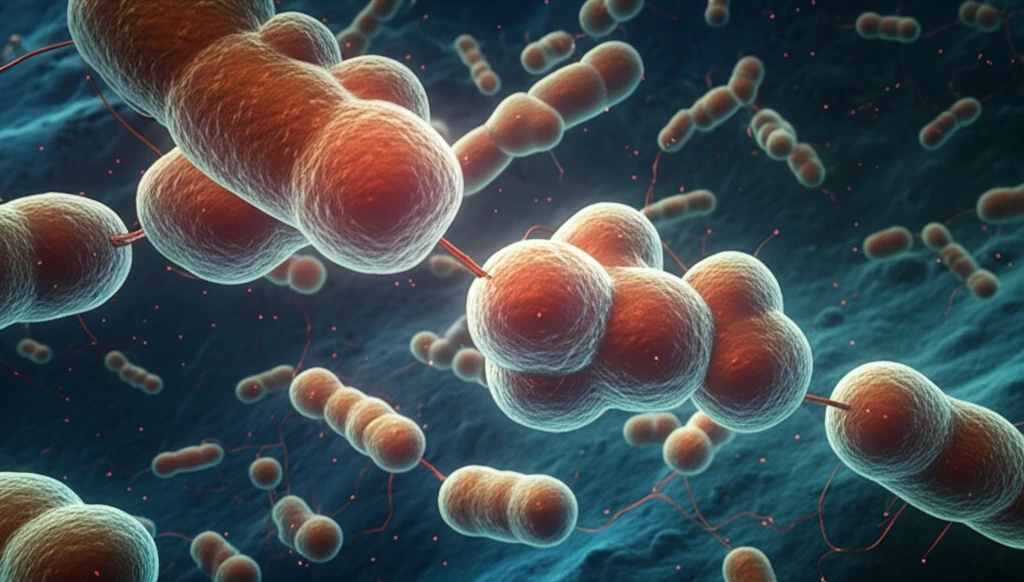
Decoding the Secrets of Cell Size: How Growth Affects Bacteria

"New research reveals the surprising link between nutrient availability, growth rate, and cell size in bacteria, challenging long-held assumptions."
In the intricate world of microorganisms, maintaining a stable cell size is crucial for survival. Bacterial cells, like tiny biological machines, must coordinate their growth with the progression of their cell cycle to ensure proper function and replication. This balance, known as cell size homeostasis, is essential for bacterial populations to thrive in diverse environments.
For years, scientists believed that fast-growing bacteria, such as Escherichia coli (E. coli), adjusted their cell size based on the nutrients available—a principle known as the 'nutrient growth law.' This law states that when nutrients are abundant, bacteria grow larger and faster; conversely, when nutrients are scarce, they grow smaller and slower. However, a new study is turning this conventional wisdom on its head by exploring whether nutrient limitations impact cell size in slow-growing bacterial species as well.
This pioneering research delves into the growth patterns of Sinorhizobium meliloti, a slow-growing bacterium, to understand how it adapts its cell size to different nutrient conditions. By examining the cell size and DNA content of these bacteria, scientists are uncovering fundamental principles that could reshape our understanding of microbial life and its adaptability.
Why Bacterial Size Matters
Bacterial cell size is not arbitrary; the smallest cells must maintain enough volume to accommodate the genetic resources needed to support their lifestyle. Physical factors such as temperature, pH, osmotic pressure, hydrostatic pressure, and radiation each influence microbial growth and therefore the sizes populations can reach. Because size feeds directly into growth, survival, and practical concerns like food safety, understanding its determinants has broad scientific and applied impact.
The Adder Model and Its Limits
The prevailing model explaining bacterial size homeostasis is the "adder" model, which proposes that during each cell cycle event, a fixed volume is added to the cell regardless of its size at birth. This constant-extension rule has been shown to drive bacterial cell size homeostasis in experimental studies. However, the adder model is a simplification: it describes an average behavior and does not by itself explain why the fixed increment is set at a particular value, which is an active area of research.
From the Growth Law to the Adder Rule
Early work established a general growth law that relates cell size to growth conditions, and more recent findings show this general growth law can explain the origin of the nutrient growth law in E. coli. A key milestone was the discovery that cell size can be controlled and predicted for any growth condition, along with the observation of an invariant initiation mass that links DNA replication to cell size. These foundations set the stage for modern models such as the adder, which refined the picture by focusing on the constant volume added per cell cycle.
The Surprising Link Between Growth and Cell Size
The recent study led by Dai et al. has shed new light on how slow-growing bacteria manage their cell size in response to nutrient scarcity. By quantitatively investigating the cell size and cell cycle progression of Sinorhizobium meliloti, the researchers discovered that these bacteria also adjust their cell size based on nutrient availability. This finding suggests that the nutrient growth law, previously associated with fast-growing bacteria, may be a universal principle applicable across different bacterial species.
- Cell size homeostasis is critical for bacteria.
- Nutrient growth law applies to slow-growers.
- Cell size and DNA content are linked to growth rate.
- Adaptation helps bacteria survive.
Predicting Cell Size Across Conditions
Recent work highlights that the general growth law explains the origin of the nutrient growth law, showing how cell size can be controlled and predicted for any growth condition in E. coli. Complementary modeling studies describe homeostasis mechanisms that set a target cell size and characterize a noisy linear map underlying oscillations in cell size and gene expression. Together these advances move the field from describing size control to predicting it quantitatively.
Is Cell Size a Spandrel?
Although bacterial cell size follows various quantitative laws and is often placed center stage, some researchers suggest a different view: that cell size may be a "spandrel," a by-product of other constraints on the cell cycle rather than a directly selected trait. Under this view, the main constraints are not on size itself but on the coordination of growth and division. This perspective complicates the assumption that size control mechanisms are themselves the adaptive target of selection.
Growth Laws Across Conditions and Environments
Size homeostasis differs across growth conditions, and the ability to predict cell size for any growth condition in E. coli suggests general rules operate beneath environmental variability. Environmental factors such as moisture and water availability shape bacterial growth and survival, while physical parameters including temperature, pH, osmotic pressure, hydrostatic pressure, and radiation each modulate growth in distinct ways. Comparing these factors reveals that size control is only one component of a larger set of environmental constraints acting on bacterial populations.
Implications and Future Directions
These findings not only broaden our understanding of bacterial physiology but also open new avenues for research. By recognizing the universal nature of the nutrient growth law, scientists can explore how different bacterial species adapt to various environmental stresses. Further investigations into the molecular mechanisms that regulate cell size could lead to the development of novel antimicrobial strategies or biotechnological applications that harness the adaptive capabilities of bacteria.
A Converging Picture of Size Control
The adder model, the general growth law, and invariant initiation mass together describe bacterial size as the outcome of a robust, predictable control process rather than random variation. At the same time, the smallest cells are limited by the need to house sufficient genetic resources to sustain their lifestyle. Synthesizing these views, size appears governed by quantitative rules whose exact targets remain an open question.
Predicting and Manipulating Cell Size
The demonstration that cell size can be controlled and predicted for any growth condition in E. coli points toward predictive, condition-independent models of size homeostasis. Future work is likely to extend these predictions to other organisms and to uncover how the fixed volume increment of the adder model is itself determined. The ability to predict size may also open doors to engineering bacterial growth behaviors for applied purposes.
Size Control in the Broader Microbial World
Size regulation operates within a web of environmental constraints, since water availability shapes bacterial growth and survival and physical factors such as temperature, pH, osmotic pressure, hydrostatic pressure, and radiation all influence microbial growth. These interactions matter well beyond the laboratory, because controlling moisture and other growth conditions is central to food safety and preservation. Understanding how size and growth respond to these systemic factors has direct practical consequences.
From Cells to Therapies
Knowledge of how bacteria grow, survive, and interact with their environment underlies real-world applications such as controlling moisture for food safety and preservation. It also informs emerging biomedical uses, such as research in which specific bacteria trigger a massive influx of T cells, B cells, and neutrophils, recruiting immune cells to act against disease. These developments illustrate how fundamental biology about bacterial growth and survival translates into practical benefits.