
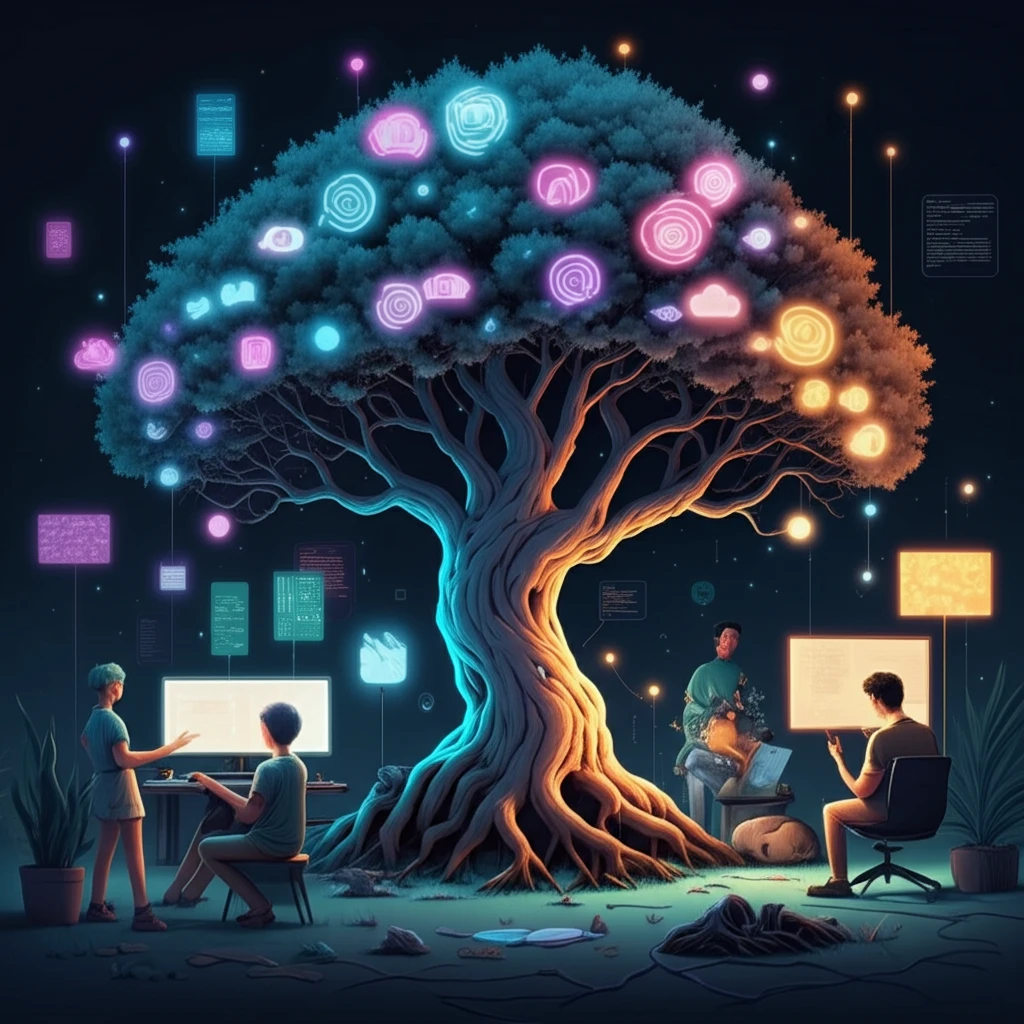
Decoding the Personalities Behind Open Source: How Understanding Developers Can Build Better Teams

"Uncover how personality traits influence developer contributions in open-source projects and what it means for team building."
Large-scale distributed projects, like those in the open-source world, thrive on the collective efforts of diverse developers, each bringing a unique personality to the table. Understanding these personalities isn't just an abstract exercise; it's a key to unlocking better collaboration, smoother workflows, and ultimately, more successful projects.
Recent research has delved into the personality traits of developers in open-source software (OSS) projects, viewing them as extreme examples of distributed collaboration. These projects, often without a central authority, rely heavily on the interactions and contributions of individuals with varying personalities. The goal? To see how these traits influence their behavior, contributions, and overall project dynamics.
By analyzing data from the Apache Software Foundation (ASF) projects, this research sheds light on how developers' personalities evolve over time, whether personality traits differ between core and peripheral contributors, and if certain traits make developers more likely to become active participants.
Scale and Foundations
Research analyzing 16,935 active developers across 1,860 GitHub projects reveals that personality diversity correlates with better project outcomes. The academic consensus centers on the Big Five personality model—openness, conscientiousness, extraversion, agreeableness, and neuroticism—as the foundation for understanding developer behavior. Open-source psychometric tools like the IPIP-NEO questionnaire enable self-administered personality assessment aligned with this framework. Datasets from online personality tests provide raw data for studying how these traits manifest in collaborative coding environments.
Community Norms and Assessment Gaps
Community managers emphasize flexibility and empathy when contributors deviate from established processes, recognizing that rigid adherence can alienate diverse personality types. The standard assessment approach relies on the Big Five model, with free open-source tests enabling developers to self-identify traits like genericist tendencies—those who prioritize broad usability through abstraction layers—versus specialists focused on specific use cases. Research highlights that communities embracing a diversity of social traits report superior contribution experiences compared to homogeneous groups. However, current methods often overlook how personality differences affect process adoption and conflict resolution in distributed teams.
From Trait Measurement to Persona Frameworks
Early open-source personality tooling focused on implementing the Big Five model in accessible formats, such as Python-based interfaces for trait assessment and visualization. The field has evolved toward structured persona frameworks like OpenPersona, which introduces a four-layer architecture (Soul, Body, Faculty, Skill) for modeling AI personas with state history and event logging capabilities. These developments reflect a progression from static trait measurement to dynamic, composable personality systems compatible with agent orchestration platforms. Foundational work on GitHub repositories established the technical infrastructure for personality-aware developer tooling.
How Developers' Personalities Evolve in Open Source
One of the most interesting findings is that developers' personalities tend to shift over time as they become more involved in open-source projects. Specifically, developers often become more conscientious (organized and diligent), agreeable (cooperative and empathetic), and neurotic (prone to worry and stress).
- Conscientiousness: Developers become more organized, responsible, and detail-oriented as they contribute to projects. This might stem from the need to manage code effectively and meet project deadlines.
- Agreeableness: Developers show more empathy, cooperation, and trust. With increased interactions within a project, being more agreeable can facilitate smoother collaboration and conflict resolution.
- Neuroticism: Developers become more prone to worry, self-consciousness, and stress. Deadlines and constant scrutiny from other developers online can increase stress levels.
Emerging Directions
Recent studies continue to explore how personality dimensions influence open source participation patterns, though comprehensive longitudinal analyses remain limited. Emerging research applies natural language processing to contribution histories and communication logs to infer trait expressions in situ. Methodological challenges persist in disentangling personality effects from project-specific cultural norms and technological constraints. The field awaits large-scale replication studies that could validate early findings across diverse project ecosystems.
Methodological Tensions
A 2017 exploratory study using novel visualization methods acknowledged significant limitations in its analysis of software practitioners' personality traits, cautioning against overgeneralization. Contrasting findings suggest personality may significantly determine whether developers can successfully contribute to open source projects, with University of Waterloo research indicating trait-based barriers to participation. However, typological approaches that categorize developers into fixed personality types risk oversimplifying the fluid, context-dependent nature of collaborative behavior. These tensions highlight the need for more nuanced, situational models that account for how traits interact with project governance and community norms.
Distributed vs. Co-located Dynamics
Comparative analysis of distributed open source projects reveals that personality traits shape collaboration outcomes in ways that differ markedly from co-located teams. The University of Waterloo study, reported across multiple outlets, identifies specific trait configurations that either facilitate or hinder contribution success in asynchronous, text-heavy environments. These findings contrast with traditional team dynamics models developed for in-person settings, where nonverbal cues mediate personality expression. Cross-project comparisons suggest that governance structures modulating communication patterns can amplify or mitigate personality-driven friction.
The Bottom Line: Building Better Teams Through Personality Insights
Understanding the personalities within open-source teams can significantly improve collaboration and project outcomes. By recognizing how developers' traits evolve and influence their contributions, project managers and team leaders can create more supportive, efficient, and harmonious environments. As the world of software development continues to rely on distributed and collaborative efforts, these insights will become increasingly valuable in building successful and innovative teams.
Converging Perspectives
Expert commentary converges on the view that personality awareness represents an underleveraged lever for improving open source sustainability, though consensus on implementation remains elusive. Practitioners advocate for lightweight trait-aware onboarding and mentorship matching over rigid profiling, which risks reinforcing stereotypes. The synthesis of observational and interview data suggests that personality characteristics selectively influence requirements engineering and conflict resolution activities. Future frameworks will likely integrate trait insights into tooling rather than treating them as separate assessments.
Learned Skills and AI Integration
Emerging guidance identifies clear communication, collaborative adaptability, and persistent curiosity as foundational traits for open source success, emphasizing that these skills are learned rather than innate. Future frontiers include AI-assisted personality-aware tooling that surfaces communication style mismatches in real time and recommends mediation strategies. Research priorities encompass longitudinal tracking of trait development through contribution trajectories and cross-cultural validation of trait-expression norms in global communities. The next decade will likely see personality insights embedded directly into contribution workflows rather than siloed in separate assessments.
Structural Risks and Governance Gaps
Systemic challenges include the risk of personality-based gatekeeping in meritocratic communities, where trait stereotypes could reinforce existing demographic imbalances. Legal and ethical frameworks for personality data in open source remain undeveloped, raising concerns about consent and profiling. Platform-level affordances for personality expression—such as communication style indicators or collaboration preference badges—are absent from major forges. Addressing these gaps requires coordinated effort among researchers, platform maintainers, and community governance bodies.
Behavioral Validation
Case studies analyzing logs from eight open-source projects using agile metrics demonstrate measurable correlations between Big Five trait profiles and developer performance indicators. A 2024 ACM study combining observational data with team member interviews found that specific personality characteristics—particularly high openness and conscientiousness—directly influence requirements engineering activities such as stakeholder negotiation and scope clarification. These real-world validations move the field beyond self-report surveys toward behaviorally grounded evidence. The human impact manifests in onboarding effectiveness, conflict escalation patterns, and long-term contributor retention.