
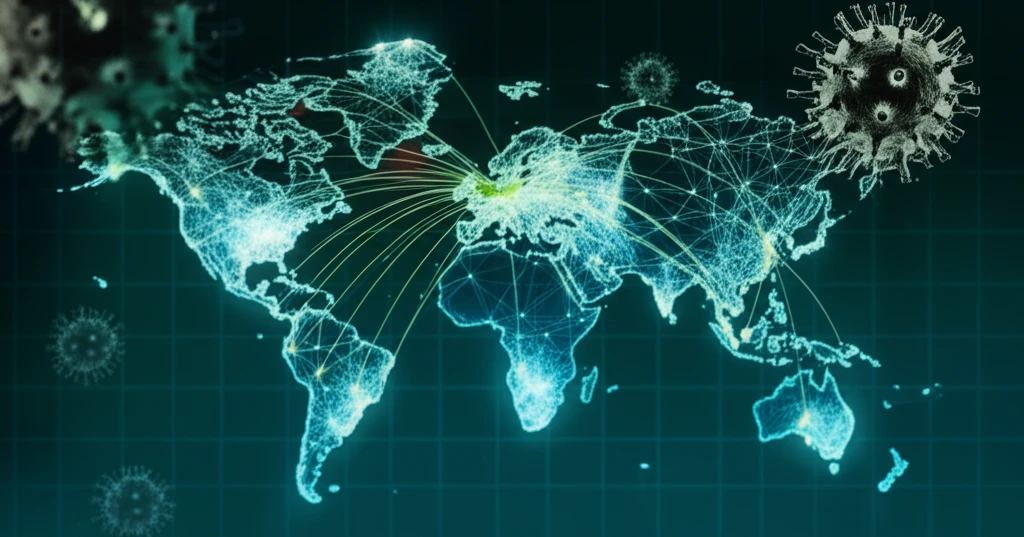
Decoding the Pandemic's Economic Web: How Connected Countries Weathered the COVID Storm

"A Deep Dive into Multiplex Networks and the Hidden Links That Shaped Global Responses to COVID-19"
The COVID-19 pandemic was more than just a health crisis; it was a complex global event that exposed the deep interconnectedness of our world. From international trade to governmental policies, various factors influenced how different countries were affected and how they responded. Understanding these intricate relationships is crucial for preparing for future global challenges.
Traditional methods of analyzing such complex systems often fall short, but a groundbreaking approach known as multiplex network analysis offers a more comprehensive view. This method allows researchers to simultaneously consider multiple layers of interaction, such as trade, public health measures, and disease spread, providing a richer understanding of the pandemic's impact.
A recent study delved into these complex dynamics, using multiplex networks to analyze how countries behaved during the COVID-19 pandemic. By examining data on stringency indices (government measures), COVID-19 infection rates, and international trade, the researchers identified clusters of countries that exhibited similar reactions to the crisis, offering valuable insights into economic resilience and policy effectiveness.
Multiplex Networks Map the Pandemic's Economic Interconnections
Multiplex network analysis has become a central tool for studying how connected countries fit into the pandemic's economic web. One study brings stringency index values, COVID-19 infections, and international trade data into a single multiplex framework to detect coupled national dynamics. Another examined the containment measures adopted by European Union countries during the initial wave of the pandemic. In complementary work, researchers have identified COVID-19 spreaders by analyzing the relationship between socio-cultural and economic characteristics, while others have reconstructed multiplex networks — whose nodes represent regions such as cities and provinces — to model the spatial diffusion of the virus and related information. Collectively, these studies treat infection dynamics, policy response, and trade flows as interdependent layers of one system.
Single-Layer Analyses and Their Known Limits
Standard analyses of the pandemic's economic effects have typically focused on one dimension at a time, tracing either case counts, containment stringency, or trade flows in isolation. Because such single-layer views can miss how infections, policy, and commerce shape one another, work in this area commonly notes limitations around data comparability across countries and time lags in reporting. As a consequence, conclusions drawn from any single indicator should be read with caution, and claims about how connectivity influenced economic outcomes generally remain provisional rather than definitive.
A Rapidly Maturing But Young Field
Study of the pandemic's economic web has a short historical arc, taking shape quickly in the years after COVID-19 emerged as a global crisis. Earlier scholarship on disease transmission and trade networks supplied conceptual groundwork, but systematic investigation of pandemic-economy coupling is largely a product of the past few years. Because the field is young, clearly established milestones are still emerging, and its early history should be treated as an evolving narrative rather than a settled record.
Unraveling Multiplex Networks: A New Lens on Pandemic Analysis
Multiplex networks provide a powerful tool for understanding interconnected systems. Unlike traditional single-layer networks, which only capture one type of relationship, multiplex networks allow for the simultaneous analysis of multiple layers of interaction. This is particularly useful for studying complex events like pandemics, where health policies, economic factors, and social behaviors all play a role.
- Stringency Index: Reflecting the strictness of government measures like lockdowns and travel restrictions.
- COVID-19 Infection Rates: Showing the spread of the virus within each country.
- International Trade Data: Indicating the flow of goods and services between countries.
Current Guidance and Ongoing Transmission
Current public-health and reference sources converge on the core facts of the pandemic as it stands. COVID-19 is caused by infection with the coronavirus SARS-CoV-2, whereas influenza is caused by a different virus, even though both are contagious respiratory illnesses. The global pandemic began with an outbreak in Wuhan, China, in December 2019, spread to other parts of Asia, and then reached worldwide in early 2020. Existing guidance from the U.S. Centers for Disease Control and Prevention continues to document the range of COVID-19 symptoms as well as treatment options, symptom management, and recovery.
The Pandemic's Persistent, Seasonal Presence
Despite advances in managing the virus, COVID-19 has not disappeared, and its ongoing presence complicates tidy narratives of recovery. According to a HuffPost report, COVID tends to peak several times throughout the year — around September–October and again later in winter — based on Dr. Michael Angarone, an infectious diseases specialist at Northwestern Medicine in Chicago. The same report notes that although the chance of contracting COVID-19 at the time of article publication was comparatively low, infection was certainly still possible. Such recurrent seasonal circulation is a reminder that even highly connected, open economies must keep planning for rolling waves of infection.
Comparisons Complicated by Measurement Differences
Cross-country comparisons remain difficult because containment measures, testing capacity, reporting practices, and economic structure differ widely and shift over time. Published analyses in this area therefore tend to caution that apparent differences between countries can reflect measurement choices rather than genuinely different outcomes. Any comparative verdict about which countries weathered the storm best should be read as indicative rather than as a firm result.
The Future of Pandemic Preparedness: Learning from Network Science
The COVID-19 pandemic underscored the importance of understanding global interconnectedness. Studies using multiplex networks offer valuable insights into how different factors interact during a crisis, which can inform future policy decisions and improve pandemic preparedness. By embracing these advanced analytical tools, we can better navigate future challenges and build more resilient economies and societies.
From Network Models to Real-Time Policy Insight
Expert commentary connects the network view of the pandemic to concrete policy work. Community detection methods applied to multiplex networks have been used to analyze employment dynamics during COVID-19 within complex systems. Economists have likewise applied production network analysis to understand the effects of imposing and lifting lockdowns, and to shape policies supporting recovery. At the same time, outlets such as CEPR's Covid Economics published research in real time, with submissions evaluated within roughly five days so that evidence could appear online and inform decisions while the crisis unfolded.
Toward Richer, Real-Time Evidence
Future research is expected to place growing weight on richer multi-layer data and on real-time analysis that keeps pace with rapidly evolving conditions. Because much of the current evidence derives from a single crisis, its lessons will likely be refined as recoveries and subsequent waves provide additional observation points. Projections about the next frontiers of pandemic-economy research should therefore be treated as informed speculation rather than established findings.
Pandemic Economics Inside Wider Global Systems
The pandemic's economic effects sit inside wider global systems — including trade linkages, labor markets, and public-health infrastructure — that predate the crisis. How countries responded interacted with these pre-existing structures in ways that varied by place, making it difficult to isolate any single cause of economic harm. A systemic view that accounts for these interconnections remains important, even as its conclusions stay incomplete and continue to evolve.
Burden and Recovery Beyond the Aggregate Numbers
Behind the statistics, the pandemic placed real strain on households, workers, and communities whose experiences differed by sector, region, and access to support. Analyses of employment during this period underscore that aggregate figures can hide how unevenly losses were distributed. Any account of the pandemic's economic web should therefore keep these human impacts in view, even when the quantitative evidence remains partial.