
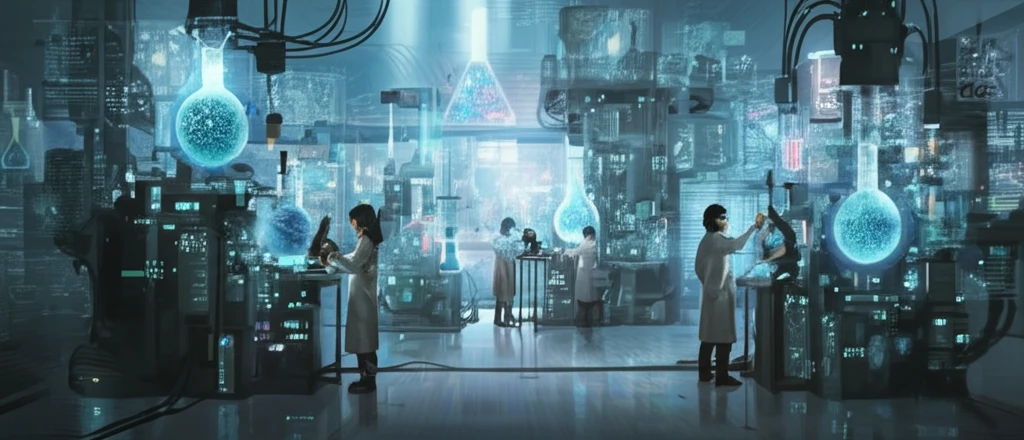
Decoding the Latest Scientific Breakthroughs: A Guide for Everyday Life

"Stay informed about the most recent discoveries in science, from cancer research and mental health to quantum physics and environmental solutions, all explained in an accessible way."
Science is constantly evolving, with new discoveries emerging daily that have the potential to reshape our understanding of the world and improve our lives. However, keeping up with the latest research can be challenging, especially when scientific papers are filled with jargon and complex data.
This article aims to bridge that gap by providing clear, concise summaries of recent scientific breakthroughs across various fields. Whether you're interested in the latest advancements in cancer treatment, the mysteries of quantum physics, or innovative approaches to mental health, we've got you covered.
Our goal is to present this information in an accessible way, highlighting the potential impact of these discoveries on your life and the world around you. Let's dive into some of the most exciting developments in science.
The Scale and Speed of Modern Breakthroughs
The pace of scientific discovery has accelerated dramatically in recent years, with breakthroughs now emerging across fields from genomics to nanotechnology at unprecedented rates. In 2025, researchers advanced DNA-based data storage to a point where AI-driven methods can recover information from DNA strands nearly 90 times faster than previous techniques, hinting at a future where digital data could be encoded in molecular form. Meanwhile, nanotechnology is opening doors to applications such as medical nanorobots and high-efficiency photovoltaic panels, operating at scales where a single nanometer could hold seven oxygen atoms. These developments underscore how scientific progress is no longer confined to laboratories but is rapidly reshaping everyday technology and industry.
The Scientific Method and Its Evolving Boundaries
Since the Renaissance, the scientific method—emphasizing systematic observation, experimentation, and conclusion—has served as the backbone of all scientific endeavors, providing a structured framework for understanding the natural world. However, as the volume and complexity of data grow across disciplines, traditional methods face increasing limitations in detecting and validating genuine breakthroughs. Researchers have recently developed new large-scale analytical methods to help identify scientific breakthroughs more reliably, addressing gaps in how progress is measured and recognized. These evolving approaches reflect a growing awareness that established methods, while foundational, must adapt to the realities of modern, data-intensive research.
From Ancient Egypt to the DNA Double Helix
Some of history's most transformative scientific breakthroughs emerged from unexpected circumstances. Napoleon's invasion of Egypt in the late 18th century, for instance, inadvertently catalyzed at least nine significant scientific advances, including laying the groundwork for modern ophthalmology as researchers raced to understand diseases encountered during the campaign. Centuries later, the discovery of DNA's double-helical structure by James Watson, Francis Crick, and Rosalind Franklin would become one of the most celebrated milestones in biology, fundamentally changing medicine and genetics. These examples illustrate that foundational discoveries often arise not from linear progress but from curiosity, competition, and even conflict.
Groundbreaking Discoveries Across Disciplines
The scientific landscape is vast, encompassing everything from the tiniest subatomic particles to the vast expanse of the universe. Recent research has yielded significant insights in several key areas:
- Key Finding: Identification of H19 as a critical regulator in cancer metastasis.
- Impact: Potential for developing site-specific cancer treatments.
- Next Steps: Further research to explore how H19 can be targeted therapeutically.
Federal Funding and the Breakthrough Pipeline
Decades of deep U.S. federal investment in scientific research have produced transformative breakthroughs that reshaped modern life, though recent funding cuts now threaten that pipeline of discovery. The contributions of taxpayer-funded research span decades of innovation across health, technology, and environmental science, as documented by major news outlets tracking the most consequential outcomes. Science news platforms like ScienceDaily and ScienceAlert continue to catalog breaking discoveries from leading universities and research organizations worldwide, providing public access to the latest findings. As funding landscapes shift, the relationship between public investment and scientific progress has become a pressing concern for researchers and policymakers alike.
Challenging Assumptions in Neuroscience and Beyond
Recent neuroscience breakthroughs have repeatedly challenged preconceptions about human cognition and identity, with studies on live 3D brain function mapping and enhanced cognition through electrical stimulation pushing the boundaries of what was thought possible. Transcranial direct current stimulation (tDCS), sometimes called 'brain zapping,' applies weak electrical currents to the scalp to potentially heighten brain activity, though its long-term effects remain debated. A persistent question in the scientific community is whether mainstream or unconventional thinking better drives breakthroughs, with evidence suggesting that creative minds within established institutions have produced a substantial share of major discoveries. These discussions highlight that scientific progress often involves not just new findings but also fundamental debates about methodology and interpretation.
A Century of Progress: 1922 to 2022 and Beyond
Comparing scientific breakthroughs across a century reveals the extraordinary acceleration of technological capability. The period leading up to 2022 saw landmark achievements including the James Webb Space Telescope's first images, NASA's DART mission successfully altering an asteroid's trajectory, and the first-ever fusion ignition achievement in nuclear energy. These accomplishments stand in stark contrast to the breakthroughs of a century earlier, illustrating how the scale, speed, and global coordination of research have transformed. The comparison underscores not just quantitative growth in discoveries but a qualitative shift in humanity's capacity to explore, protect, and understand the cosmos.
The Path Forward
These scientific advancements represent just a small fraction of the ongoing research that is shaping our world. By staying informed and engaged with these discoveries, we can better understand the challenges and opportunities that lie ahead. The future of science is bright, and its potential to improve our lives is immense.
Creativity, Curiosity, and the Limits of AI
As artificial intelligence tools like large language models become more capable, a critical debate has emerged about the role of human creativity in scientific discovery. Experts caution that creativity and imagination—qualities that have historically driven breakthroughs—are fundamentally different from asking an AI to answer a predetermined question. Scientific breakthroughs often emerge from exploring completely unrelated questions, driven by researchers' curiosity rather than directed optimization. This tension between AI-assisted efficiency and human-driven serendipity is shaping conversations about the future direction of scientific research and funding priorities.
From Discovery to Therapy and Collaborative Research
The journey from scientific breakthrough to real-world therapy involves complex pathways of translation, regulatory approval, and implementation that can take years or decades. In 2025, digital collaborative platforms have begun facilitating cross-border and interdisciplinary research at unprecedented scales, enabling scientists to share data and insights more rapidly. Funding patterns are also shifting, with more grants now allocated to interdisciplinary projects recognized for their potential to generate impactful discoveries. These trends suggest that the next frontier of scientific progress may depend as much on how researchers collaborate and communicate as on the discoveries themselves.
Food Security, Brain Science, and Systemic Pressures
Looking toward 2030, the National Academies have identified critical scientific advances needed to make the U.S. food and agricultural system more efficient, resilient, and sustainable—a strategy addressing one of the most pressing systemic challenges of the coming decade. Simultaneously, neuroscience breakthroughs such as transcranial direct current stimulation (tDCS) are exploring ways to enhance cognition through electrical stimulation applied to the scalp, raising both promise and ethical questions. These diverse frontiers—from feeding growing populations to augmenting human cognition—illustrate that the most consequential scientific challenges ahead span multiple domains and require coordinated, long-term investment.
Bridging the Gap Between Lab and Life
In 2025, NVIDIA unveiled transformative innovations in robotic learning designed to narrow the gap between simulation and real-world results, marking a significant step toward making robotic systems practical for everyday applications. Companies like amass are leveraging AI to accelerate scientific breakthroughs, with venture firms using these tools to build biotech companies that can translate research into commercial products more rapidly. These developments reflect a broader shift in how science moves from discovery to real-world impact, with AI and advanced computing serving as bridges between theoretical research and tangible benefits for society. The accelerating pace of this translation suggests that the interval between breakthrough and application will continue to shrink.