
Decoding the Economy: How Finance, Labor, and Housing Shape Our Future

"Uncover the hidden connections between financial markets, employment, and housing investments that drive U.S. business cycles and affect your financial well-being."
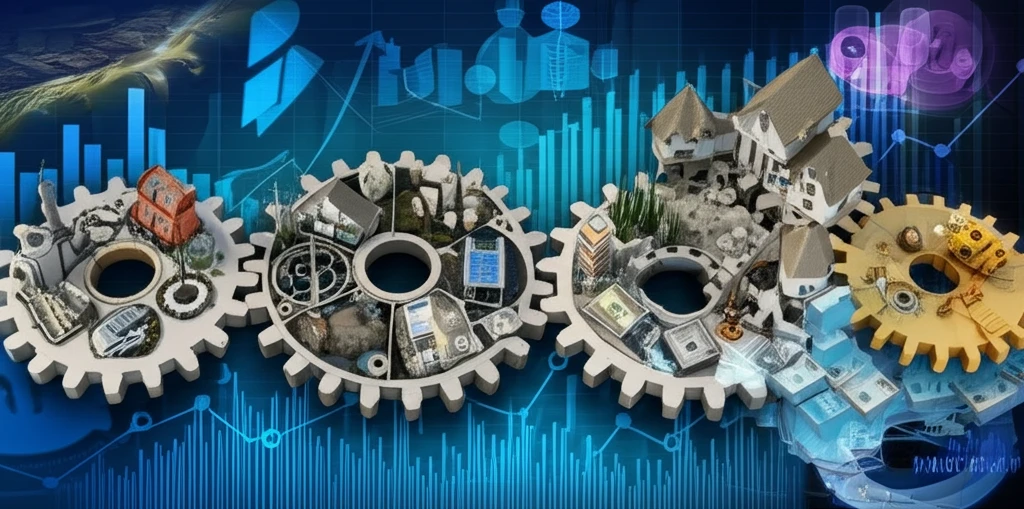
The economy can feel like a vast, incomprehensible machine, its gears turning in mysterious ways that impact our jobs, investments, and overall financial stability. One key to understanding this machine is the "Goodwin pattern," which describes the cyclical relationship between economic activity and the labor share of income. Think of it as a dance: when the economy thrives, does the wealth get shared fairly with workers, or does it concentrate at the top? This dynamic has been a central focus for economists trying to make sense of boom and bust cycles.
But the Goodwin pattern, while insightful, doesn't tell the whole story. It often overlooks the crucial role of capital accumulation – how we invest in things like housing and infrastructure – and the complex interactions between the real economy and the financial sector. Housing, in particular, acts as a critical link. It's where many people invest their savings, and it's a major driver of economic growth during recoveries. Ignoring these connections leaves a big gap in our understanding.
Traditional economic models often fall short by assuming a static picture of the economy. They offer a single set of answers that are supposed to apply across different time periods, failing to capture the continuous shifts and changes that define the real world. This is especially problematic when analyzing the U.S. economy, which has undergone dramatic transformations, from the post-war "Golden Age" to the era of deregulation and the "Great Moderation." To truly understand what's happening, we need models that can adapt and evolve with the data.
Reading the Headlines, Soundly
Economic figures appear constantly in the news, yet how those numbers are produced and what they actually capture is rarely explained. Most people meet the economy through headline statistics, but the distance between aggregate data and a household's own experience can be wide. Because the underlying data shifts frequently and early readings are often revised, figures in this article should be treated as provisional snapshots rather than settled facts. The sections ahead aim to make economic measurement more legible and its limits more visible.
Tools of the Trade and Their Blind Spots
The conventional way of studying an economy treats it as a set of measurable activities: production, exchange, and consumption that can be tracked through formal indicators and models. This approach is valuable because it produces comparable, testable numbers. Yet it leans on assumptions about data quality, household and firm behavior, and which activities deserve to be counted that critics increasingly question. Naming those assumptions is the first step toward reading any economic analysis critically.
From Definition to Discipline
Modern economics grew out of deliberate efforts to understand how societies organize the production, distribution, and consumption of goods and services, and it is still defined this way today. Reference works agree that economics is a social science centered on those three activities, while an economy is understood more broadly as the social domain in which production, trade, use, and management of resources take place. Within the discipline, microeconomics focuses on the basic elements: individual agents and markets and their interactions. None of this is static, since ongoing economic news coverage shows these foundational ideas being continually tested against real-world events.
The Goodwin Model: A Foundation for Understanding Economic Cycles
The Goodwin model is a theoretical framework that helps economists understand the cyclical interactions between economic activity and the labor share of income. It suggests that there is a constant struggle between capitalists and workers over the distribution of income. During times of economic expansion, unemployment decreases, and workers have more bargaining power, leading to an increase in wages and the labor share of income. This, in turn, reduces profits for capitalists, which eventually leads to a slowdown in investment and economic activity, causing a recession.
- Profit-Led vs. Wage-Led Demand: Some economists argue that the U.S. economy is 'profit-led,' meaning that increased profits drive investment and growth. Others argue for a 'wage-led' model, where higher wages fuel consumer spending and economic expansion.
- Profit-Squeeze vs. Wage-Squeeze Distribution: Similar to demand, there are competing theories about how income gets distributed. The 'profit-squeeze' theory suggests that a tight labor market increases wages at the expense of profits, while the 'wage-squeeze' theory argues that economic growth benefits profits more than wages.
A Field in Motion
The research frontier in economics is advancing quickly, with new studies regularly revisiting long-held views about finance, labor markets, and housing. Findings first circulated as working papers or preprint reviews have not yet been fully validated, so headline results should be read cautiously. Consensus in this discipline usually only forms after replication and re-examination by other researchers. For that reason, what is summarized here reflects where the field appears to be heading rather than settled conclusions.
When the Models Miss
Economic reasoning has not been immune to failure, and its tools have at times badly misread turning points, under-weighted risk, and over-trusted assumptions of rational behavior. Critics contend that elegant theories have repeatedly been humbled by messy realities such as crises and structural change. Defenders counter that models are simplifications meant to illuminate a problem, not to forecast with certainty. Both sides nonetheless converge on a shared point: healthy skepticism is essential when confronting confident economic claims.
Finance, Labor, and Housing Side by Side
Setting finance, labor, and housing next to one another reveals both parallels and tensions. All three respond to interest rates, public sentiment, and policy, yet they move on different timetables and are governed by different institutions. Comparing them can expose where pressure in one sphere spills over into the others. Such comparisons are necessarily approximate, since the boundaries between the sectors blur in practice.
Putting It All Together: A More Complete Picture of the Economy
By combining insights from the Goodwin model with an understanding of financial and investment dynamics, we can develop a more complete picture of the forces that shape the U.S. economy. This more comprehensive framework will allow us to analyze the dynamic relationships between demand and distributive regimes, as well as their financial interactions over time. Although the model has its limitations due to it being a single country analysis, it finds valuable statistical evidence in favor of the Goodwin Pattern that has impacted the real and financial sector.
One Shared Vocabulary
Investopedia frames economics as a branch of social science focused squarely on the production, distribution, and consumption of goods and services - a definition that anchors this article's three themes of finance, labor, and housing. Because every economic choice involves who produces, who distributes, and who consumes, that simple frame connects otherwise disconnected policy debates. Expert commentary built on this definition tends to judge outcomes by tracing how money and goods flow through households and markets. It also underscores why so many headline arguments return to the same underlying question of who benefits and who bears the cost.
Where Change Is Most Likely
Looking ahead, the most consequential developments are likely to involve technological change, shifts in how and where people work, and the affordability of housing. Each of these is already reshaping financial flows and labor markets in ways that conventional statistics capture imperfectly. Projections of what comes next are inherently uncertain and depend heavily on how policy and private behavior respond. The safest expectation is that the interplay among finance, labor, and housing will only grow more consequential.
A System, Not a Set of Silos
The three themes of this article do not exist in isolation; they sit inside wider systemic questions about inequality, sustainability, and the stability of financial systems. Challenges such as stretched household budgets and uneven access to credit cut across finance, labor, and housing at the same time. Interventions aimed at one sector often create new pressures in another, which is part of why the overall system is so hard to manage. Understanding that systemic context is a precondition for judging whether any single policy will actually help.
Households, Not Just Headlines
Behind the indicators and models are households making daily decisions about jobs, savings, and where to live. Those choices are the ground truth against which economic theory is ultimately judged. Because the human experience of the economy varies widely with income, location, and opportunity, aggregate figures can obscure as much as they illuminate. Keeping that human scale in view is a reminder that the purpose of economics is, at bottom, to improve people's circumstances.