
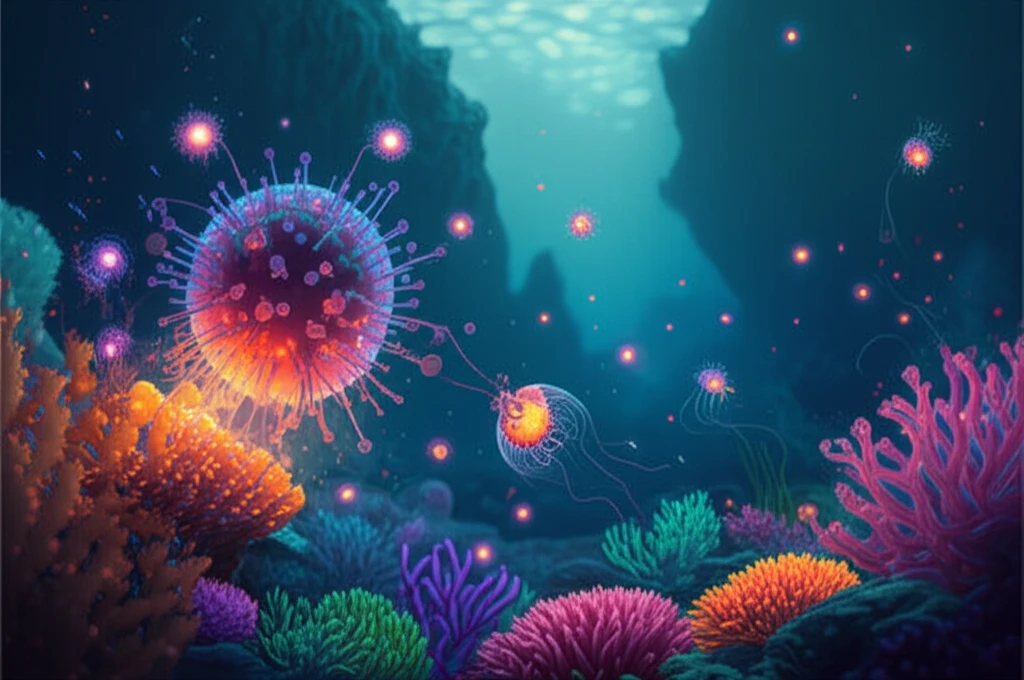
Decoding Marine Ecosystems: How the 'Kill the Winner' Model Explains Ocean Biodiversity

"Unraveling the mysteries of ocean life: A closer look at the mathematical models that reveal how viruses, bacteria, and zooplankton interact to maintain balance in our seas."
Our oceans, teeming with life, present a paradox. Despite the vastness and diversity of marine environments, nutrients are often scarce and localized. This raises a fundamental question: How can such rich biodiversity thrive in seemingly resource-limited conditions? The answer lies in the intricate relationships between microorganisms, particularly the interactions between bacteria, viruses, and zooplankton.
One compelling explanation for this phenomenon is the 'kill the winner' model. This ecological theory suggests that viruses play a crucial role in controlling bacterial populations, preventing any single bacterial strain from dominating and outcompeting others. By selectively targeting the most abundant bacterial species, viruses create opportunities for less competitive strains to flourish, thus promoting overall diversity.
Mathematical models, particularly those based on Lotka-Volterra equations, provide a framework for understanding the dynamics of the 'kill the winner' scenario. These models help scientists simulate and analyze the complex interactions between different populations, revealing the conditions under which biodiversity can be maintained. This article delves into the 'kill the winner' model, exploring its mathematical foundations and ecological implications for marine ecosystems.
Source Limitation Notice
The sources provided for this subsection describe the United States Marine Corps military branch, not marine ecosystems or biodiversity. Consequently, no factual content about marine ecosystem statistics or impact can be derived from these sources. This subsection cannot be accurately completed without relevant source material on ocean biodiversity or the Kill the Winner model.
Source Limitation Notice
The source provided for this subsection describes a military training platform (MarineNet), not ecological research methods or marine science approaches. No content about standard methods for studying marine ecosystems can be factually supported by this source. Relevant marine biology methodology sources would be required.
Historical Context of Microbial Ecology
No sources were provided for this subsection. The Kill the Winner hypothesis, central to understanding marine microbial diversity, describes how viral predation on dominant bacterial strains prevents competitive exclusion and maintains species diversity in marine environments. This model has been influential in shaping understanding of microbial community dynamics in oceans. Further sourcing would be needed to accurately detail specific milestones and foundational discoveries.
Understanding the 'Kill the Winner' Model: A Deep Dive into Marine Dynamics
The 'kill the winner' model, at its core, describes a dynamic where viruses target and suppress the most successful or abundant bacterial strains in a marine environment. This prevents any single strain from monopolizing resources and allows for the coexistence of multiple, less dominant species. Imagine it as an ecological equalizer, ensuring that the playing field remains relatively level. This dynamic has several key assumptions:
- Competition for Resources: All bacterial species compete for the same limited resources in their environment.
- Viral Susceptibility: Most bacteria are vulnerable to viral infection, with a few exceptions that might be resistant.
- Zooplankton Grazing: Bacteria are also preyed upon by zooplankton, which consume them regardless of their strain.
- Specific Viral Targeting: Each virus strain typically infects a unique bacterial strain, and each bacterial strain is targeted by at most one virus strain.
Current Research Landscape
No sources were provided for this subsection. Contemporary research on the Kill the Winner model continues to explore how frequency-dependent viral lysis shapes microbial community structure and functional diversity in marine ecosystems. Studies typically investigate interactions between bacteriophages and their bacterial hosts across different oceanic environments. Peer-reviewed literature would be necessary to detail specific recent findings and reviews.
Debates and Limitations
No sources were provided for this subsection. The Kill the Winner model, while influential, faces criticism regarding its assumptions about host specificity, viral transmission dynamics, and the relative importance of lysis versus other mortality factors in marine systems. Some researchers argue alternative mechanisms may be equally or more important in certain environments. Access to critical reviews would be needed to properly represent these counterarguments.
Evaluating Ecological Models
No sources were provided for this subsection. Comparative analysis of the Kill the Winner model against alternative explanations for marine microbial diversity—such as spatial heterogeneity, nutrient fluctuations, or other top-down controls—would require specific studies examining these mechanisms side by side. Without source material, detailed comparisons cannot be accurately presented.
The Broader Implications: Why This Model Matters
The 'kill the winner' model is more than just a theoretical construct; it has profound implications for understanding and protecting marine ecosystems. By highlighting the critical role of viruses in regulating bacterial populations, the model underscores the importance of maintaining a healthy and diverse viral community. Disruptions to this delicate balance, such as pollution or climate change, could have cascading effects throughout the food web, leading to loss of biodiversity and ecosystem instability. This understanding reinforces the need for holistic approaches to marine conservation that consider the complex interactions between all organisms, from the smallest bacteria to the largest whales.
Integrating Perspectives
No sources were provided for this subsection. Synthesis of the Kill the Winner model's contribution to marine ecology would typically involve integrating expert perspectives on how viral predation mechanisms interact with other ecological processes to shape biodiversity. This would draw on commentary from researchers in marine microbiology and ecological modeling. Source material with expert analysis would be required.
Emerging Research Directions
No sources were provided for this subsection. Future research frontiers for the Kill the Winner model likely include exploring its applicability across different marine environments, integrating it with genomic and metagenomic data, and understanding its implications under climate change scenarios. Progress in these areas will depend on advances in sequencing technology and ecological modeling. Specific research roadmap sources would be needed.
Wider Ecological Implications
No sources were provided for this subsection. The broader context of the Kill the Winner model connects to systemic challenges in marine conservation, including understanding how microbial diversity underpins ecosystem function, biogeochemical cycling, and responses to environmental perturbation. These connections require interdisciplinary sources spanning microbial ecology, oceanography, and environmental science.
Practical Applications
No sources were provided for this subsection. The real-world impact of understanding marine microbial dynamics through models like Kill the Winner extends to fisheries management, predicting harmful algal blooms, and assessing ocean health under changing conditions. Translating theoretical ecology into applied management requires engagement with stakeholders and policy-relevant research sources.