
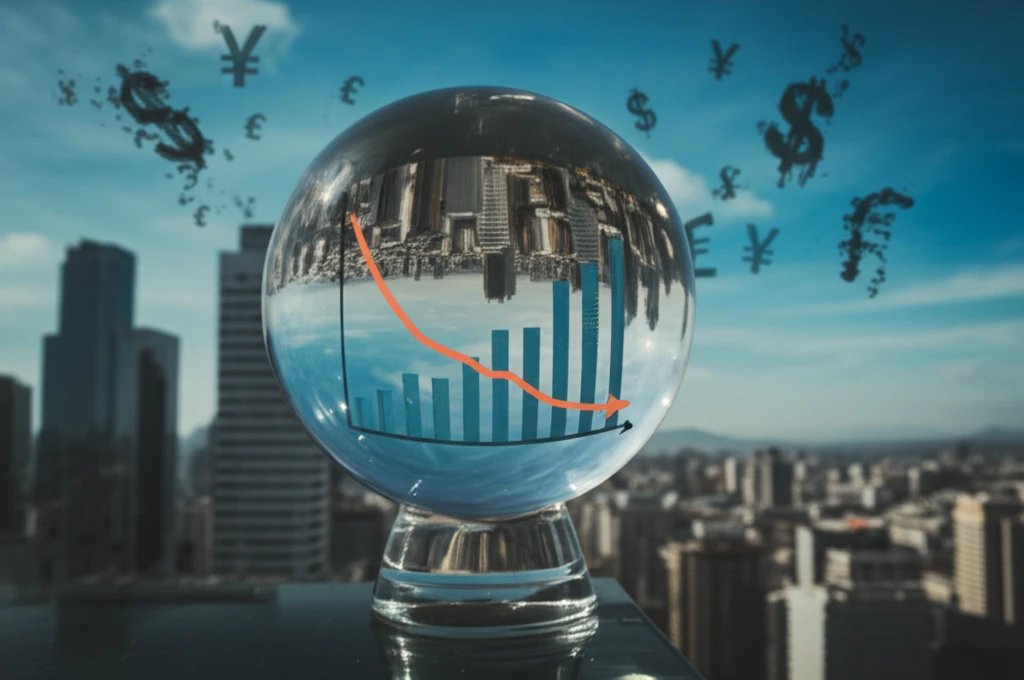
Decoding Inflation: Why Your Forecasts Might Be Leading You Astray

"Unraveling the complexities of inflation forecasting and how professional insights can help you make better financial decisions."
In today's economy, everyone's keeping an eye on inflation. It affects everything from your grocery bills to the interest rates on your loans. Central banks work hard to manage inflation, but it's a tricky business, and a big part of the challenge lies in predicting what inflation will do next. These expectations can be difficult to nail down, but new methods help us get a grip on where prices might be headed.
Inflation expectations offer insight into whether current strategies to stabilize prices will be successful. As economists dig deeper, they're using new resources that include financial market data, statistical models, economic models, and surveys. Among the most insightful of these is the Survey of Professional Forecasters (SPF), which asks experts where they see inflation going. Their insights are useful for assessing real and future financial landscapes.
This article cuts through the complexity, inspired by a recent study from the Australian National University, and explains why understanding inflation predictions matters to you. By tapping into the wisdom of professional forecasters, you can better prepare for the twists and turns of the economy. Let’s dive into how these experts see the future and how it might impact your financial decisions.
Inflation Is Cooling, But Still Pressuring Households
Overall inflation, measured by the Consumer Price Index (CPI), currently stands at 3.5%. Inflation is simply how fast prices are rising on everyday items like groceries, gas, and rent. Understanding inflation is important for anyone living in today's economy, much like knowing the forecast before planning a picnic.
Forecasters Must Respect Time Lags
The inflation forecaster must also consider time lags, because the economy does not react instantaneously to changes in money. The impact of Federal Reserve policy on spending, production, and employment takes roughly one year to materialize. Forecasters also lean on tools such as inflation surveys and the New Keynesian Phillips curve, but each method carries its own limitations.
From Expectation Origins to Modern Debate
Institutions such as the Brookings Institution have traced the origins of inflation expectations as a concept. Historically, consumers, economists, and bond traders have all attempted to forecast inflation, though with mixed results. That history has fueled ongoing debate over just how useful inflation expectations really are.
How the Pros Forecast Inflation
The pros use a blend of different factors to predict inflation. One approach combines two models: the unobserved components (UC) model and the sticky information (SI) model. The UC model looks at trend and temporary factors influencing inflation, and the SI model considers that not everyone updates their information at the same rate. The information people are relying on can be ‘sticky’ or outdated. This is something to consider in personal finances and even broader, when analyzing the health of the economic landscape.
- Bayesian tools: They use data and probability to forecast.
- Particle filters: Advanced algorithms help to make better predictions.
- Markov chain Monte Carlo: To model the uncertainty of economic activity.
Frequency-Domain Phillips Curve Forecasting
Recent research forecasts US inflation with a New Keynesian Phillips curve (NKPC) in the frequency domain. The study, published in the Oxford Bulletin of Economics and Statistics in 2024, builds on earlier work on inflation and real activity over the business cycle.
Walking in the Dark
Even as consumers, economists, and bond traders attempt to forecast inflation, some analysts argue that we really are walking in the dark. A prominent news analysis on the topic advised readers not to even try to predict inflation. Such warnings highlight the fundamental limits of forecasting in uncertain economic conditions.
Surveys Versus Alternative Methods
Inflation prediction methods can be compared, with inflation surveys representing one common approach. In a global economy, businesses may have to forecast inflation, exchange rates, and all sorts of other moving targets. Choosing among survey-based and alternative methods depends on context, data availability, and the time horizon involved.
Applying Expert Insights to Your Finances
The next time you read about inflation forecasts, remember that experts are considering various factors, from trend and temporary influences to how quickly information spreads. By understanding these dynamics, you're better equipped to interpret financial news and make informed decisions. Paying attention to professional insights can offer a clearer view of the economic landscape, helping you navigate the ups and downs with greater confidence.
Central Bankers Lean on Expectations
In a July 2025 speech, former Atlanta Fed president Raphael Bostic explained why the FOMC's then-forthcoming policy framework should place greater emphasis on inflation expectations. Inflation expectations matter a lot, but questions remain about exactly why they matter so much.
Downward Trend Opens Door to Rate Cuts
Inflation, a key economic indicator, has been on a downward trend in recent data. That cooling trend has led analysts to decode the potential for interest rate cuts. Inflation's path remains central to debates about when and how the Federal Reserve might act.
Businesses Face a Global Moving Target
Investors and businesses need to understand the effects of inflation, including how to profit from it. In a global economy, firms may have to forecast inflation, exchange rates, and all sorts of other moving targets at once. Getting these forecasts wrong can ripple through pricing, planning, and investment decisions.
Why the Forecast Matters at Home
Understanding inflation is important for anyone living in today's economy; it's like knowing the forecast before planning a picnic. Rising prices on groceries, gas, and rent show up directly in everyday household budgets, from receipts at the store to mortgage payments. Even as inflation cools, its pace still shapes how far each dollar goes.