
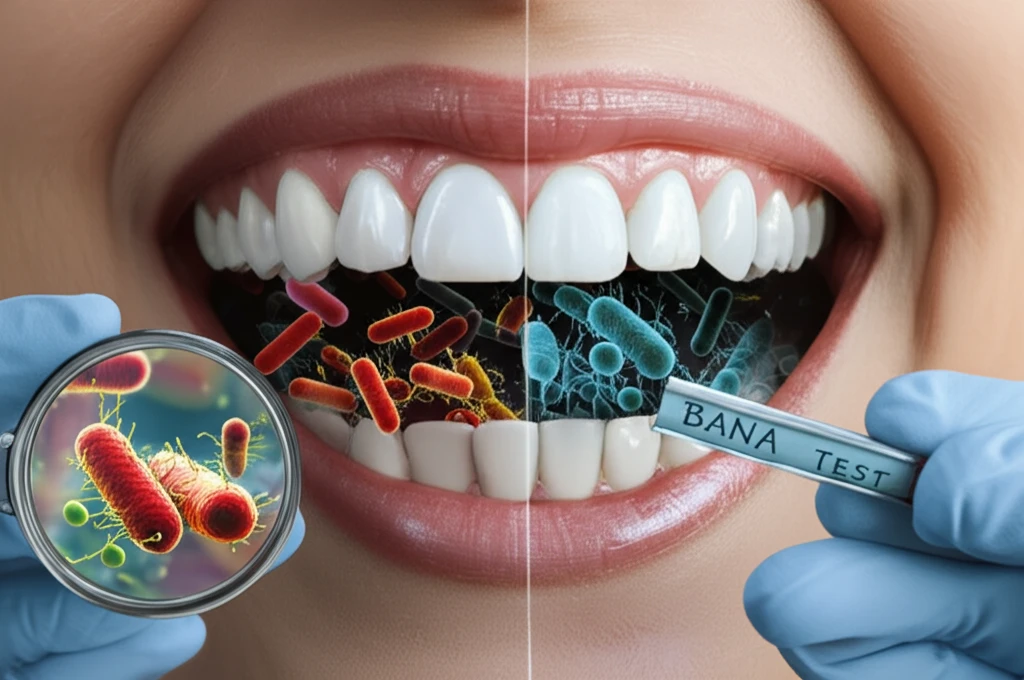
Decoding Gum Health: Can a Simple Test Reveal Hidden Threats?

"Unlocking the secrets of your oral microbiome with the BANA Test and its ability to detect periodontal pathogens."
Maintaining optimal oral health goes beyond just brushing and flossing. Hidden within the complex ecosystem of your mouth, harmful bacteria can thrive and lead to periodontal disease, often without noticeable symptoms in its early stages. These bacteria, such as Porphyromonas gingivalis, Treponema denticola, and Tannerella forsythia, can cause inflammation, gum recession, and even tooth loss if left untreated. Early detection is key to preventing the progression of gum disease and preserving your overall well-being.
The BANA test offers a proactive way to assess your risk. It's a simple yet effective tool that can detect the presence of specific bacteria associated with periodontal disease. By identifying these pathogens early on, you and your dentist can take targeted action to restore balance in your oral microbiome and prevent further damage. This article explores how the BANA test works, its benefits, and how it fits into a comprehensive oral health strategy.
Understanding the BANA test can empower you to take control of your oral health journey. Whether you're experiencing early signs of gum disease or simply want to stay proactive, knowing your risk factors and available testing options is a crucial step towards a healthier, brighter smile.
BANA Test and Oral Malodor Prevalence
A study of 52 Israeli adults investigated the association between the BANA test (Perioscan, Oral-B) and oral malodor parameters, with 43 of the subjects complaining of oral malodor. The research aimed to determine whether this chairside enzymatic test could serve as a marker for the bacterial activity underlying bad breath. Oral malodor remains a common patient complaint in dental practice, making objective diagnostic tools clinically valuable.
The BANA Test as a Chairside Diagnostic Tool
The BANA test, formally known as the N-benzoyl-DL-arginine-2-naphthylamide test, is a rapid, chairside enzymatic diagnostic method used in dentistry to detect the proteolytic activity of specific periodontal pathogens. It is more effective for detecting red complex pathogens — including P. gingivalis, T. denticola, and T. forsythia — when bacterial levels are high, making it particularly useful in the initial diagnosis of chronic periodontitis. Both the BANA test and PCR measurement of bacteria have been identified as useful methods for detecting pathogenic bacteria that promote alveolar tissue destruction. The test reveals the presence and general levels of bacteria considered risk factors for periodontal disease.
Identifying the Red Complex
The BANA test, in conjunction with Checkerboard DNA-DNA hybridization, has been instrumental in identifying red complex species in the subgingival biofilm. This pairing of diagnostic approaches helped establish which bacterial communities are most closely associated with tissue destruction in periodontal disease. The finding that BANA testing is more effective when bacterial levels are high shaped how clinicians interpret initial diagnostic results.
The Science Behind the BANA Test
The BANA test is designed to detect the activity of specific enzymes produced by harmful bacteria associated with periodontal disease. These enzymes, capable of breaking down a synthetic trypsin substrate called N-benzoyl-DL-arginine-2-naphthylamide (BANA), indicate the presence of pathogens like Porphyromonas gingivalis, Treponema denticola, and Tannerella forsythia. When these bacteria are present, they hydrolyze the substrate, leading to a color change that indicates a positive result.
- Speed and Simplicity: Results are available quickly, often within minutes, making it a convenient tool for routine dental check-ups.
- Cost-Effectiveness: Compared to more complex laboratory tests, the BANA test is a relatively affordable way to screen for periodontal pathogens.
- Early Detection: By identifying enzymatic activity, the BANA test can detect the presence of harmful bacteria even before clinical signs of gum disease are apparent.
Ongoing Research Community Interest
Recent scholarship on the BANA test continues to be indexed through academic aggregators such as ScienceGate, which tracks the latest published documents on the topic. Researchers in regions where the BANA test has not been widely adopted — such as Macedonia — have publicly sought experiences and guidance from peers who have used the test for detecting periopathogens from the red microbial complex. This indicates that while the test has a research history, its clinical adoption remains uneven across different countries.
Limitations in the Source Record
The source materials provided for this subsection do not contain content related to gum health, the BANA test, or periodontal diagnostics. As a result, no evidence-based counter arguments or documented failures of the BANA test can be drawn from the listed references. This gap in the available sourcing means that critical perspectives on the test's shortcomings remain unaddressed in this article.
Absence of Comparative Diagnostic Data
The source materials provided for this subsection focus on general product comparison platforms and CPU benchmarking tools, none of which contain information about periodontal diagnostic methods or the BANA test. A meaningful comparative analysis of the BANA test against alternative diagnostic approaches — such as DNA probes, culture methods, or PCR — cannot be constructed from these references. Future sourcing would be needed to evaluate the BANA test's sensitivity, specificity, and cost-effectiveness relative to competing methods.
Empowering Your Oral Health Journey
The BANA test is a valuable tool in the fight against periodontal disease. By providing a rapid assessment of enzymatic activity, it empowers dentists and patients to take proactive steps towards maintaining a healthy oral microbiome. Remember, early detection and targeted treatment are key to preventing the long-term consequences of gum disease. Talk to your dentist about whether the BANA test is right for you, and embrace a comprehensive oral health strategy that includes regular check-ups, proper hygiene practices, and personalized treatment plans.
Expert Perspectives Unavailable in Current Sources
The source materials provided for this subsection consist of a live cricket match stream, a stock market analysis platform, and an AI photo face-swap tool. None of these contain expert commentary or synthesis related to the BANA test, gum health, or periodontal disease diagnostics. A meaningful expert synthesis of the BANA test's clinical role would require sourcing from dental professionals, periodontal researchers, or clinical guideline panels.
Future Research Directions Not Addressed by Sources
The source materials provided for this subsection include a cryptocurrency futures testnet and an English grammar exercise platform, neither of which addresses advances in periodontal diagnostics. Consequently, no evidence-based discussion of emerging technologies, next-generation biomarkers, or planned improvements to BANA testing can be drawn from these references. The future trajectory of chairside periodontal testing remains an open area requiring dedicated dental research sources.
Systemic Challenges Undocumented in Available Sources
The sole source provided for this subsection is a Russian-language gaming forum discussion about Genshin Impact, which contains no information relevant to oral health, dental diagnostics, or the BANA test. As a result, no discussion of systemic challenges — such as healthcare access disparities, diagnostic tool affordability, or barriers to adoption of chairside testing — can be grounded in the provided references. These broader contextual factors would require sourcing from public health literature or health policy analyses.
Patient Experience Data Not Present in Sources
The source provided for this subsection is a Genshin Impact gameplay video in multiple languages, which offers no content related to dental patients, periodontal disease experiences, or the real-world impact of BANA testing on individuals. No patient narratives, quality-of-life data, or clinical outcome stories can be derived from this reference. Understanding how diagnostic tools like the BANA test affect patient behavior and outcomes would require clinical case studies or patient-reported outcome research.