
Decoding Greenland's Dwarf Birch: How Climate Change is Rewriting the Rules of Growth

"Uncover the surprising ways Greenland's dwarf birch adapts to climate shifts, revealing key insights into arctic ecosystem resilience."
The Arctic is warming, and its plant life is responding in surprising ways. While increased shrub growth has been observed across high northern latitudes, the reasons behind these changes are complex and not fully understood. Recent research focuses on Greenland’s dwarf birch (Betula nana), a keystone species in arctic ecosystems, to uncover the secrets of its adaptation to a changing climate.
Dwarf birch is uniquely positioned to provide insights into climate-growth relationships. This resilient shrub exhibits remarkable adaptability, adjusting its growth strategies in response to fluctuating environmental conditions. Scientists are particularly interested in how its xylem—the plant's water transport system—responds to these changes.
By studying the anatomical traits of xylem, researchers can unlock the mechanisms that allow dwarf birch to thrive (or struggle) in a rapidly changing world. This article delves into a groundbreaking study that explores the intricate relationship between climate, xylem anatomy, and growth patterns in dwarf birch, offering valuable clues about the future of arctic vegetation.
A Growing and Tangible Threat
As the climate crisis intensifies and extreme weather events become more common, the UK's buildings, cities and critical infrastructure, along with the communities that occupy them, are in increasing danger. Climate change-induced weather variability, particularly changes in temperature and rainfall patterns, poses significant challenges to agroforestry systems, highlighting the reach of the problem across built and natural environments. In Port Harcourt, Nigeria, regression analysis of climate change awareness and adaptation examined variables including climate-resilient housing, renewable energy adoption, water management and community-based adaptation measures. Across these settings, the sources converge on a single picture: impacts are already material and demanding active response.
Standards on Paper, Shortfalls in Practice
Standardized approaches have been developed to guide organizational adaptation, including the ISO 14090:2019 standard on climate change adaptation principles and requirements and the ISO 14091:2021 standard, which are offered as frameworks for building climate resilience. Yet critics argue that five years into ISO 14090, organisations can demonstrate full compliance without proving they are any more resilient, raising questions about whether existing standards are fit for purpose or simply performance art. Adaptation to changing circumstances is a phenomenon of all times, but climate change has intensified interest in methods to anticipate longer-term change and uncertainty. The conventional approach built up over the past 60 years is also showing strain, as discrepancies between real-world observations and expectations of regional climate change have emerged alongside disruptive new computational methods.
A Long History of Human Adaptation
Human adaptation has deep historical roots; one early and important chapter is even said to fit into a device the size of a side table, the Franklin stove, showing that climate adjustment is a social and political problem with a much bigger history. In the modern era, the UNFCCC brought representatives from all countries together to set plans to limit the impacts of climate change, yet because these plans and treaties were not legally binding, they received hardly any attention. From a historical standpoint, the neglect of climate change adaptation agendas can also be attributed to disagreements arising from different perspectives on responsibility for the origin of climate change. The scientific foundation itself is now firmly established, with unequivocal evidence that Earth is warming at an unprecedented rate and that human activity is the principal cause.
Xylem's Secret Language: How Dwarf Birch Adapts
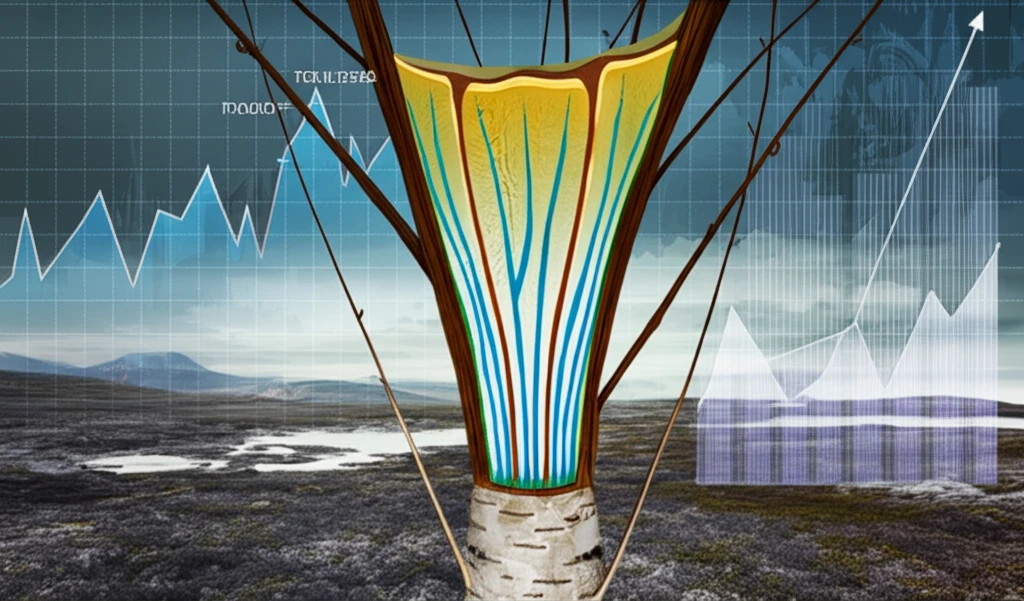
At the heart of this research is the xylem, a complex network of vessels responsible for transporting water and nutrients throughout the plant. The size and arrangement of these vessels directly impact a plant’s ability to efficiently manage water, a critical factor in the harsh Arctic environment. By examining xylem anatomical traits, scientists can gain insights into how dwarf birch responds to climatic variations.
- Water Management: The study highlighted the importance of summer precipitation and winter temperature in promoting growth. Increased precipitation during the growing season provides crucial moisture, while warmer winters potentially extend the growing season.
- Xylem Optimization: The size and arrangement of xylem vessels play a key role in growth. Larger vessel lumen areas and strategic vessel grouping enhance water conductivity and hydraulic connectivity, allowing the plant to optimize its water transport system.
- Temperature Sensitivity: Vessel lumen area appears to be influenced by spring and summer temperatures, while vessel grouping is primarily driven by winter temperature. This suggests that dwarf birch fine-tunes its xylem anatomy in response to both short-term and long-term climatic cues.
New Findings Across Sectors and Scales
Climate-change policy spans local, national and international scope, and recent research includes findings that racialized economic concentration predicts storm-related injuries and deaths in the United States between 2005 and 2022. A systematic review identified 72 relevant research articles examining when place attachment leads to climate change adaptation, assessing the types of climate impact, forms of adaptation, locations and methods studied. The US National Park Service highlights a body of peer-reviewed adaptation science developed through its Climate Change Response Program to inform management decisions. Separately, a systematic literature review on gender-differentiated labor and the adaptation effects of climate change in rural areas has been posted, though the authors note it is a preprint that has not yet been peer reviewed by a journal.
The Widening Adaptation Gap
Adaptation efforts are not keeping pace with fast-growing climate risks, and the widening adaptation gap is not an abstract accounting problem but is visible in the wreckage of homes, farms and economies. As one observer put it, the gap is the difference between being able to rebuild and being left behind. New Zealand's Climate Change Minister has described adaptation as the most complex and politically charged part of the adaptation challenge, insisting the government was not 'head in the sand' about potential costs. Climate change itself refers to long-term shifts in temperatures and weather patterns, which can be natural, while cities face significant challenges in adapting to dynamic climate risks and protecting critical infrastructure and residents' livelihoods.
Adaptation in Practice Around the World
Because climate change's material impacts are already being felt, climate politics can no longer focus only on preventing future catastrophes. A comparative analysis of adaptation practices in the United States, Australia and China finds that most adaptation reform has occurred in the field of spatial and land-use planning, with those reforms shaped by each country's institutional, political and fiscal context. Meanwhile, adaptation research itself is dominated by in-depth, qualitative, single- or small-n case studies that produce rich understanding of adaptation processes in specific locations. On the ground, studies are identifying the factors that influence farm households' adaptation choices, such as a recent examination of decision-making among smallholders in southern Ethiopia.
Looking Ahead: The Future of Arctic Ecosystems
This study provides valuable insights into the adaptability of dwarf birch and its potential to cope with climate change. By understanding the mechanisms that govern its growth and survival, we can better predict the future of arctic ecosystems. Further research, with denser sampling and a focus on multiple spatial scales, is needed to fully unravel the complex relationships between climate, anatomical traits, and shrub growth. This knowledge is particularly crucial for forecasting vegetation changes in the vulnerable arctic ecosystem and ensuring its long-term health.
Expertise Under Pressure
Expert opinion is central to adaptation decision-making, but synthesizing it is itself difficult; a study of façade greening and heat stress in Berlin found that the chief challenges in analyzing questionnaires lay in interpreting different expert opinions about the probability of an element's state. That difficulty resonates with broader assessments in which expert panels grapple with projected climate impacts and the sobering conclusion that 'we are not well prepared.' Analyses of major research programs combine expert opinions, literature reviews and document studies to probe how climate change adaptation challenges disciplines such as civil engineering. Yet questions persist about whose expertise counts, as scientific advice remains indispensable while the more extensive decision-making processes often give marginal representation to those who are constantly adapting to changing ground realities.
Long Horizons, Short-Sighted Institutions
Since the impacts of climate change unfold over decades and centuries, adaptation policies should ideally be based on long-term observations combined with projections; however, current institutional designs favour actions with short-term gain. The Hamburg Climate Futures Outlook 2024 takes up this tension by examining the conditions for sustainable climate change adaptation. Mountain regions are a pressing frontier, where adaptation is crucial not only for the people living in the mountains but also for those living downstream. The Carpathians, one of the most extensive mountain ranges in Europe, illustrate the stakes: the region hosts outstanding ecosystems such as virgin forests and grasslands now threatened by climate change.
Beyond Symptom-Level Solutions
Climate change is a systemic challenge, and adaptation solutions that focus only on dealing with its direct impacts may not be enough in the face of the much broader direct and indirect impacts. This has pushed efforts toward systemic responses: a series of consultations among experts, policy makers and practitioners explored the contribution of agroecology to innovative and transformative climate change adaptation. Successful adaptation also requires addressing risks to specific elements of the food system without creating negative impacts on other elements of that system. Designing such systemic responses, and measuring their impacts, is a challenging task in its own right.
From Strategies to Livelihoods
Adapting to climate change is a relatively new concept to many, as reflected in case studies of good practice such as the City of Melbourne's Climate Change Adaptation Strategy and Action Plan. For smallholder farmers, the stakes are immediate: research on supplemental irrigation as an adaptation strategy for maize production in the Eastern Cape Province of South Africa illustrates how concrete measures shape on-the-ground resilience. A Lao PDR case study further illustrates the benefits and challenges for small-scale farmers in developing countries investing in adaptation, concluding that adaptation is profitable. Reviews of climate-smart investments, drawn from areas such as agriculture and water management, reinforce that the human element — who pays, who benefits and who is left behind — determines whether adaptation delivers real-world impact.