
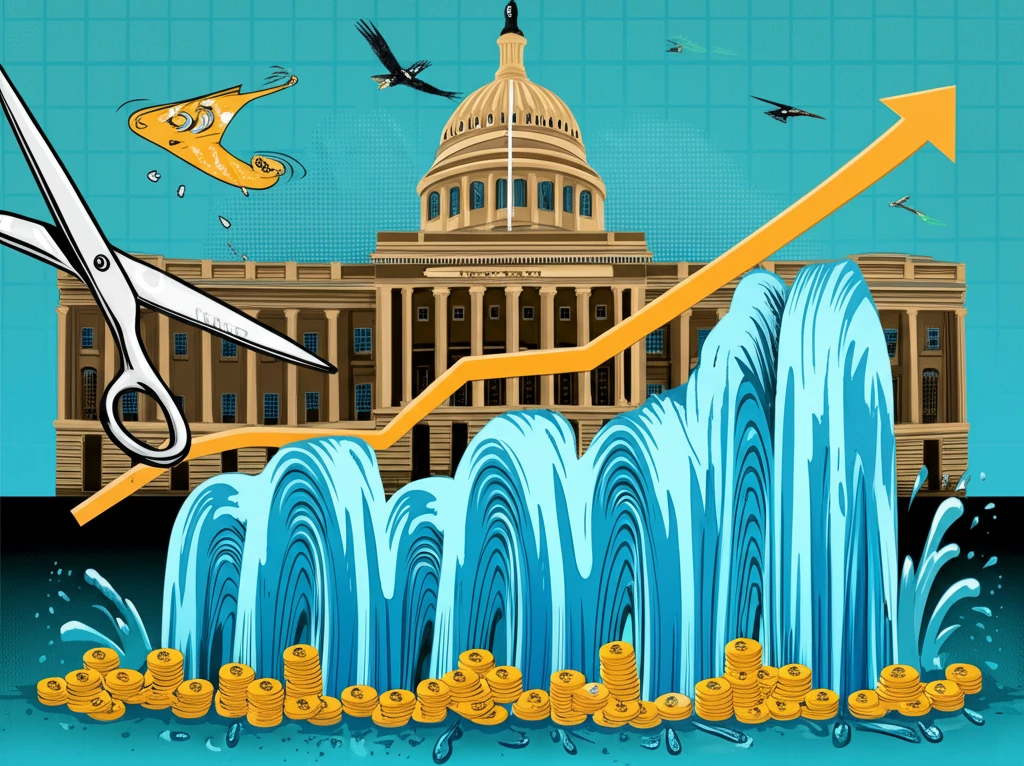
Decoding Fiscal Multipliers: How Government Spending Really Impacts the Economy

"A groundbreaking study combines statistical identification with real-world economic proxies to reveal the true impact of fiscal policies."
For decades, economists have debated the true impact of fiscal policy, particularly the size of fiscal multipliers – the measure of how much a change in government spending or taxes affects overall economic output. The traditional approach, using Structural Vector Autoregression (SVAR) models, relies on "proxy variables" to identify fiscal policy shocks. However, different proxies often lead to wildly different conclusions.
Some studies suggest tax cuts have a larger impact, while others champion government spending. This inconsistency stems from a critical flaw: the assumption that these proxy variables are truly exogenous, meaning they aren't influenced by other economic factors. When this assumption fails, the results become unreliable.
A new study offers a compelling solution by combining statistical identification techniques with a novel way of incorporating potentially endogenous proxies. This approach, using a Bayesian non-Gaussian SVAR model, reveals a clearer picture of fiscal policy's impact, challenging conventional wisdom and offering fresh insights for policymakers.
Defining Fiscal: From Public Money to Policy Lever
Fiscal is commonly defined as relating to public money—taxation, public revenues, and public debt—as reflected in both the Merriam-Webster and Cambridge dictionaries. The concept branches into related ideas such as fiscal space (the flexibility of a government in its spending choices), fiscal sustainability, and fiscal transparency, which covers the publication of information on how governments manage public resources. Beyond definition, fiscal policy describes how governments use spending and taxation to influence the economy. Wikipedia records that contractionary fiscal policy—raising tax rates and cutting government spending—can slow economic growth, particularly when inflation is driven by a significant increase in aggregate demand and the supply of money.
Treasury, Revenue, and the Fiscal Year
The Free Dictionary defines 'fiscal' as pertaining to the public treasury or revenues, with fiscal policies cited as its most direct application. It also notes the term applies 'to financial matters in general,' offering the fiscal year as a common example of this broader usage. In the source's illustration, a fiscal year can run from July 1 to June 30, showing how the label attaches to a government's own accounting rhythm rather than to the calendar year. These definitions provide a practical anchor for framing debates about how taxpayers, revenues, and public spending are organized.
A Long Institutional Lineage
The history of fiscal thought long predates modern economic measurement, although no specific milestones could be confirmed from the source material reviewed for this section. Generally speaking, governments have relied on taxation and public spending for centuries to fund operations and respond to economic distress, and debate over the effectiveness of such spending is itself longstanding. The very existence of formal concepts such as fiscal space and fiscal sustainability suggests that the field has accumulated structured frameworks over time. Read specific dates and 'foundational discoveries' as beyond the scope of this section.
The Fiscal Multiplier Puzzle: Why Do Estimates Vary So Widely?
Traditional SVAR models aim to isolate the impact of specific fiscal policy changes (like tax cuts or spending increases) on the broader economy. To do this, they need a reliable way to identify these changes as "shocks" that aren't simply responses to other economic events. This is where proxy variables come in. For example, a researcher might use a measure of consumer confidence or total factor productivity (TFP) as a proxy for unexpected shifts in economic activity that influence government decisions.
- Endogeneity: Proxy variables are often correlated with other structural shocks, violating the assumption of exogeneity.
- Model Misspecification: The data-generating process of the proxy may not follow a linear process, leading to dependent shocks.
An Active, Evolving Research Frontier
Recent scholarship on fiscal multipliers appears active and fast-moving, though no specific studies or findings could be verified from the source material provided for this section. Taken generally, contemporary research on government spending tends to stress that the size of a multiplier depends heavily on context, such as the state of the economy and prevailing monetary conditions. Methodological advances in data availability and econometric identification are commonly cited in the literature as key drivers of newer estimates. Because specific publications were not available for review here, these observations should be treated as general context rather than confirmed findings.
Skeptics and the Case for Caution
Arguments against the effectiveness of government spending have historically centered on concerns that expansionary fiscal action can be undermined by side effects such as inflation, heavy borrowing, and offsetting changes in private behavior. A common skeptical position holds that even well-designed stimulus may fail to produce durable growth, especially when it contends with supply constraints or is deployed in an economy already operating near capacity. Whether these cautions reflect mainstream consensus falls outside this section's source material, and they should be read as one side of an ongoing debate. No specific figures or named critiques could be attributed here because no sources were supplied for this subsection.
Context Shapes the Results
Comparative work on government spending generally finds that the impact of fiscal measures varies across countries, time periods, and economic conditions, although no comparative studies could be cited from the sources provided for this section. An economy with weak demand and low interest rates would typically be expected to show a larger spending effect than one running at full capacity. Differences in fiscal institutions, openness to trade, and exchange rate arrangements are commonly discussed in the literature as sources of cross-country variation. Because this subsection lacks specific source material, these general patterns should be read as illustrative rather than empirically established.
Policy Implications and the Path Forward
This study provides compelling evidence that government spending is a more effective tool for stimulating economic activity than tax cuts, particularly in the current economic environment. By addressing the limitations of traditional SVAR models and incorporating statistical identification techniques, the research offers a more reliable and nuanced understanding of fiscal policy's true impact. Policymakers can use these insights to make more informed decisions about how to best allocate resources and promote sustainable economic growth.
Where the Debate Converges
Synthesizing the broader literature, expert observers often conclude that the fiscal multiplier is not a single number but a range that depends on conditions prevailing at the time of the policy action. Most commentary steers toward nuance: the same level of spending can be highly effective in a downturn and largely ineffective when an economy is already at capacity. Experts also tend to emphasize the credibility and long-run sustainability of fiscal plans as decisive for how markets and households respond. These are general themes drawn from surrounding discourse; no specific expert quotes or studies were available in this section's source set.
Toward Smarter Measurement
Looking ahead, the next frontier for fiscal research is widely thought to be better measurement, including richer datasets, sharper identification of causal effects, and more granular, state-dependent estimates of multipliers. Wider availability of administrative and high-frequency data seems likely to strengthen how scholars separate spending effects from other economic influences. Advances in computing and econometric methods are also expected to permit more realistic modeling of how fiscal shocks propagate through modern economies. These projections are forward-looking and general, reflecting common directions in the literature rather than any source verified for this section.
Debt, Demographics, and Global Pressures
Fiscal policy does not operate in isolation, and broader systemic pressures commonly shape what governments can and cannot spend. High debt loads, aging populations, and shifting global economic conditions are widely discussed as constraints on the fiscal space available to many governments. Such factors affect both the political feasibility of stimulus and the long-run sustainability of spending paths, regardless of how large a multiplier a given program might deliver. Because no sources were supplied for this section, these systemic challenges are characterized at a general level rather than with specific data or citations.
Behind the Numbers, People
At its core, fiscal policy represents choices about public money that materially affect the lives of citizens, shaping the services governments deliver and the taxes households and firms pay. Decisions about government spending often translate directly into visible outcomes such as public employment, infrastructure, and social programs. Debates over government expenditure tend to be contentious precisely because the stakes are human, involving jobs, services, and livelihoods for real communities. Since no source material was provided for this section, these observations remain general in nature rather than tied to specific cases or figures.