
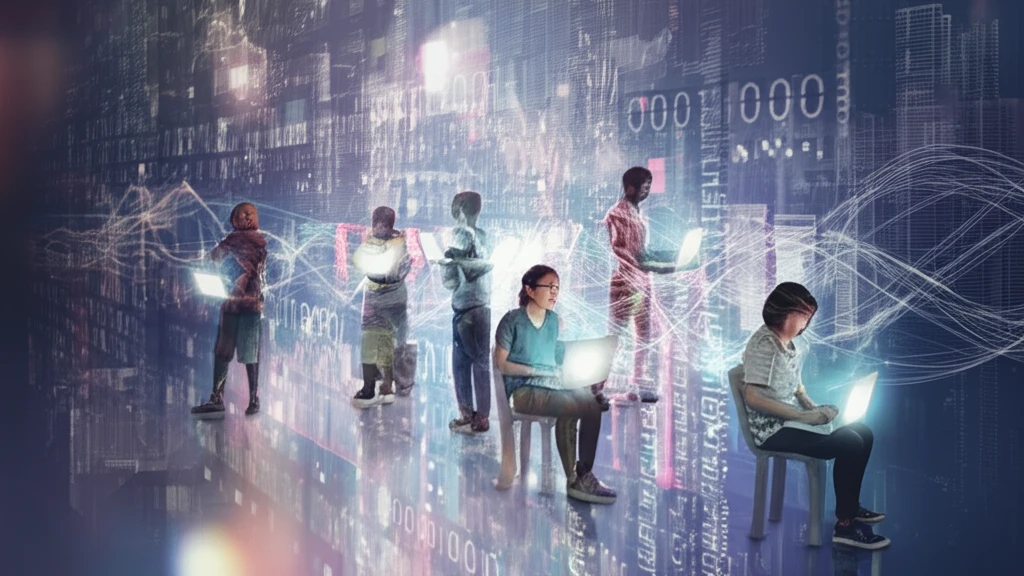
Decoding Digital Learning: How Student Attitudes Shape Computer Education

"Explore how high school students in Sunyani Municipality perceive computer education and its impact on their future success."
In our rapidly evolving digital age, Information Communication Technology (ICT) has become an indispensable tool, permeating every aspect of our lives and playing a pivotal role in national development. The swift advancement of ICT has revolutionized how we communicate, conduct business, and access information. Recognizing this transformative power, educational systems worldwide are integrating ICT into their curricula to equip students with the skills necessary to thrive in an increasingly digital world.
Ghana, like many other nations, has embraced this educational paradigm shift, embedding ICT education into its school system. This initiative aims to cultivate a generation of tech-savvy individuals capable of driving the nation's information and knowledge economy. However, the effectiveness of this integration hinges not only on resources and infrastructure but also on students' attitudes toward computer education.
Understanding how students perceive and engage with computer education is crucial for optimizing learning outcomes and ensuring the successful implementation of ICT initiatives. This article delves into a study conducted in the Sunyani Municipality of Ghana, exploring the attitudes of senior high school students toward computer education. By examining factors such as access to technology, gender differences, and teacher influences, we aim to shed light on the dynamics shaping students' engagement with digital learning.
Defining the Machine at the Center of Modern Learning
A computer is fundamentally a machine that can be programmed to automatically carry out sequences of arithmetic or logical operations, and modern digital electronic computers can perform generic sets of operations, known as programs, that enable a wide range of tasks. In everyday education and work settings, these machines typically take the form of personal computers meant to be operated directly by an end user rather than by an expert or technician, supporting tasks such as word processing, web browsing, email, file management, spreadsheets, and video calling. The same sources also describe the computer more broadly as a programmable device for processing, storing, and displaying information, and retailers treat laptops, desktops, and tablets as a standard consumer category. Together these definitions help explain why computers have become the practical backbone of digital learning environments.
From Human Calculators to Programmable Devices
The standard way of understanding what a computer is centers on the idea of a programmable device that stores, retrieves, and processes data. ComputerHope reports that the term "computer" was originally applied to humans, so-called human computers, who performed numerical calculations using mechanical aids such as the abacus and slide rule. This historical framing highlights a key limitation of the common definition: it describes capability rather than experience, saying little about how learners actually relate to these machines. Because this source offers a single angle, its claims should be read as one reference point rather than a settled consensus on all approaches to computer education.
Milestones in Educational Technology and Digital Learning
Interest in using technology to advance human learning dates back to the early 1900s, when education and training professionals first became intrigued with the potential of new technologies. A foundational milestone came with Patrick Suppes's vision that "the computer makes the individualization of instruction easier, because it can be programmed to follow each student's history," an idea that framed computers as tools for adaptive, student-centered teaching. Institutionally, key research bodies trace their origins to 1958, when scholars, educational psychologists, sociologists, and psychometricians gathered at the UNESCO Institute to launch comparative education efforts that would eventually inform digital learning research. Later milestones charted by practitioners include the recognition in 1970 that different media have different instructional effects, the 1978 insight that asynchronous learning offers distinct advantages, and ongoing shifts through the 1980s as computers moved into mainstream classrooms.
Unveiling Student Perceptions: Access, Attitudes, and Influences
A survey was conducted among senior high school students in the Sunyani Municipality to gauge their attitudes toward computer education. The study explored several key areas:
- Availability of Computers at Home: The study revealed that the majority of students (approximately 57%) did not have access to computers at home. This suggests that most students rely on external resources like internet cafes or school computer labs, which may limit their opportunities for consistent practice and skill development.
- Duration of Computer Access: Among those with home access, a considerable number had only been using computers for a relatively short period (one to three years). This indicates that many students are still in the early stages of developing their digital literacy skills.
An Evolving Evidence Base
Research on how student attitudes shape computer education is continuously evolving, though no single authoritative review was identified for this section. Recent work tends to examine learner motivation, self-efficacy, and engagement alongside measurable outcomes such as digital skills and course persistence. As with many young research areas, authors frequently caution that findings are context-dependent and that early studies should be treated as provisional rather than definitive. Readers should therefore interpret the current literature as a developing conversation rather than a settled body of conclusions.
Awareness of Limits and Critiques
Critics point out that positive attitudes toward computers do not automatically translate into successful learning, and several initiatives have fallen short of their promises. Common failure modes include overinvestment in hardware without corresponding teacher training, and curricula that treat technology as an end in itself rather than a means to understanding. Evaluations of such efforts frequently find uneven results that depend heavily on implementation quality and institutional support. No specific studies were available to cite, so these observations should be regarded as general cautions rather than verified findings.
Contrasting Settings and Approaches
Comparisons across different learning contexts suggest that the role of student attitudes varies with how computer education is delivered, such as face-to-face instruction, online platforms, or hybrid models. Differences in age, prior exposure, cultural norms, and available infrastructure can make results difficult to generalize from one setting to another. Some analyses also contrast skill-building approaches with conceptual or project-based models, which may appeal differently to different learners. Because no direct source material was available, this comparison is offered only as a general framework for thinking about the issue.
Empowering Digital Learners: Recommendations for the Future
The study's findings underscore the importance of addressing the digital divide and fostering positive attitudes toward computer education among students. Bridging the digital gap and nurturing a passion for technology will empower students to thrive in the digital age and contribute to Ghana's socio-economic development.
Bringing the Threads Together
The available material suggests that effective computer education depends on more than access to hardware; it depends on how learners perceive and engage with the technology. Historical examples, from human computers to programmable machines for individualized instruction, show that attitudes and expectations have always shaped how computing tools are adopted. Experts generally agree that instructional design, teacher preparation, and learner motivation interact in ways that single-factor explanations cannot capture. Without dedicated source material, this synthesis should be treated as a reasonable but unverified summary of common expert thinking.
Where the Field Appears Headed
Looking ahead, computer education seems likely to become more personalized and more integrated into everyday learning, building on the long-standing promise of instruction that adapts to each student. Emerging directions include AI-assisted tutoring, blended and asynchronous models, and greater attention to digital literacy as a life skill. These developments are projections rather than established findings, and their real impact will depend on how well institutions address equity, training, and ongoing evaluation. Future research will need to track both learner attitudes and measurable outcomes to know which innovations genuinely help.
Institutional and Structural Obstacles
Beyond individual classrooms, systemic forces such as funding, infrastructure, curriculum standards, and teacher professional development shape what computer education can achieve. Schools in well-resourced settings tend to convert technology access into learning gains more easily than those facing connectivity or equipment gaps. Policy decisions about when and how computing is taught also influence whether students develop confidence or avoid the subject altogether. These observations are offered as general context, since no specific sources were available to document particular systemic cases.
Why Attitudes and People Still Matter
At its core, computer education remains a human endeavor in which motivation, confidence, and curiosity determine whether students engage with machines productively. The original meaning of "computer" as a person who computes is a useful reminder that computation has always been a human activity before it became an electronic one. Real-world impact is therefore measured not just in skills tests but in whether learners carry digital competence and confidence into their lives and careers. This human dimension is widely acknowledged in principle, though specific evidence was not available for direct citation.