
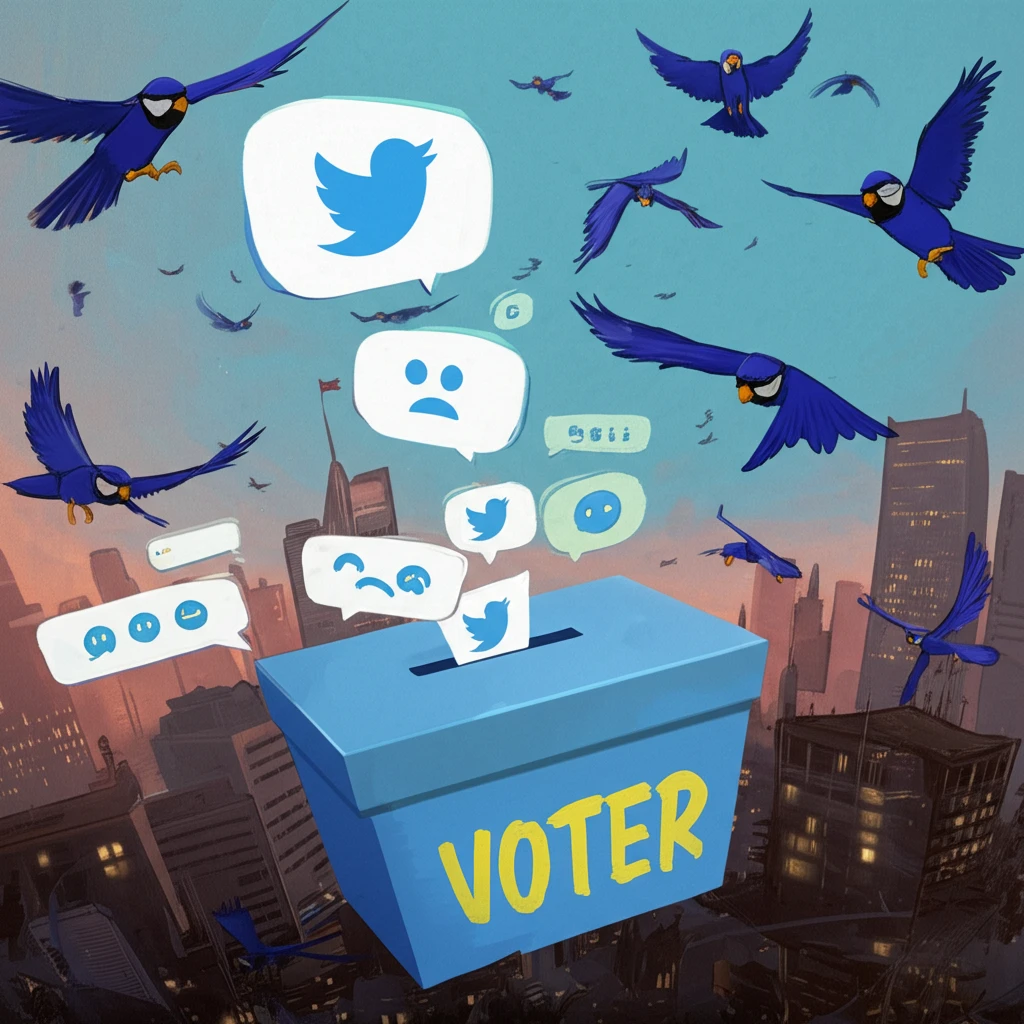
Decoding Democracy: Sentiment Analysis of Live Tweets After Elections

"Can social media chatter accurately reflect public sentiment and predict political outcomes? Dive into our analysis of post-election tweets and discover the surprising trends shaping public opinion."
Elections stand as pivotal moments in shaping the direction of a nation, influencing leadership and policy for years to come. In the digital age, social media platforms like Twitter (now X) have become virtual town halls where citizens voice their opinions, creating a rich tapestry of sentiments.
The surge of micro-blogging and real-time commentary surrounding elections offers a unique opportunity to gauge public sentiment. By analyzing the text of tweets, we can discern prevailing opinions and emotional responses, a process known as sentiment analysis or opinion mining. This approach provides invaluable insights into the electorate's mindset.
This article explores the application of sentiment analysis to live tweets collected after a recent election. By examining the emotional undertones and key themes expressed in these digital dialogues, we aim to uncover the sentiments of the people in the wake of the election results. This research seeks to understand how social media reflects and potentially influences perceptions of political events.
Sentiment Analysis at Scale: Growing Adoption and Accuracy Gaps
Sentiment analysis has gained significant traction in recent years, with the technology increasingly adopted across industries seeking to understand customer opinions at scale. Vendor-reported accuracy figures for AI-powered sentiment analysis routinely reach 90–95%, though these benchmarks are achieved on controlled test sets and rarely reflect real-world production conditions. Among classification approaches, Naive Bayes remains the simplest and fastest algorithm for processing large volumes of text data, making it a common baseline for sentiment tasks. The latest industry data indicate that the technology continues to gain strength as businesses recognize its value for decision-making.
Rule-Based, ML, and LLM Methods for Sentiment Classification
The standard approach to sentiment analysis classifies text into positive, negative, or neutral categories based on the degree of opinion expressed. A common starting point is rule-based sentiment analysis, which relies on predefined lexicons and linguistic rules without requiring training data or machine learning models. More advanced methods employ machine learning techniques, using tools such as Rapid Miner to process and transform text data through pipelines that include case normalization and vector representation. More recently, large language models have been applied to sentiment analysis at scale, analyzing opinions across news and other textual sources, though they introduce their own complexity and resource demands.
From Linguistics to Algorithms: Sentiment Analysis Foundations
Sentiment analysis emerged at the intersection of linguistics and computer science, aiming to automatically determine the sentiment contained in text by characterizing it as positive or negative evaluation expressed through language. A foundational challenge recognized early on is the distinction between the sentiment expressed in text and the sentiment the author actually felt—researchers caution against conflating the two, as expressed language does not always mirror internal states. Methodological milestones include the adoption of pre-processing techniques and word vector representations such as GloVe embeddings, which transformed raw text into numerical form and enabled more sophisticated aspect-based sentiment analysis. These foundational developments laid the groundwork for the machine learning and deep learning approaches that dominate the field today.
The Pulse of the People: Analyzing Post-Election Tweets
Our study focused on tweets related to a specific political figure, collected during the five days following an election. This timeframe allowed us to capture the immediate reactions and evolving sentiments as the election's impact unfolded. The collected tweets underwent a series of processing steps to prepare them for analysis.
Deep Learning and Social Media Drive New Sentiment Research
Recent research in sentiment analysis has seen significant growth, particularly in deep learning-based aspect-level sentiment analysis (DL-ABSA), with contributions from a diverse range of institutions and publication sources worldwide. Studies increasingly focus on social media data, where sentiment analysis techniques describe the polarity of reviews to help users make decisions without reading entire texts. Sentiment evaluation from complex textual sources, including macaronic (mixed-language) reviews, has emerged as an active research topic in textual content mining, reflecting the growing diversity of data that sentiment tools must handle. Peer review platforms such as Gartner also now provide structured evaluations of commercial sentiment analysis tools, helping organizations navigate an expanding vendor landscape.
Ethical Concerns and Domain-Specific Limitations
Sentiment analysis faces significant ethical challenges, particularly around the collection and processing of consumer data, with scholars raising concerns about social bias embedded in analysis tools and how results are interpreted and applied. Traditional methods such as bag-of-words models have proven limited in capturing the nuance of sentiment, especially in specialized domains like finance where context and domain-specific vocabulary are critical. These limitations have driven a shift in natural language processing toward transfer learning approaches, exemplified by models like FinBERT, though concerns about bias and data ethics persist. In operational settings such as contact centers, sentiment analysis is used to uncover areas needing improvement and monitor customer loyalty, but its reliability depends heavily on the quality of underlying models and training data.
Tool Benchmarks: VADER, Flair, TextBlob, and Enterprise Platforms
Comparative studies of sentiment analysis tools reveal notable performance differences across methods. In direct text-level comparisons, VADER consistently analyzed articles and reviews more accurately than Flair and TextBlob, which often failed to produce decisive results. At the enterprise level, platforms such as Brandwatch, Meltwater, and Talkwalker differ substantially in source coverage, output format, setup effort, and the degree of human synthesis required after automated monitoring. Some solutions excel at visualizing sentiment data for quick identification of positive and negative trends, while others prioritize depth of analysis and integration with broader social listening workflows.
The Future of Political Sentiment Analysis
In conclusion, our analysis of post-election tweets underscores the potential of social media as a barometer of public sentiment. By harnessing the power of sentiment analysis, we can gain valuable insights into the emotional landscape surrounding political events, informing our understanding of public opinion and its potential impact. As social media continues to evolve, further research is needed to refine our analytical methods and explore the complex interplay between online discourse and real-world outcomes. This will allow for a more comprehensive understanding of public sentiment and its potential implications for governance and policy-making.
Converging Techniques and the Expanding Tool Landscape
Sentiment analysis, opinion mining, and subjectivity analysis are interrelated research areas that draw on techniques from natural language processing and information retrieval to extract and classify opinions from text. As an integral component of speech and text analytics systems, sentiment analysis determines customers' opinions and attitudes, enabling organizations to derive actionable insights from unstructured data. Surveys of classification techniques reveal ongoing empirical comparisons between methods such as support vector machines and artificial neural networks for document-level sentiment classification, with no single approach universally dominating. The landscape of available tools continues to expand, with numerous platforms now offering sentiment analysis capabilities tailored to different organizational needs and data environments.
Market Growth and the Push Toward Contextual Understanding
The sentiment analysis market is projected to grow at a compound annual growth rate of 13.8% from 2026 to 2033, reflecting expanding adoption across industries and increasing investment in the technology. Future research is expected to focus on improving models' ability to handle nuanced contexts, including better detection of sarcasm, irony, and subtle emotional cues that current systems often misclassify. These advancements aim to bridge the gap between controlled benchmark performance and real-world accuracy, particularly for complex use cases like political discourse and live social media monitoring. As the field matures, the integration of contextualized models promises to move sentiment analysis beyond simple polarity classification toward a richer understanding of human expression.
Public Opinion Monitoring and Brand Reputation at Scale
Sentiment analysis plays an increasingly central role in marketing analytics and survey research, providing researchers and marketers with tools to analyze trends and public sentiment at scale. Standard systems assign structured sentiment scores and polarity labels—positive, negative, or neutral—to textual data, enabling systematic comparison across sources and time periods. On social media, sentiment analysis allows organizations to gain an overview of wider public opinion behind certain topics, helping brands find a tone that matches their customer base. The breadth of applications spans from brand reputation management to broader public opinion monitoring across professional networks like LinkedIn, underscoring the technology's growing systemic importance.
From Brand Monitoring to Market Saturation: Real-World Outcomes
Real-world applications of sentiment analysis demonstrate tangible impacts on business outcomes, with case studies showing how brands use the technology to monitor social media comments and improve brand perception on platforms like Instagram. Research applying both traditional and advanced models to consumer reviews—such as studies of Starbucks feedback—emphasizes the importance of retaining real-world class imbalance to preserve deployment realism in model evaluation. However, practitioners caution that sentiment analysis is ultimately just a tool; in domains like finance, its effectiveness has diminished as market players have adapted to and learned to manipulate sentiment-driven strategies. This tension between utility and saturation highlights the need for continuous methodological evolution in sentiment analysis applications.