
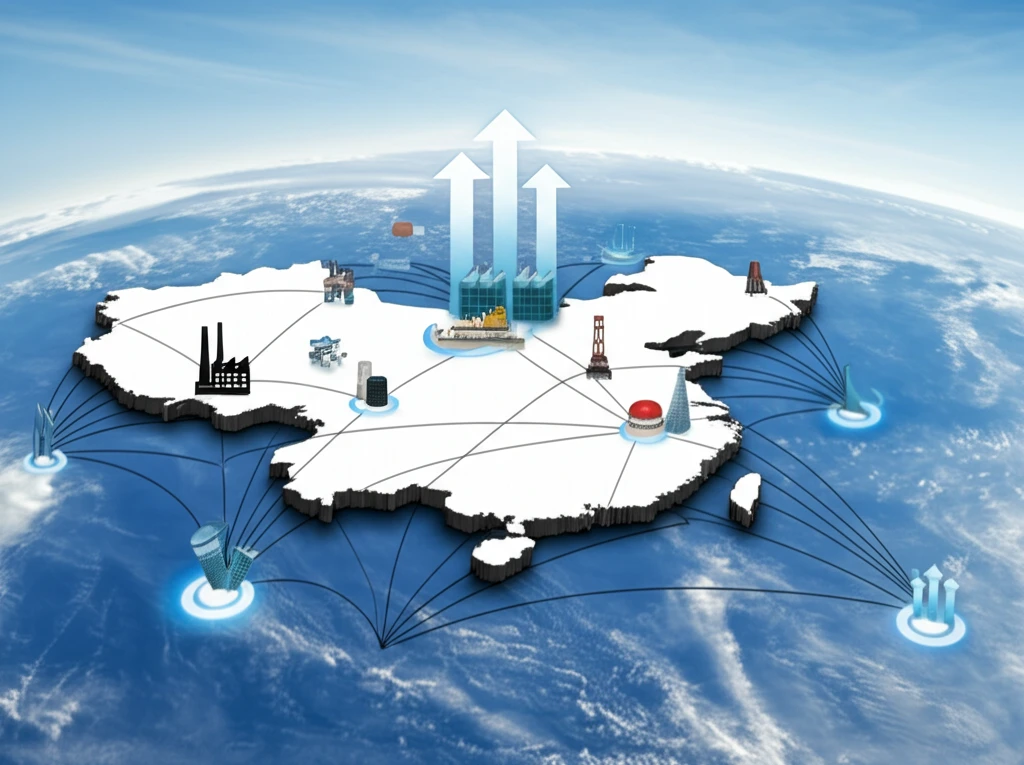
Decoding China's Economic Transformation: How Global Value Chains Are Reshaping Its Future

"Explore China's evolving role in global value chains, from manufacturing hub to a powerhouse in services and innovation, influencing both its economy and global trade dynamics."
China’s economy has undergone a massive shift since joining the World Trade Organization (WTO) in 2001. It's no longer the same economic landscape it was back then. To really understand what's happening now, we need to look at recent changes and the forces behind them.
Several key events have shaped China's economic path. WTO entry boosted exports, but the 2008 global financial crisis, the rise of domestic companies, and increasing wages, especially for skilled workers, have all played significant roles. Understanding these shifts is key to getting the full picture.
That's why research, like Heli Simola's analysis of Chinese value-added in global value chains (GVCs), is so valuable. It gives us a crucial perspective on how China's involvement in global production has changed between 2000 and 2014.
Mapping Global Value Chain Data Infrastructure
Major international institutions have built extensive data infrastructure to track global value chains. The WTO, in collaboration with the Asian Development Bank, IDE-JETRO, and the University of International Business and Economics, maintains a joint Global Value Chains Dataset designed to better understand the ongoing development and evolution of GVCs and their implications for economic development. The U.S. Bureau of Economic Analysis notes that global value chain statistics reveal the mix of domestic and foreign value embedded in production chains, offering a more granular picture of supply chain linkages than traditional trade statistics alone. The WTO's GVC Dashboard further provides visualization of sectoral value-added origins of world exports across manufacturing industries, enabling researchers to trace how value is distributed across borders in complex production networks.
Methodological Foundations and Constraints
Research on global value chains commonly relies on multi-regional input-output (MRIO) frameworks, which trace the flow of intermediate goods and services across national borders to decompose the domestic and foreign value content of exports. While these methods have become standard, they depend on the quality and timeliness of underlying national accounts data, which can vary considerably across countries. Data latency remains a persistent challenge, as input-output tables are typically updated only every few years, potentially lagging behind rapid structural changes in trade patterns.
The Rise of Global Production Fragmentation
The concept of global value chains emerged from the observable fragmentation of production processes across multiple countries, driven by declining trade and communication costs beginning in the late twentieth century. Early scholarship recognized that the international division of labor allowed firms in developing countries to participate in world markets by specializing in specific stages of production. Over time, this fragmentation deepened and diversified, moving well beyond low-skill assembly work into more complex and technologically sophisticated activities, fundamentally altering how economists理解 global trade patterns.
Unpacking the Evolution: Key Shifts in China's Global Value Chain Dynamics
Simola's research highlights several significant shifts in China's economic engagement. Of these changes, Simola's results are particularly interesting. These findings challenge some common assumptions about China's economic role and offer new insights into its future direction.
- Growth of Services: The increase in China's domestic value-added share is partly due to the growth of its services sector. While China is often seen as the world's factory, the GVC data indicates that its growing strength in services should not be ignored.
- Decline of Low-Skilled Labor: China's production in GVCs shows a declining contribution from low-skilled labor, suggesting a move towards product upgrading and higher value-added activities.
- Rise of R&D: Supporting this trend, Simola's research shows that China's share of global Research and Development (R&D) services in GVCs has also been increasing.
Current State of GVC Research
Research on China's role in global value chains continues to evolve rapidly, driven by recent shocks including the U.S.-China trade war, the COVID-19 pandemic, and accelerating technological competition. Scholars are increasingly examining whether the era of hyper-efficient, globally dispersed production networks is giving way to more regionalized or resilience-oriented configurations. The methodological toolkit has expanded to incorporate network analysis, firm-level data, and technology sovereignty metrics, reflecting the growing complexity of the phenomena under study.
Evidence Against Full Decoupling
Research published in Nature challenges the narrative that China is fully decoupling from global value chains. Using multi-regional input-output data, scholars constructed a Global Industrial Value Chain Network model and found that deep, clustered domestic industrial and value chains ensure the relative completeness and independence of China's industrial and supply chain systems, enabling the economy to withstand external pressures. Separate research analyzing technology dependence across 38 countries using input-output and business R&D expenditure data contributes to reassessing how dependent nations are on foreign technology sources within global value-chain frameworks. A 2025 study on ResearchGate similarly aims to provide a theoretical basis for understanding shifts in China's position within GVCs, offering strategic suggestions rather than assuming a straightforward decoupling trajectory.
Structural Shifts and Divergent Trade Modalities
A 2026 study published in Structural Change and Economic Dynamics examines the structural characteristics and temporal evolution of China's GVC integration from the heterogeneous perspective of general trade versus processing trade, revealing distinct patterns in inter-industry production linkages and upstream-downstream relationships with trading partners. Research from the Journal of International Economics addresses whether global value chains have shifted in recent years, noting that the global fragmentation of production surged over past decades but faces new headwinds from trade wars and pandemic disruptions. Meanwhile, analysis from Duke University highlights that China's size, ambitious national goals, and growing technological capabilities have permitted rapid entry into innovation-oriented industries while the country continues to leverage production dominance in traditional sectors to move toward higher-value upstream activities such as R&D and design.
The Road Ahead: Navigating China's Evolving Economic Landscape
In conclusion, this research provides valuable insights into the key changes happening within China's GVC activities. To truly understand these shifts, future studies should delve deeper into disaggregated data and explore the connection between foreign investment and firm activity in China. This will help us better understand how these elements influence China's GVC activity and its overall economic composition. The transformation of China's role in global value chains is a complex process with far-reaching implications. By understanding the driving forces behind these changes, businesses and policymakers can make informed decisions and navigate the evolving global economic landscape.
China's Functional Role Reassessed
A 2026 analysis published in Journal of Contemporary China and East Asian Studies offers a new investment-based framework for reassessing what functional role China actually plays in global value chains, moving beyond traditional export-centric measures. This research by Xiaoming Su at Hunan University applies conceptualization and formal analytical methods to evaluate China's GVC participation through the lens of foreign direct investment patterns rather than solely trade flows. The study represents a growing recognition among scholars that investment data may provide a more accurate picture of a country's true position and influence within global production networks.
Navigating Structural Volatility in 2026
The World Economic Forum's Global Value Chains Outlook 2026, produced in collaboration with Kearney and drawing on over 100 consultations with industry, government, and academic leaders plus survey data from more than 300 global executives, describes a new operating reality defined by persistent volatility and disruptions embedded in the global economy. The report offers a dual playbook for companies to re-architect operations for agility and trust while outlining how nations can build competitive and investable supply chain ecosystems. A January 2026 UNCTAD Global Trade Update reinforces this picture, noting that geopolitical considerations, economic headwinds, shifting supply chains, digital breakthroughs, and sustainability imperatives are redefining how countries engage in commerce, with especially profound implications for developing nations.
From World Factory to Technology Leader
Scholarly analysis published by Springer documents that China's role in global value chains has changed fundamentally in recent decades, with the country moving from being the world factory for a diverse range of low-tech, mid-tech, and high-tech consumer goods to the goal of becoming a technological leader. This transformation is not without systemic challenges, as it requires sustained investment in R&D, human capital, and institutional frameworks that support innovation. The shift also raises fundamental questions about how established economic powers will respond to a competitor that is moving up the value chain while maintaining dominance in traditional manufacturing.
Digital Technology and Restructuring of Production Networks
Research published in Economic Analysis and Policy reveals that digital technology input promotes China's participation in the reconstruction of global value chains through two key channels: increasing the export scale of high-tech products and exporting greater domestic added value. This finding underscores that digital transformation is not merely an efficiency tool but a structural force reshaping how value is captured and distributed within production networks. A separate analysis from the China Economic Journal notes that the China-U.S. trade war and the COVID-19 pandemic sent shock waves through China-centered GVCs established across a variety of manufactured products, sending ripples through the broader international production landscape.