
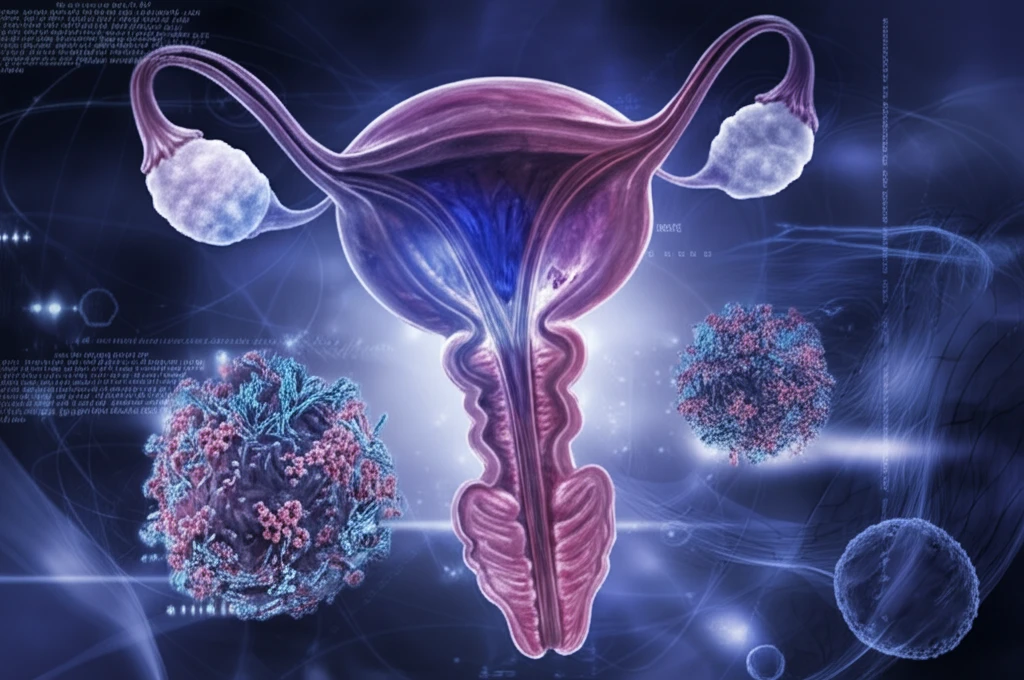
Decoding Bladder Cancer: How Hormones Hold the Key to Better Outcomes

"New Research Reveals the Impact of Sex Hormones on Bladder Cancer Treatment and Survival"
Bladder cancer, particularly muscle-invasive urothelial carcinoma (UCB), is a formidable challenge, often recurring even after radical cystectomy (RC). For decades, treatment options have remained limited, and recurrence rates stubbornly high. However, emerging research is shedding light on a new frontier: the critical role of sex hormones and their receptors in bladder cancer progression and treatment outcomes.
A groundbreaking study analyzes the expression of sex-steroid hormone receptors—androgen receptor (AR), estrogen receptor 1 (ESR1), and progesterone receptor (PGR)—in patients undergoing RC. By measuring mRNA levels of these receptors, scientists are uncovering how these hormones influence the course of the disease, offering potential new avenues for targeted therapies.
With a keen focus on how these hormonal signals affect recurrence-free survival (RFS) and disease-specific survival (DSS), this research opens doors to more personalized and effective treatment strategies. Understanding these hormonal dynamics is the first step toward transforming bladder cancer care and improving patient outcomes.
A Disease of Steady Numbers and Silent Onset
The American Cancer Society predicts 84,530 new bladder cancer cases in the U.S. for 2026, a figure reported by LIV Hospital as evidence of why early detection matters. SEER supplies detailed cancer statistics for bladder cancer broken down by sex, race, age, and stage, giving researchers and clinicians a granular view of the disease's impact. ZipDo's education report aggregates more than 100 bladder cancer statistics, each checked through reproduction analysis and cross-referenced across at least two independent databases. Blood in the urine is the most common early sign, and most bladder cancers start in the innermost layer of the bladder, where treatment before the disease spreads offers the best outcomes.
Surgery at the Core of a Risk-Stratified Playbook
The cornerstone of surgical treatment is transurethral resection of the bladder tumor (TURBT), which uses special instruments attached to a cystoscope to cut the tumor and remove it with an electrical cautery device or laser. Cystoscopy can be enhanced with fluorescence, during which fluorescent dyes are placed in the bladder and taken up by cancer cells to improve visualization. Treatment choices hinge on whether the cancer is non-muscle or muscle invasive and may include surgery, BCG, chemotherapy, and targeted therapy. The AUA/SUO guideline provides a risk-stratified clinical framework for managing non-muscle invasive bladder cancer, reflecting how treatment intensity is calibrated to each patient's risk level.
From Environmental Exposures to Family History
Bladder cancer is one of the most common urological cancers, with NAF reporting that the American Cancer Society estimates more than 84,000 Americans will be diagnosed in 2026 and nearly 18,000 will die from the disease. Documented historical risk factors include exposure to arsenic and aristolochic acid, as well as a history of receiving chemotherapy or radiotherapy agents. A personal or family history of bladder cancer also increases risk, according to MedlinePlus, which notes that having a relative with the disease raises a person's likelihood of developing it. WebMD's foundational overview covers symptoms, risk factors, diagnosis, and prevention as part of the standard baseline understanding of the disease.
The Hormonal Connection: What the Research Reveals
The study assessed mRNA expression of AR, ESR1, and PGR in 87 patients with muscle-invasive UCB. The findings highlight a significant imbalance: AR mRNA expression was markedly lower compared to ESR1 and PGR expression. This disparity is critical, as it directly correlates with patient survival outcomes.
- AR mRNA expression is lower compared to ESR1 and PGR expression.
- High AR expression levels are associated with reduced RFS and DSS.
- Lymph node status is an independent predictor of reduced RFS and DSS.
- ESR1 and PGR expression status can further stratify patients with low AR expression into subgroups with significantly reduced RFS and DSS.
Genomics, Biomarkers, and the Inner Lining
Nature notes that most bladder cancers are transitional cell carcinomas that begin in the cells making up the inner lining of the bladder, while other types include squamous cell carcinoma and adenocarcinoma. UroToday publishes the latest bladder cancer research, including full-text abstracts and researcher-authored "Beyond the Abstract" articles that add context to published studies. MassiveBio highlights recent work in genomics, biomarkers, and early detection methods as the emerging frontier of bladder cancer research. The World Cancer Research Fund also maintains a running program of research into what causes bladder cancer.
When Symptoms Mislead and Burden Mounts
Bladder cancer is often mistaken for a bladder infection because the two share overlapping symptoms, yet they require fundamentally different treatments, with cancer typically demanding surgery or chemotherapy. The NIH notes that because of the disease's high incidence and frequent tumor recurrence, bladder cancer exacts an outsized medical burden in the United States and globally. Mayo Clinic emphasizes that bladder cancer is best managed by surgeons who are specially trained to treat the disease. NHS Highland reports that approximately 21,000 patients are diagnosed with bladder cancer each year in the UK, yet it remains a cancer that is rarely talked about and many people are unsure what symptoms to look out for.
UTI or Cancer, Surgery or Preservation
Healthline compares urinary tract infections with bladder cancer and advises that abnormal urinary symptoms such as pain or increased frequency warrant a doctor visit, where testing can determine the underlying cause. At the treatment level, comparative research examines muscle-invasive bladder cancer by pitting radical cystectomy against bladder-sparing therapy. That analysis underscores how consequential the disease is in some populations, noting that bladder cancer is the most predominant cancer among Egyptian men, with a prevalence rate above 15% and roughly 8,000 deaths. The comparison between infectious and malignant causes of urinary symptoms is a recurring theme in both primary care and urologic oncology.
The Future of Bladder Cancer Treatment: A Personalized Approach
These findings mark a significant step forward in understanding the complex interplay between sex hormones and bladder cancer. By identifying specific hormonal profiles and their impact on survival, researchers are paving the way for personalized treatment strategies. Future research will likely focus on developing targeted therapies that modulate hormone receptor activity, offering new hope for patients with muscle-invasive UCB. The ability to stratify patients based on their AR, ESR1, and PGR expression levels will enable clinicians to tailor treatment plans, potentially leading to improved outcomes and a better quality of life for those affected by this challenging disease.
Checkpoint Inhibitors: Effective but Modest
Expert commentary in Expert Opinion on Biological Therapy notes that the most common form of urothelial carcinoma is bladder cancer, while upper urinary tract UC accounts for about 6% of all cases, and that response rates to nivolumab and other checkpoint inhibitors after first-line chemotherapy remain under 30%. Another expert analysis examines intravesical apaziquone (EO9) for TaT1 bladder cancer through a comparative analysis of tumor recurrence rates. On the diagnostic side, Tower Urology describes starting with urinalysis to check for blood and abnormal cells, along with urine cytology to look for cancerous cells shed into the urine. CancerCenter rounds out the picture by listing family history, smoking, and chemical exposure among the top risk factors that guide who gets screened.
A Molecular Roadmap to Better Outcomes
The bladder cancer market is projected to reach USD 9.95 billion by 2035, growing at a 4.6% CAGR, according to MarketResearchFuture. OncLive reports that immunotherapy continues to shape the future bladder cancer paradigm, with experts debating pseudoprogression and how results will ultimately turn out. One expert notes that 30% of stage 4 bladder cancer patients can now live beyond five years, and that the future of all tumors, including bladder cancer, revolves around understanding molecular biology, with FGFR, H-RAS, and P-53 all elevated in bladder cancer patients. BCAN adds that some cancer treatments, including the chemotherapy drug cyclophosphamide, may slightly increase future bladder cancer risk, a counterweight to therapeutic progress.
Polyps, Prior Treatments, and the Standard of Care
Ezra notes that it is challenging to determine an exact percentage of bladder polyps that are non-cancerous, and that polyps can be potentially serious, with untreated lesions potentially developing into bladder cancer. Healthline adds that bladder stones, a history of chemotherapy or radiation, the chemotherapy drug cyclophosphamide, and radiation to the pelvis are all linked to increased bladder cancer risk. For those who do develop muscle-invasive disease, cisplatin-based neoadjuvant chemotherapy followed by radical cystectomy continues to represent the standard of care for eligible patients, as outlined by American Nurse. Together these factors frame bladder cancer as a disease influenced by both incidental findings and the long shadow of prior medical treatments.
What Happens When Patients Are Treated for Real
A retrospective, non-interventional, multicenter study demonstrates that SII-ONCO-BCG is an effective and safe treatment for patients with intermediate- and high-risk non-muscle invasive bladder cancer, adding real-world evidence to clinical trial data. HealthCentral notes that urothelial carcinoma accounts for 90% of all bladder cancer cases, and that the specific type can affect how rapidly the disease progresses and which treatment is recommended. OncLive reports on a single-arm real-world immunotherapy study that enrolled a high number of patients, 270, describing it as a different agent but not necessarily a new paradigm. As Alex Chehrazi-Raffle, MD, told Targeted Oncology, real-world studies are going to be key to understanding how those sorts of changes fit into current practice patterns and how the field can move forward with new data.