
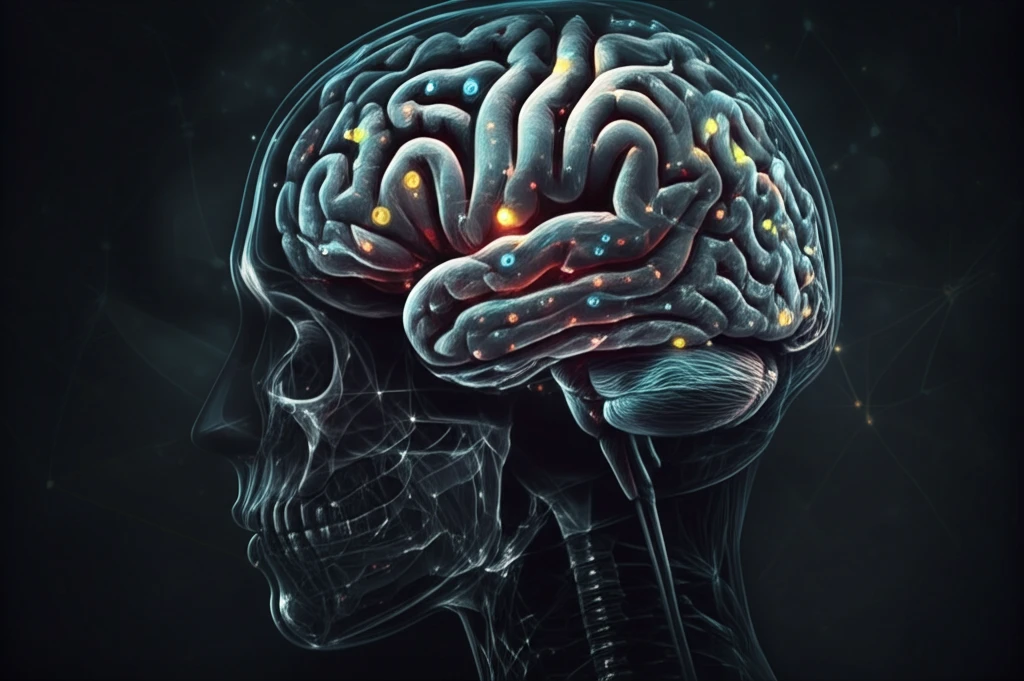
Cracking the Anxiety Code: Can a Brain Circuit Hold the Key to New Treatments?

"Emerging research highlights a potential breakthrough in anxiety treatment by targeting a specific brain circuit and a novel opioid receptor agonist KNT-127."
For millions, anxiety isn't just a fleeting feeling—it's a persistent battle that disrupts daily life. While existing treatments offer some relief, they often come with unwanted side effects, highlighting the urgent need for more targeted and effective solutions. Imagine a future where anxiety is managed with precision, minimizing side effects and maximizing well-being. Recent research is offering a glimmer of hope, pointing towards a specific brain circuit that could hold the key to unlocking innovative anxiety treatments.
At the forefront of this research is the prefrontal cortex (PFC), the brain's command center for decision-making and emotional regulation. Within the PFC, scientists are particularly interested in the prelimbic region, a key player in anxiety-related behaviors. Studies suggest that by modulating activity in this specific area, we might be able to directly influence anxiety symptoms. This focus on targeted intervention represents a significant shift in how we approach mental health treatment.
Adding another layer of intrigue is a compound called KNT-127, a delta opioid receptor agonist. Opioid receptors, traditionally associated with pain relief, are now being recognized for their role in emotional regulation. KNT-127, in particular, has shown promise in preclinical studies for its anxiolytic (anxiety-reducing) effects. The big question now is, how does KNT-127 interact with the prelimbic prefrontal cortex to alleviate anxiety, and what does this mean for future therapies?
The Scale of Anxiety Worldwide
Anxiety is among the most common mental health conditions, with anxiety disorders affecting hundreds of millions of people worldwide and frequently co-occurring with depression and other illnesses. Statistical collections such as those compiled by the Priory draw on facts and figures from leading mental health organisations, academia and public health bodies to show how widespread the condition is. Global data aggregators likewise note that their figures are assembled from peer-reviewed studies, official statistics and industry databases. Because anxiety touches so many lives, educating ourselves on the data is often framed as the first step toward recognising symptoms and seeking help.
The Gold Standard and Its Limits
Cognitive behavioral therapy (CBT) remains the gold standard for anxiety treatment, a research-supported type of psychotherapy that has been well studied for generalized anxiety disorder. According to clinical guidance, successful treatment generally involves medication combined with psychotherapy rather than relying on a single method alone. Providers increasingly emphasise personalised, science-based treatment designed to reduce symptoms and help patients regain calm and move toward a more fulfilling life. Because no single approach fits everyone, standard methods typically need to be combined and tailored to each individual's symptoms and circumstances.
From The Scream to Modern Care
Anxiety has been depicted in art for well over a century, with Edvard Munch's The Scream often cited as a visual expression of the complex human experience of anxiety. Understanding of the condition has evolved from earlier eras, when practices such as those seen in the medieval period involved unconventional physical treatments, to the modern recognition that anxiety is a treatable condition. Without treatment, anxiety disorders tend to remain, and modern care may include lifestyle changes, counselling and medications. Today, organisations such as the NHS and Beyond Blue describe several distinct anxiety disorders, including social anxiety disorder and generalised anxiety disorder, each with different symptoms and treated differently.
Decoding the Delta Opioid Receptor and Anxiety
A groundbreaking study published in Behavioral Brain Research delves into the intricate relationship between the delta opioid receptor agonist KNT-127 and anxiety-like behaviors in mice. Researchers Akiyoshi Saitoh, Satoshi Suzuki, and their team focused on how KNT-127, when introduced directly into the prelimbic medial prefrontal cortex (PL-PFC), could mitigate anxiety triggered by veratrine, a neurotoxic steroidal alkaloid. This research opens new doors in understanding how specific brain circuits can be targeted to alleviate anxiety.
- Decreased anxiety-like behaviors in open field tests.
- Reduced extracellular glutamate levels in the PL-PFC.
- Diminished veratrine-induced c-Fos expression in the amygdala.
- No significant impact on anxiety-like behaviors when administered alone.
New Clinical Evidence Emerging
Recent reviews of pharmacotherapy for anxiety disorders in adults point to a growing pipeline of ongoing clinical studies registered on databases such as ClinicalTrials.gov, each identified by its National Clinical Trial number. A multicenter double-blind placebo-controlled randomized trial reported that the anxiolytic drug Tenoten proved effective in treating anxiety in adults with somatoform and other neurotic disorders. Across the field, researchers and clinicians consistently note that the most effective treatments for anxiety are therapy and medication used together. Patients are accordingly being directed toward evidence-based treatment information backed by scientific research and expert reviews to guide their choices.
Where Approaches Fall Short
Not every widely promoted approach succeeds, and critics note that positive psychology has real limitations: there is no scientific method to measure the effects of its interventions, and it does not place enough focus on the treatment of mental health problems, which can leave people with serious issues under-supported. Clinicians also point out that anxiety frequently does not appear alone — social anxiety disorder often occurs alongside major depressive disorder, substance abuse problems and other anxiety disorders, complicating treatment. Hypersensitivity to criticism, poor social skills, isolation and difficult social relationships are recognised consequences that can derail recovery. In some cases, doctors turn to medications not primarily designed as anxiety drugs, such as propranolol, which is approved for heart problems but also helps with symptoms of anxiety.
Similar Symptoms, Different Solutions
Comparative analysis shows that conditions with overlapping symptoms can still demand very different care. Anxiety and ADHD, for example, both involve difficulty concentrating, restlessness and feeling overwhelmed, yet their root causes and treatments are very different, so accurate diagnosis matters. Similarly, phone anxiety and social anxiety look alike on the surface, but the differences shape whether scripts, exposure, therapy or delegation is the right next step. Even repurposed medications behave differently across people: a common blood pressure drug being studied for anxiety was found to alter how the brain processes distractions, affecting men's and women's focus in completely opposite ways — a reminder that treatment response is not one-size-fits-all.
The Future of Anxiety Treatment: Precision and Modulation
This research provides a compelling case for the potential of targeted therapies in mental health. By focusing on specific brain circuits and utilizing compounds like KNT-127 to modulate neural activity, we may be able to develop more effective and less invasive treatments for anxiety. While these findings are still preliminary, they offer a promising roadmap for future research and the development of innovative interventions that could transform the lives of millions.
What Experts Agree On
Expert commentary on anxiety treatment tends to converge on a few practical points: medication choices such as Wellbutrin must be weighed for effectiveness, side effects and best practices for usage, guided by qualified clinicians. At the same time, recovery specialists stress that the work of therapy comes first and results follow, with lasting recovery depending on treating the anxiety itself and the hyperstimulation symptoms that sustain it. Enduring improvement, in this view, rests on understanding the many aspects of therapy and committing to the process rather than expecting a quick fix. Together, these perspectives suggest that medication and structured therapeutic work are complementary parts of a durable recovery plan.
Biomarkers and Novel Treatments Ahead
The future of anxiety care points toward personalisation and novel therapeutics. Researchers have found a potential biomarker: adults with anxiety who had greater pre-treatment volume in the nucleus accumbens, a region that plays a key role in avoidance behaviour, responded best to psychosocial or SSRI treatment. Meanwhile, a phase 2 clinical trial reported that LSD proved effective in treating anxiety, underscoring how long patients with generalised anxiety disorder have been left behind — the last approval of a new GAD treatment came in 2004. Even established medications continue to be refined, with detailed guidance on dosage requirements for drugs such as Klonopin. Together these developments suggest a pipeline of biomarker-guided and novel treatments aimed at patients who have seen little progress in recent decades.
Anxiety's Reach Beyond the Individual
Anxiety disorders ripple far beyond internal distress, affecting social relationships, work performance and overall quality of life. Intense fear or social discomfort can make it difficult to form or maintain relationships and to participate in normal everyday activities, and these effects are felt across communities. A systemic challenge is that many people delay seeking help; health services advise seeing a GP when anxiety is having a big impact on daily life. Reassuringly, social anxiety is a common problem and there are treatments that can help, which makes improving access to care a central priority.
Individual Stories Behind the Numbers
Behind the statistics are individual stories: the case of Mr. Smith, a 52-year-old man, illustrates the multifaceted nature of anxiety disorders and the importance of a comprehensive approach to treatment and management. Researchers have also devoted careers to humanising care — with more than 200 scientific publications, Barbara Rothbaum was a forerunner in the use of virtual reality to treat anxiety disorders and helped change the field of PTSD. Even unconventional interventions are being tested in real-world settings, with a preliminary study reporting that patients with advanced disease and refractory cancer-treatment symptoms showed decreased mild-or-higher levels of both anxiety and depression after ozone therapy. Meanwhile, dedicated treatment centres continue to offer adult intensive outpatient and outpatient care for generalised anxiety disorder, panic disorder, social anxiety disorder, agoraphobia and specific phobias.