
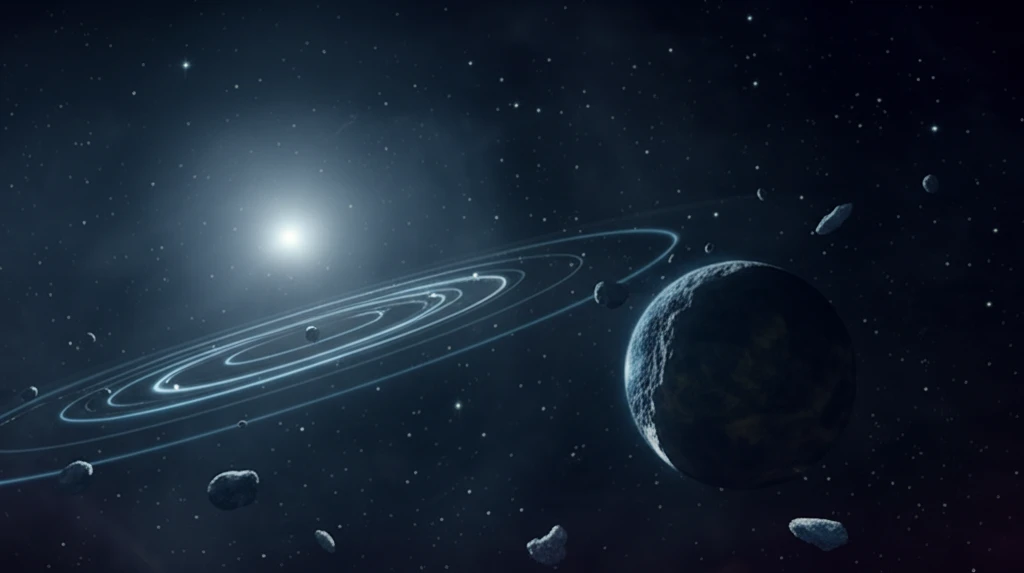
Cosmic Catch: Unraveling the Mystery of Neptune's Transient TNOs

"New simulations shed light on how trans-Neptunian objects become temporarily trapped in Neptune's resonances, challenging existing theories of Kuiper Belt formation and offering fresh insights into our solar system's early dynamics."
The outer reaches of our solar system are a realm of icy bodies known as trans-Neptunian objects (TNOs). These objects, residing beyond Neptune's orbit, offer valuable clues about the solar system's formation and evolution. A significant number of TNOs find themselves in a delicate dance with Neptune, caught in what are called mean-motion resonances. These resonances occur when a TNO's orbital period is related to Neptune's by a simple integer ratio, leading to a repeating gravitational interaction.
Traditionally, it was thought that many of these resonant TNOs were captured during Neptune's early migration, a period when the planet's orbit shifted due to interactions with a surrounding disk of planetesimals. However, a different mechanism known as 'transient sticking' can also contribute to the resonant population. Transient sticking occurs when TNOs, which are actively scattered by Neptune, become temporarily trapped in a resonance before eventually being ejected or continuing their chaotic journey.
A recent study published in The Astronomical Journal uses numerical simulations to investigate the role of transient sticking in shaping the current population of resonant TNOs. This research challenges existing theories about the Kuiper Belt's formation and offers a fresh perspective on the dynamic processes at play in our solar system's outer regions.
A Crowded Frontier Beyond Neptune
A trans-Neptunian object (TNO) is any minor planet in the Solar System that orbits the Sun at a greater average distance than Neptune, which has an orbital semi-major axis of 30.1 astronomical units (AU). The Kuiper Belt, a region extending from beyond the orbit of Neptune, contains thousands of icy bodies and dwarf planets. Scientists believe at least one TNO, officially called 2003 UB313, is larger than Pluto.
Defining the Boundary by Distance
The accepted method for identifying a TNO relies on orbital distance, classifying any minor planet whose semi-major axis exceeds Neptune's roughly 30 AU orbit. This distance-based definition is straightforward, but it has limits, as the discovery of 2003 UB313 showed an object larger than Pluto that defied the existing planet classification and earned the nickname "tenth planet." Such cases reveal that the outer edge of the Solar System is far from empty and that simple boundaries can obscure complex realities.
From Edgeworth's Insight to a Tenth Planet
Kenneth Edgeworth was among the first to observe that a belt extends from beyond the orbit of Neptune, a region far larger than the asteroid belt it resembles. Later, the discovery of the TNO called 2003 UB313, nicknamed the "tenth planet" because it appears bigger than Pluto, marked a major milestone in proving the outer Solar System is not empty.
Simulating the Dance: How TNOs Get Stuck
The research team, led by Tze Yeung Mathew Yu, Ruth Murray-Clay, and Kathryn Volk, focused on understanding the contribution of transient sticking to the resonant TNO population. They ran numerical simulations to model the behavior of TNOs that are actively scattered by Neptune. These simulations tracked the TNOs as they moved through the region between 30 and 100 astronomical units (au) from the Sun, carefully recording any instances where they became temporarily trapped in a mean-motion resonance.
- Modeling the current scattering population based on observational data.
- Tracking the TNOs movements between 30 and 100 astronomical units (au).
- Analyzing 111 different resonances
- Identifying the periods of libration
Planet Nine and Unexplained Orbits
Recent research on the Kuiper Belt, which holds thousands of icy bodies and dwarf planets, focuses on the unexplained orbital patterns of these distant objects. Planet Nine remains a leading hypothesis for those patterns, suggesting a hidden influence may be shaping the region's structure. Neptune itself rests at the boundary between the large outer planets and this field of icy, Pluto-like stones.
Models Under Pressure from the Great Dark Spot
The mystery of Neptune's Great Dark Spot highlights the limitations of current models, and by unraveling what it hides, scientists can refine their models of planetary atmospheres. These refinements are essential because atmospheric understanding contributes directly to how planets form and evolve, both in our Solar System and beyond. Such unresolved features remind researchers that distance-based categorization of TNOs is only part of a much larger puzzle.
An Asteroid Belt on a Grander Scale
The Kuiper Belt is frequently compared to the asteroid belt, but it is far larger and extends from beyond the orbit of Neptune. While both are belts of minor bodies, the Kuiper Belt holds thousands of icy objects and dwarf planets, in contrast to the rocky remnants that dominate the asteroid belt. This contrast underscores Neptune's unique position at the boundary between the giant planets and the trans-Neptunian frontier.
A New Perspective on the Kuiper Belt
This research underscores the importance of transient sticking in shaping the structure of the Kuiper Belt. By demonstrating that a significant fraction of resonant TNOs are captured through this mechanism, the study challenges existing theories about planetary migration and the formation of the Kuiper Belt. Furthermore, the study provides a framework for interpreting observational data and for identifying transient interlopers within resonant populations dominated by other capture mechanisms. As observational surveys continue to map the outer solar system with increasing precision, these findings will be crucial for unraveling the complex history of our planetary neighborhood.
Neptune as the Gateway to the Icy Frontier
Neptune rests at the boundary between the large outer planets and a field of icy, Pluto-like stones called Trans-Neptunian Objects, making it the gateway to the Solar System's outer frontier. By unraveling the mysteries of Neptune's Great Dark Spot, scientists can refine their models of planetary atmospheres, and this knowledge contributes to our understanding of how planets form and evolve.
Following the Clues of Planet Nine
Looking ahead, Planet Nine remains a leading hypothesis for the unexplained orbital patterns observed in the Kuiper Belt and among TNOs. Continued study of the thousands of icy bodies and dwarf planets in this region offers the best chance to confirm or refute that hidden influence. Each new observation sharpens the picture of a frontier that scientists now know is far from empty.
Precision at the Edge of the System
Studying objects so distant demands extraordinary precision, much like the extremely precise work required to catch an uncrewed cargo ship in orbit, where GPS technology and a laser navigation system guide the approach. The classification of bodies like 2003 UB313 also poses systemic challenges, as an object larger than Pluto forces a re-examination of what counts as a planet. These obstacles mirror the broader scientific struggle to map the true outer edge of the Solar System.
A Frontier That Captures the Imagination
The notion that the outer edge of the Solar System is not empty reshapes how the public thinks about our cosmic neighborhood, and the nickname "tenth planet" for 2003 UB313 illustrates how these icy discoveries capture popular imagination. Writers have taken up these ideas as themes for reflection, exploring trans-Neptunian objects as subjects of nonfiction, philosophy, and wonder. Far beyond the scientific data, these discoveries invite humanity to reconsider its place on the edge of a vast frontier.