
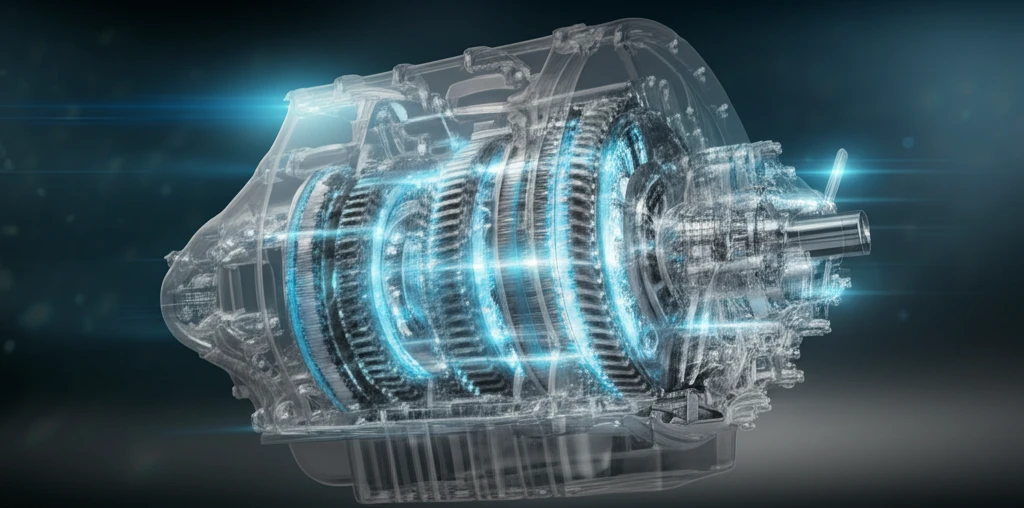
Cooling Clutches: How Smart Design Keeps Your Car Running Smoothly

"Uncover the secrets of wet multi-plate disk clutches and how innovative cooling techniques are boosting performance and efficiency in modern vehicles."
In the relentless pursuit of automotive excellence, engineers are constantly seeking ways to enhance the performance and longevity of vehicle components. Among these critical elements, the transmission system stands out as a key area for innovation, particularly concerning the clutches that enable seamless gear changes.
Wet multi-plate disk clutches, known for their robust nature and ability to handle high torque loads, are increasingly employed in modern transmissions, especially in dual-clutch systems. However, their operation generates significant heat due to friction, necessitating effective cooling strategies to prevent overheating and ensure reliable performance. This is why researchers and engineers are focused on optimising wet multi-plate disk clutches, to keep vehicles on the road longer.
This article delves into the fascinating world of wet multi-plate disk clutches, exploring the innovative cooling techniques that are revolutionizing transmission technology. From novel groove designs to optimized oil flow strategies, we'll uncover the secrets of how smart engineering is keeping your car running smoothly and efficiently.
The Role of Clutches in Modern Vehicles
Clutches are fundamental components in virtually all vehicles with manual or automatic transmissions, enabling the engagement and disengagement of power between the engine and drivetrain. While precise global failure rates are not well-documented in publicly available literature, clutch wear and thermal degradation are widely recognized as among the most common maintenance concerns for high-mileage vehicles. The automotive clutch market has grown into a multi-billion-dollar global industry, reflecting the scale of clutch-related engineering and replacement demand across passenger cars, commercial vehicles, and industrial machinery.
Conventional Clutch Cooling Design and Its Constraints
Traditional wet clutch systems rely on continuous oil flow through the clutch pack to carry away frictional heat generated during engagement and slipping. Designers typically size oil flow rates and cooler capacity based on worst-case operating conditions such as repeated low-speed crawling or towing under load. However, this approach can lead to over-engineered cooling systems that add weight, parasitic losses, and complexity, while still leaving edge cases—such as sustained hill starts or aggressive driving—where localized hot spots may exceed design assumptions and accelerate wear.
The Evolution of Wet Clutch Technology
The wet clutch concept dates back to the early 1900s with the Hele-Shaw clutch, an early multi-plate design named after Professor Henry Selby Hele-Shaw, who was known for his work on viscosity and flow through small gaps between parallel plates. The fundamental principle—submerging friction plates in oil to manage heat—has remained consistent for over a century, though materials, control strategies, and modeling techniques have advanced considerably. Recent academic work has introduced multi-body dynamic models integrating thermal contact conductance with tribo-dynamic behaviors, representing a significant step toward predictive clutch design rather than purely empirical approaches.
The Crucial Role of Cooling in Clutch Performance
Wet multi-plate disk clutches rely on a constant flow of oil to lubricate and cool the friction surfaces. The oil not only reduces wear and tear but also carries away the heat generated during engagement and disengagement. Without adequate cooling, the clutch can overheat, leading to reduced performance, premature wear, and even catastrophic failure.
- Optimized Groove Designs: Innovative groove patterns on the friction plates help to channel oil flow and enhance heat transfer.
- Targeted Oil Flow: Precisely directing oil to the areas where heat is generated most effectively removes thermal energy.
- Advanced Materials: The use of advanced friction materials with improved thermal conductivity helps to dissipate heat more efficiently.
Current State of Clutch Cooling Research
Contemporary research in clutch cooling increasingly focuses on computational modeling and real-time thermal management rather than purely passive fluid-based cooling. Researchers are exploring sensor-driven adaptive cooling strategies that adjust oil flow dynamically based on actual operating conditions, potentially reducing parasitic energy losses. The integration of finite-element thermal analysis with multi-body dynamics simulation represents a growing trend, allowing engineers to predict temperature distributions across clutch plates during transient engagement events.
When Clutch Cooling Systems Fail or Underperform
Field failure analyses have documented cases where multi-plate wet clutches in off-highway transmissions failed due to inadequate thermal management and contamination, stalling entire transmission systems. Research has shown that traditional centralized valve-controlled hydraulic systems contribute to energy losses, and decomposing these into separate subsystems for clutch control, cooling, and lubrication can improve efficiency. These findings highlight that cooling system design is not just about thermal capacity but also about minimizing parasitic losses from the hydraulic components that deliver cooling fluid.
Wet vs. Dry Clutch Cooling Trade-Offs
Wet clutches offer superior heat dissipation compared to dry clutches because the surrounding fluid continuously cools the friction surfaces, making them better suited for applications involving frequent slipping or high thermal loads. However, dry clutches achieve the same torque capacity with fewer plates, resulting in lower rotational inertia and inherently higher mechanical efficiency due to reduced parasitic losses. Manual transmissions with dry clutches typically have the highest efficiency among common transmission types because they rely on simple splash lubrication rather than oil-pump-driven cooling systems.
The Future of Clutch Technology
As automotive technology continues to evolve, the demands placed on transmission systems will only increase. With the rise of electric vehicles and hybrid powertrains, the need for efficient and reliable clutches has never been greater. Ongoing research and development efforts in cooling techniques, material science, and design optimization promise to unlock even greater levels of performance and efficiency in the clutches of tomorrow. By embracing innovation and pushing the boundaries of engineering, we can ensure that our vehicles continue to run smoothly, efficiently, and reliably for years to come.
Balancing Thermal Management and Efficiency
The central tension in clutch cooling design is the trade-off between robust thermal protection and system efficiency—more aggressive cooling reduces thermal risk but introduces parasitic losses and mechanical complexity. Expert consensus, reflected in recent literature, increasingly favors intelligent, condition-based cooling strategies over fixed-flow-rate approaches. The challenge for engineers is designing cooling systems that respond dynamically to real-world operating demands without adding unnecessary weight or energy consumption to the vehicle.
Market Growth and Emerging Technologies
The global automotive clutch market is valued at over $9.3 billion, with dual wet clutch segments projected to reach $5.0 billion by 2034 at a compound annual growth rate of 7.2 percent. Growth is driven by increasing adoption of automatic and semi-automatic transmissions, which depend heavily on wet clutch technology for smooth power transfer. The rise of electric vehicles and the push for improved fuel efficiency are expected to reshape clutch design priorities, with future systems likely integrating advanced materials and smarter thermal management algorithms.
System-Level Implications of Clutch Thermal Design
Clutch cooling does not exist in isolation—it interacts with the broader vehicle thermal management system, including engine cooling, transmission lubrication, and in some architectures, electric motor cooling. As vehicles become more electrified and hybridized, the thermal budgets for drivetrain components are becoming more constrained, requiring holistic system-level optimization rather than component-by-component design. This systemic perspective is becoming essential as manufacturers seek to reduce vehicle weight and energy consumption while maintaining durability.
What Clutch Cooling Means for Drivers
For everyday drivers, effective clutch cooling translates directly into smoother gear engagement, reduced NVH (noise, vibration, and harshness), and longer service intervals between clutch replacements. In commercial and heavy-duty applications, reliable clutch thermal management can mean the difference between continued operation and costly unplanned downtime. As vehicle technology advances, the sophistication of clutch cooling systems will increasingly be invisible to drivers, quietly working behind the scenes to ensure consistent performance across diverse driving conditions.