
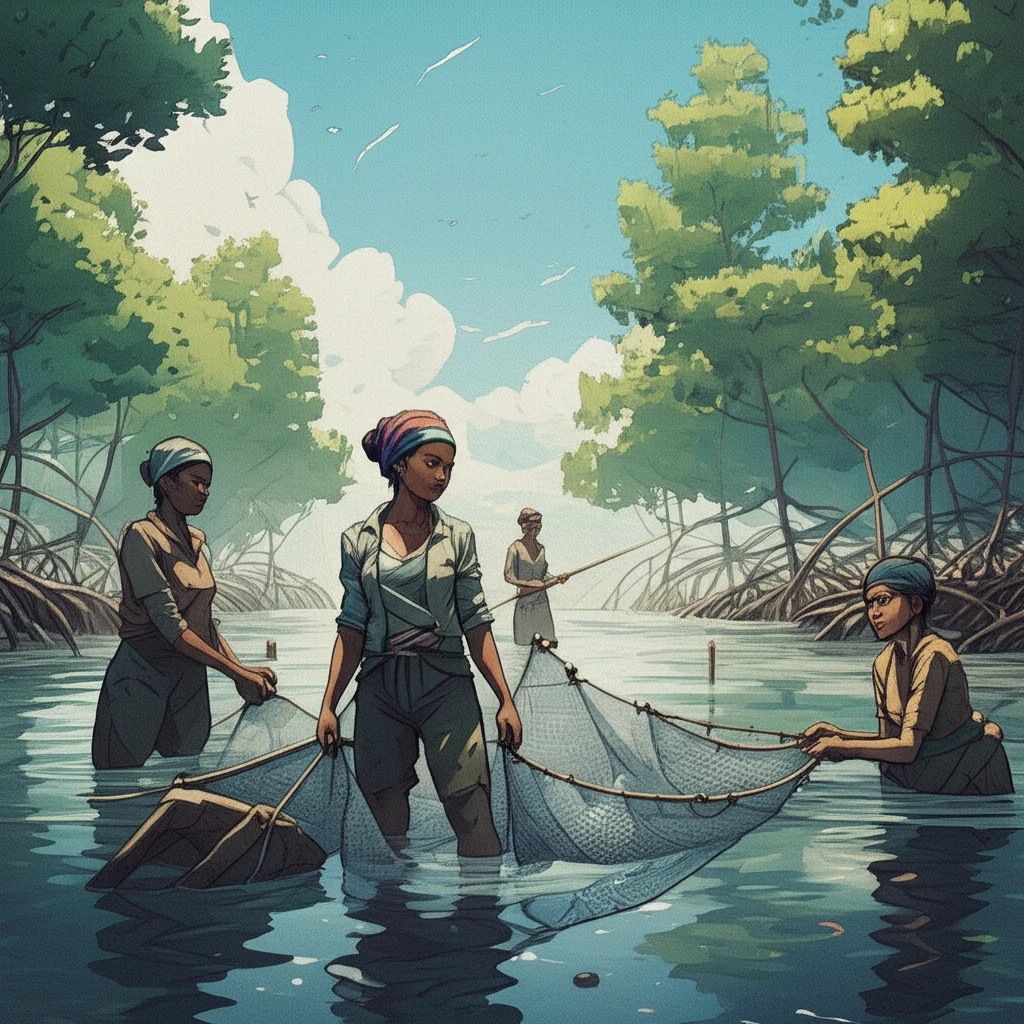
Coastal Women: The Unseen Force in Fishing and Conservation

"Exploring the vital role of women in the Mamanguape River Estuary's fishing economy and environmental preservation."
Mangrove-estuary ecosystems are vital transition zones connecting freshwater and marine environments. These areas, rich in biodiversity, not only support intricate food webs but also serve as crucial resources for local human communities. Mangroves provide lumber, dyes, and an abundance of fishes, crustaceans, and mollusks, all essential for the subsistence of those who live nearby.
Within these communities, the family unit is key. All members actively participate in fishing activities, ensuring both survival and extra income. Women play a particularly significant role, engaging in income-generating activities that are directly linked to the use and management of natural marine resources. Their involvement highlights the intersection of productive processes and environmental dynamics.
Understanding how women manage these environments is crucial for sustainable practices. This article explores the appropriation and use of fishing resources by women residing near the Mamanguape River Estuary (MRE) in Paraíba, Brazil, shedding light on their essential contributions to both the local economy and environmental conservation efforts.
Counting the Uncounted
Women are frequently absent from official fisheries statistics: as one expert put it, "women are commonly not even counted in fisheries statistics," leaving uncertainty about how many there are, where they are, and whether their numbers are rising or falling. Work on gender-inclusive data systems in small-scale fisheries finds that foot fisheries—a category of fishing usually done by women—are often overlooked in data collection. Country-level breakdowns, such as those tracked for the fishing sector in Mexico, show how the characterization of small-scale fisheries can shift once these categories are included. The result is a systemic undercount of women's participation in fishing worldwide.
The Limits of Standard Methods
A new FAO-GFCM study sheds light on women's roles, challenges and opportunities in Mediterranean and Black Sea fisheries—work that conventional approaches to the sector have tended to overlook. The limitations of accepted methods are a recurring theme: standardized approaches and international standards frequently rest on simplified assumptions that fail to capture real-world complexity. Even outside fisheries, standards bodies acknowledge that established models—such as those for shading devices in ISO 15099 and ISO 52022—assume idealized, simplified conditions that may not reflect actual use. Recognizing these constraints is a first step toward methods that accurately account for women's presence in the industry.
Hidden Histories, Visible Milestones
Women have always played pivotal roles in the success of the commercial fishing industry—as cannery workers, fish cutters, biologists and business managers—yet their work has often been overlooked, as documented in the history of Monterey Bay fisheries. This pattern of hidden contributions is gradually being corrected by new milestones in visibility. Recent examples include the Ebony Anglers, a Black competitive women's fishing team that is leaving its mark on the world of competitive angling. Such moments mark progress in making women's long-standing role in fishing visible.
Women's Roles in the Mamanguape River Estuary
A study was conducted in the Mamanguape River Estuary (MRE) to evaluate how women utilize fishing resources. Researchers combined qualitative methods, such as interviews and direct observations, with quantitative methods, like use value calculations. Thirty women were interviewed, revealing their use of 41 different species: 30 fish, 8 crustaceans, and 3 mollusks. These resources are primarily used for local consumption and sale, highlighting their economic and nutritional importance.
- Economic Contribution: Women actively participate in fishing, ensuring family survival and generating income.
- Resource Diversity: They utilize 41 species, demonstrating extensive knowledge of the local ecosystem.
- Conservation Impact: Their practices are vital for maintaining the balance of mangrove ecosystems.
- Policy Implications: Data supports the formulation of inclusive environmental policies.
Conservation, Community, and Health
Recent commentary on women in fishing highlights a conservation-minded pattern of entry into the sport. As fly fishing guide Hilary Hutcheson observes, women tend to take up fishing only after committing to caring for the resource the way they care for their families, friends, home and work—meaning they "are not going to overlook conservation education." Building support systems is also central: Kristine Fischer of Wired2Fish notes that connecting women anglers for trips, shared tournament lodging and a shared love of fishing helps "all of us succeed." Meanwhile, public health research identifies women in fishing communities around Lake Victoria as a priority population for HIV prevention and treatment because of high prevalence and incidence.
Pushback and Persistence
Growing attention to women in fishing has not come without pushback. One line of counterargument holds that women, like any group, must uphold certain standards of behavior, and that women who raise concerns or offer criticism when others fall short are upholders of integrity rather than antagonists. Advocates respond by urging women anglers to ignore the critics, framing criticism as an obstacle to participation and confidence. Beyond individual backlash, the sector also carries a legacy of governance failure—unregulated fisheries, for example, are those in which fishing peoples did nothing to limit effort or reduce the mortality of the main marine resources on which they depend.
Comparing Gendered Fishing
Side-by-side comparisons of women's and men's fishing are popular in public discourse, with viral videos contrasting "girl vs guy" fishing results and outcomes. Formal comparison in the Pacific coastal fisheries sector also finds common ground: analyses of fishermen and fisherwomen who fish for finfish and collect invertebrates compare participation in both activities, including the percentage of men engaged at various stages. These comparisons complicate the stereotype that women's fishing is limited to gleaning and shore-based collection. Broader comparisons, such as ocean versus inland fishing, further emphasize how environment shapes what fishing looks like in practice.
Empowering Women for a Sustainable Future
The study highlights the indispensable role women play in the fishing economy and conservation of the Mamanguape River Estuary. By recognizing their contributions and promoting their equal participation, we can foster more effective and sustainable environmental policies. Supporting these women not only sustains their families and communities but also ensures the long-term health and resilience of this vital ecosystem, safeguarding it for future generations.
Gender as a Core Lens
Expert synthesis of women in small-scale fisheries increasingly draws on sophisticated analytical tools and frameworks. Research in the Amazonian forest, for example, employs social network analysis to describe the structure of subsistence fishing social networks and to explore the relation between fishers' emic perceptions of fishing expertise and their position in those networks. Gender analysis is now described as increasingly orthodox in natural resource programming, including for small-scale fisheries, while social-ecological resilience analysis has added valuable contributions by integrating social dimensions. These converging lines of work position gender as a core lens for understanding how fishing communities function.
Professionalized and Sustainable
The future of the sector is being shaped by careers and markets that reward both sustainability and technical skill. Careers in fishing and fisheries science are described as both meaningful and financially rewarding in developed maritime economies, with marine engineers earning €50,000–€90,000 annually in Europe according to 2023 DNV salary data. The fishing nets market, meanwhile, is experiencing a dynamic shift toward sustainability and technological innovation, with North America remaining the largest market, driven by a strong emphasis on sustainable fishing practices. Together, these trends point to a sector in transition toward more professionalized, sustainability-focused roles.
Turning the Tide
On Lake Victoria, women who were long sidelined in the male-dominated fishing industry are now steering boats, owning vessels and shaping the future of fishing in the region. Their turn toward ownership and leadership shows how women can move past systemic barriers to accessing the resources and support they need to thrive. Yet such systemic challenges persist, spanning difficulty accessing resources and support as well as the risk of burnout, and they call for both individual strategies and structural responses. The Lake Victoria story illustrates both the scale of the obstacles and the momentum for change.
From Invisible Labor to Recognized Contribution
The substantial contributions made by women, and the multiple roles they play in fisheries, have gained increasing recognition worldwide in recent years, according to FAO. Women's participation and leadership in fisherfolk organizations has become a growing focus of international attention, with recognition spanning production, processing and organizational life. This acknowledgment marks a shift in how the human element of fishing is understood—from overlooked labor to recognized, valued contribution.