
Closing the Loop: How Circular Economies Can Combat Poverty and Protect Our Planet

"Discover how a circular economy system is breaking the vicious cycle of ecological fragility and economic poverty, offering a sustainable path forward for vulnerable regions."
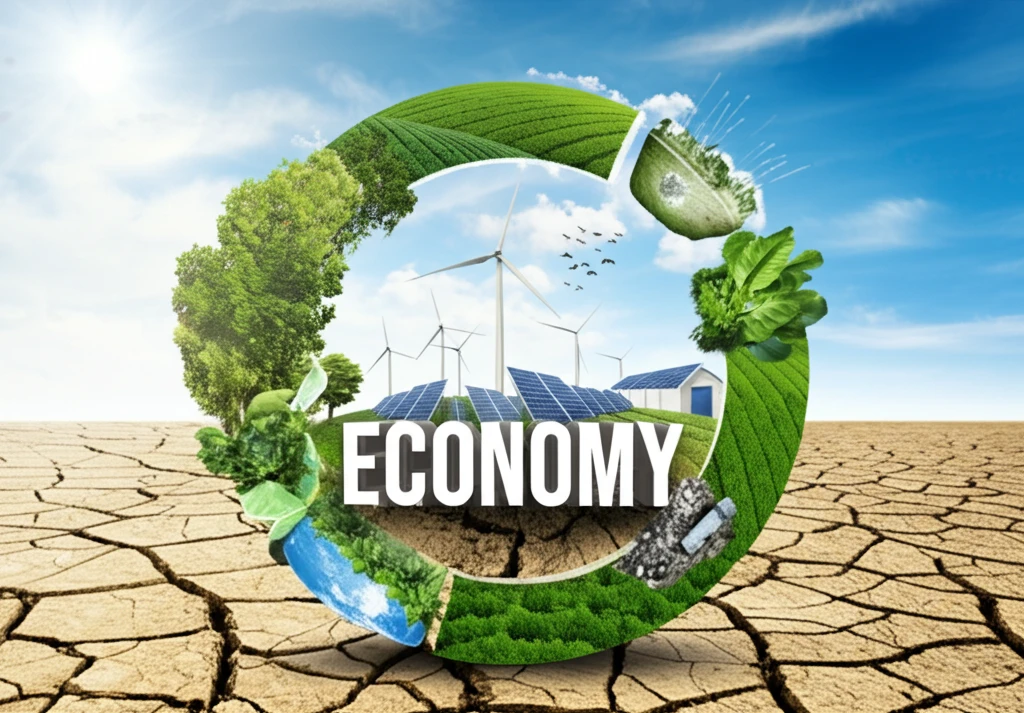
In many regions around the world, a troubling cycle persists: ecological fragility exacerbates economic hardship, and in turn, poverty drives further environmental degradation. This creates a vicious circle where exploited natural resources lead to environmental destruction and pollution, causing economic losses and deeper poverty. This dilemma, known as the environmental fragility-economic poverty vicious circle (FPVC), demands innovative solutions.
The concept of a circular economy offers a promising alternative. Unlike the traditional linear model of 'take-make-dispose,' a circular economy aims to minimize waste and maximize resource utilization. By creating closed-loop systems where waste from one industry becomes a resource for another, we can reduce environmental impact and foster economic opportunities.
This article will explore a successful case study of a circular economy system implemented in the Anding District of Northwest China, a region grappling with the challenges of FPVC. We will delve into the strategies employed, the benefits achieved, and the lessons learned, offering insights for other regions seeking to break free from this destructive cycle.
Measuring the Circular Economy
The circular economy contributes to security of supply for raw materials and supports meeting climate neutrality goals alongside the global Sustainable Development Goals. The EU monitoring framework on the circular economy tracks progress across five thematic areas: production and consumption, waste management, secondary raw materials, competitiveness and innovation, and global sustainability and resilience. Internationally comparable statistics and indicators are essential for measuring progress effectively, though their development remains an ongoing challenge.
Concept and Critique
Circular economy (CE), circularity, and sustainability are distinct yet interconnected frameworks offering transformative potential for addressing global environmental, economic, and social challenges. However, their integrative relationships and cumulative implications remain under-theorized in scholarly literature. The circular economy is a popular concept promoted by policy circles and business advocacy groups, aiming to provide a path to sustainable development by reducing pressure on the environment. Critics note that the concept has been materialized into clear business opportunities, making it more attractive than the broader notion of sustainable development.
Origins and Evolution
The idea of a circular economy was first introduced by Kenneth Boulding, an American economist, in his 1966 paper "The Economics of the Coming Spaceship Earth," arguing that limited resources require a more efficient and sustainable approach to production and consumption. The circular industrial economy (CIE) focuses on managing stocks of natural, human, cultural, and manufactured objects in a society of abundance, starting in the mid-twentieth century through research on extending the service life of objects. Today, circular economy (CE) is a model of resource production and consumption that involves sharing, leasing, reusing, repairing, refurbishing, and recycling materials and products to extend product life cycles for as long as possible.
Breaking the Cycle: The CEEPS-SD Analysis in Anding District
The Anding District, located in Gansu Province, Northwest China, faces significant environmental and economic challenges. Characterized by an arid climate, limited rainfall, and severe soil erosion, the region has historically relied on agriculture as its primary industry. However, unsustainable farming practices have led to further environmental degradation, trapping the district in the FPVC.
- Livestock Faeces Pollution Elimination: Utilizing livestock manure for biogas production reduces pollution and provides a clean energy source.
- Water Saving: Implementing water-saving technologies and practices improves water utilization efficiency in this arid region.
- Agricultural Waste Recycling: Recycling agricultural waste, such as crop straw and potato residue, minimizes waste and creates valuable resources for other industries.
- Energy Conservation and Emission Reduction: Promoting biogas and solar energy reduces reliance on fossil fuels and lowers carbon emissions.
Contemporary Research Landscape
The circular economy (CE) has emerged as a viable alternative promoting the transition to more sustainable practices that emphasize the reuse of materials, waste reduction, and efficiency of production cycles. A comprehensive review of the circular economy offers an increasingly prominent framework focused on advancing sustainable models of production and consumption. This review systematically analyses more than 160 peer-reviewed articles published between 2020 and 2025 to assess CE innovations, implementation challenges, and policy effectiveness across sectors. The circular economy has become a focal point in discussions surrounding sustainable development, industrial production, and resource efficiency.
Critiques and Limitations
The circular economy is based on an ideological agenda dominated by technical and economic accounts, which brings uncertain contributions to sustainability and depoliticizes sustainable growth. Critics demonstrate that the circular economy is far from being as promising as its advocates claim it to be. The circular economy, despite its theoretical appeal, contains significant conceptual and practical limitations that must be critically addressed if genuine sustainability is to be achieved. These limitations raise questions about whether the circular economy truly opens routes for more sustainable economic development.
Linear vs. Circular Models
The existing linear economy approach has led to increasing waste production and resource depletion, posing significant environmental and public health threats. The circular economy (CE) represents a paradigm shift from traditional linear "take-make-waste" business models, aiming to prevent resource depletion, minimize or eliminate waste, and create a closed-loop system for products, parts, and materials. The circular economy concept has gained popularity in the global industry community as an alternative model that balances environmental protection and socio-economic development. Notably, the circular economy and sustainable development goals of the UN are among the most popular topics in business sustainability discourse.
A Blueprint for a Sustainable Future
The success of the circular economy system in Anding District demonstrates the transformative potential of this approach in addressing the intertwined challenges of ecological fragility and economic poverty. By implementing closed-loop systems, promoting resource utilization, and fostering collaboration between industries and communities, we can create a more sustainable and equitable future for all.
Expert Perspectives
While the circular economy has gained significant traction in both academic and policy circles, expert opinions remain divided on its potential to deliver transformative change. The concept continues to evolve as researchers and practitioners refine their understanding of how circular principles can be integrated across diverse economic sectors and social contexts.
Looking Ahead
The circular economy is likely to remain a central focus in sustainability discussions as global resource constraints and environmental challenges intensify. Future research and innovation may address current limitations while exploring new applications across emerging industries and technologies.
Systemic Barriers
Transitioning to a circular economy requires addressing systemic challenges that extend beyond individual businesses or industries. These include infrastructure gaps, policy inconsistencies, and the need for fundamental changes in consumer behavior and production systems across global supply chains.
Practical Applications
Real-world case studies demonstrate how circular practices are being implemented across diverse sectors, from water scarcity solutions in Chinese cities to industrial waste valorization. Companies are increasingly recognizing the practical necessity of circular economy principles for meeting stringent environmental regulations and ambitious net-zero targets. These examples show how circular practices can reduce carbon footprints while creating economic value from previously discarded materials.