
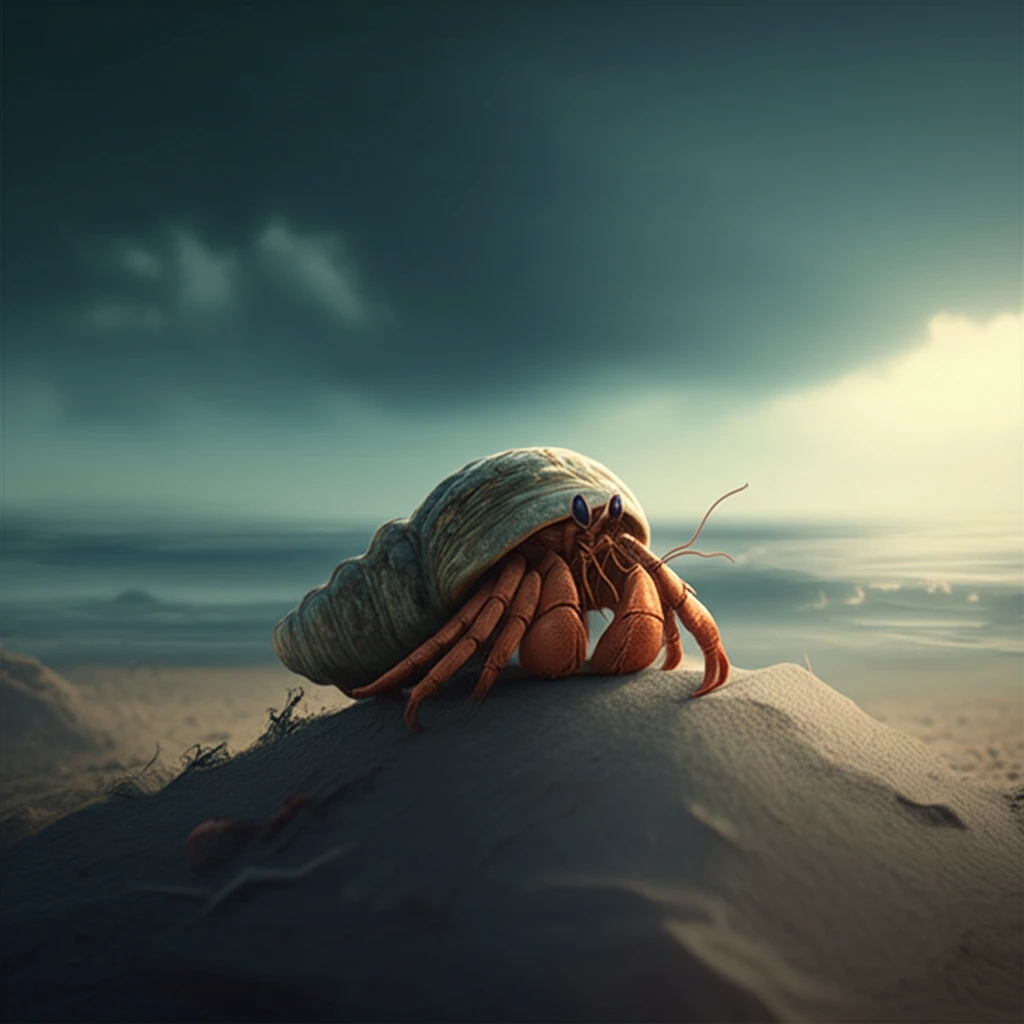
Buried Alive: How Hermit Crabs Survive Hypoxia

"The secret to hermit crabs' resilience may lie in their anaerobic abilities, challenging what we know about survival under extreme stress."
Hermit crabs, those ubiquitous inhabitants of intertidal zones across the globe, face a daily gauntlet of environmental challenges. From fluctuating salinity levels to the constant threat of predation, their survival depends on a remarkable suite of adaptations. One of the most critical of these adaptations comes into play when they are buried by sediment, a common occurrence in their dynamic coastal habitats. Understanding how these creatures cope with such events is not only fascinating but also provides valuable insights into the broader implications of environmental stress on marine life.
Burial by sediment introduces a complex set of stressors, most notably hypoxia, or oxygen deprivation. As sediment blankets their habitat, the diffusion of oxygen is dramatically reduced, forcing these crabs to rely on alternative metabolic pathways to survive. Scientists have long been intrigued by the physiological mechanisms that allow certain species to withstand these harsh conditions, and recent research is shedding light on the critical role of anaerobic respiration—a process that allows cells to generate energy without oxygen.
New research dives into the anaerobic respiration of the intertidal hermit crab, Pagurus samuelis, when buried in sediment. This study challenges the conventional wisdom regarding the limits of hypoxia tolerance and underscores the importance of understanding the nuanced strategies these animals employ to thrive in challenging environments.
Hypoxia and Hermit Crab Vitality
Research has linked hypoxia to decreased stamina in hermit crabs, undermining their ability to forage, escape predators, and maintain normal activity (Mowles et al., 2010). Studies on related crab species, such as the blue crab, show that survival under severe hypoxia can be high—nearly 100% at 1.3 mg dissolved oxygen per liter—but probability of survival decreases with longer hypoxic exposure, lower dissolved oxygen, and higher temperatures. Microplastic pollution compounds these threats by impairing shell selection behavior in hermit crabs, adding an anthropogenic stressor on top of oxygen depletion.
How Scientists Study Crab Hypoxia Responses
Under experimentally induced anoxia on sublittoral sediment, hermit crabs at mild hypoxia (2.0 to 1.0 ml l⁻¹ DO) displayed avoidance behavior, moving onto elevated, better-oxygenated substrata. They also exhibited decreased locomotory activity, increased body movements, and extension from their shells. Prior studies on hypoxia in marine benthos have focused largely on functional responses such as metabolism and gene expression, leaving potential structural damage to mitochondria or cells largely unexplored—a gap that limits understanding of the full toll hypoxia exacts.
Why Shells Define Hermit Crab Biology
Unlike true crabs, hermit crabs possess soft, vulnerable abdomens that require the protection of abandoned snail shells—a defining constraint of their biology. As they grow, they must constantly search for larger homes, making the simple act of finding a shell one of the most important events in their lives. This shell dependency shapes nearly every aspect of their behavior and ecology, including how they cope with environmental stressors like low oxygen.
Unearthing the Secrets of Survival
The study, conducted by Stephen G. Dunbar, Janelle Shives, and Danilo S. Boskovic, focused on the intertidal hermit crab Pagurus samuelis, a common species found along the California coast. The researchers subjected these crabs to varying periods of burial, mimicking natural sedimentation events. They then measured lactate levels in the crabs' hemolymph (the crustacean equivalent of blood) as an indicator of anaerobic respiration. Lactate is produced when cells break down glucose without oxygen, making it a key marker of metabolic stress.
- Lactate levels increased with burial duration, but high levels didn't always mean death.
- Crabs found alive at excavation showed varied lactate concentrations.
- Burial duration was the most significant factor affecting survival.
Hermit Crabs as Unexpected Ecological Agents
Recent research has revealed that hermit crabs perform ecological roles far beyond shell-seeking scavenging. Scientists discovered that land hermit crabs physically transport seeds across the forest floor, carrying fruits more than 5 meters from parent plants. This seed-dispersal function positions hermit crabs as underappreciated agents of forest regeneration, broadening our understanding of their ecological importance well beyond the intertidal zone.
When Hypoxia Overwhelms Crab Defenses
Pre-molt land hermit crabs spend increased time near or in water pools, since maintaining shell water is critical to respiration and molting physiology—a vulnerability that may intensify under hypoxic conditions. Research on surviving hypoxia shows that low oxygen can cause pathological events in vulnerable organs such as the kidney, liver, and brain, not just trigger protective mechanisms. These findings suggest that hypoxia tolerance has limits, and prolonged or severe oxygen deprivation can produce lasting organ damage rather than successful adaptation.
Hypoxia Across Crab Species
In Dungeness crabs (Cancer magister), three hours of hypoxic exposure significantly increased susceptibility to bacterial infection. Culturable bacteria levels in hypoxic crabs reached approximately 2,500 CFU ml⁻¹ eighty minutes post-injection, compared to about 1,000 CFU ml⁻¹ in normoxic controls. This suggests that hypoxia compromises immune function in crabs, a finding with implications for understanding how oxygen depletion affects disease dynamics across decapod crustaceans.
Implications and Future Directions
This research underscores the remarkable resilience of hermit crabs and highlights the importance of understanding the complex physiological mechanisms that allow them to thrive in challenging environments. By challenging traditional assumptions about the toxicity of lactate and emphasizing the role of factors such as glycogen stores and pre-conditioning, the study opens new avenues for research into the limits of hypoxia tolerance in marine invertebrates. Future studies are needed to fully characterize the interplay between anaerobic metabolism, glycogen utilization, and other factors in determining the survival of hermit crabs under burial stress. Further research into these adaptations can provide critical insights into how marine organisms might respond to the growing threat of habitat degradation and climate change.
What Hypoxia-Tolerant Species Teach Medicine
The study of hypoxic survival strategies in highly tolerant animals, such as the North European crucian carp and coral-reef sharks, is generating fresh ideas for treating hypoxia-related diseases in humans. These species have evolved natural hypoxic preconditioning and extreme anoxia tolerance mechanisms that may hold translational value. Understanding how whole organisms survive oxygen deprivation—beyond the organ level—could inform therapies targeting vulnerable tissues like the brain.
Open Questions in Crab Hypoxia Research
Many questions remain about how hermit crabs specifically cope with chronic and acute hypoxia, particularly regarding cellular-level damage that current functional studies have not fully addressed. Advances in point-of-care hemolymph analysis and molecular tools may enable researchers to track individual crab responses in real time. As coastal dead zones expand worldwide, understanding the physiological breaking points of ecologically important crustaceans will become increasingly urgent.
Ecological Partnerships and Coastal Stress
In Japan, sea anemones and hermit crabs form mutualistic relationships in which the anemones secrete a shell-like structure called carcinoecium onto the crab's existing gastropod shell, reinforcing and enlarging it. Such partnerships illustrate how hermit crab survival strategies extend beyond individual physiology to ecological cooperation. Meanwhile, related crab species like blue crabs prove more tolerant of low oxygen than previously thought, though cascading impacts—from salt marsh degradation by burrowing crabs to expanding hypoxic zones—pose systemic threats to coastal ecosystems.
Hermit Crabs as Ecological Partners to Plants
A Kobe University study documented land hermit crabs feeding on the fruits of a parasitic plant, with some seeds surviving passage through the digestive tract and others attaching externally to the crabs' bodies. This makes hermit crabs both external and internal seed dispersers for the plant, a previously unrecognized ecological service. Such findings highlight how human understanding of hermit crab biology continues to expand, revealing species interactions that conservation efforts may need to account for.