
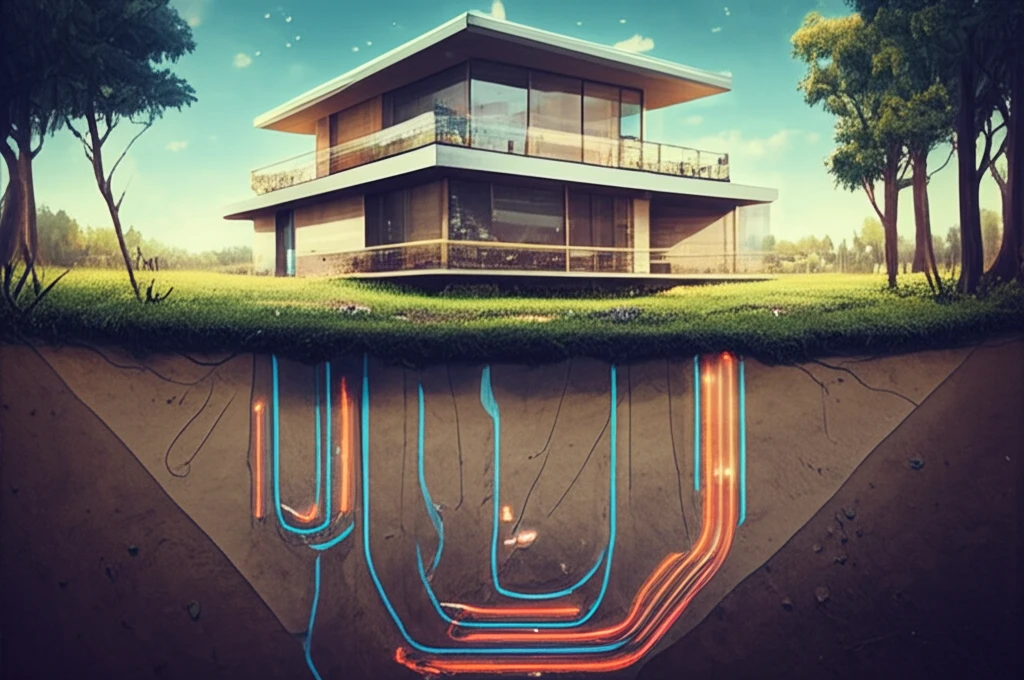
Breathe Easy: How Earth-Air Heat Exchangers Can Cool (and Heat!) Your Home Sustainably

"Discover how Earth-Air Heat Exchangers offer a natural and efficient way to regulate indoor temperatures, reducing energy bills and promoting a greener lifestyle."
Imagine a world where your home stays cool in the summer and warm in the winter, all thanks to the steady, consistent temperature of the earth beneath your feet. This isn't science fiction; it's the reality offered by Earth-Air Heat Exchangers (EAHEs), also known as geothermal or earth tube systems. With growing awareness of the environmental impact of traditional air conditioning and heating, homeowners and builders alike are seeking sustainable alternatives. EAHEs present a compelling solution, tapping into the earth's thermal energy to naturally regulate indoor temperatures.
Traditional air conditioning systems consume significant amounts of electricity, contributing to greenhouse gas emissions and straining energy grids. In many developed countries, a substantial portion of daily energy consumption goes towards powering these systems. Earth-Air Heat Exchangers offer a promising way to slash this energy consumption by leveraging the earth as a natural heat sink and source. These systems work by circulating air through buried underground ducts, utilizing the soil's stable temperature to pre-heat or pre-cool the air before it enters your home.
While the concept of EAHEs has been around for a while, it hasn't yet achieved widespread adoption globally. In places like Brazil, where hydroelectric power has been the dominant source of energy, there’s a growing need to diversify energy sources and explore more sustainable options. Concerns about the environmental impact of hydroelectric dams and the vulnerability of these systems to droughts are driving interest in alternatives like EAHEs. Keep reading to discover how this system works, what to consider when contemplating the switch and how the system is implemented.
Proven Cooling and Heating Performance
Earth-air heat exchangers (EAHXs) demonstrate measurable energy savings and temperature regulation in real-world applications. A holistic review of EAHX applications found that these systems can provide up to 86% of a building's cooling load, validated against measured field values. A recent field study by Natural Resources Canada showed that earth tubes can warm winter air by as much as 14.3°C and cool summer air by approximately 6.8°C. Additionally, a 2025 study of large-diameter EAHX systems reported peak cooling capacity of 28 kW (330 kWh/day), requiring only 50 kWh/day of fan electricity consumption.
Design Principles and System Types
Earth-air heat exchangers come in two primary configurations: open-loop and closed-loop systems, both relying on natural thermal exchange principles. Cooling performance depends on multiple design parameters, including air flow rate, pipe length, and pipe diameter, as documented in comprehensive reviews of EAHX systems. Bordoloi's intensive review found that EAHXs can significantly reduce building energy consumption and are often used in conjunction with other HVAC systems rather than as standalone solutions. The design process requires careful attention to guidelines and cooling load calculations to optimize system performance.
Geothermal Foundations of Earth Tubes
Ground-coupled heat exchangers represent one of the earliest applications of geothermal energy for building climate control. According to Wikipedia's article on ground-coupled heat exchangers, these underground systems capture heat from and dissipate heat to the ground by exploiting the Earth's near-constant subsurface temperatures. The principle of channeling outdoor air through buried pipes before it enters a building has been employed as a sustainable passive ventilation strategy. This geothermal approach forms the conceptual basis for modern earth-air heat exchanger technology.
How Do Earth-Air Heat Exchangers Work?
Earth-Air Heat Exchangers (EAHEs) utilize a simple yet ingenious principle: the earth maintains a relatively constant temperature below a certain depth. This temperature is typically cooler than the air in summer and warmer than the air in winter. An EAHE system consists of one or more underground pipes or ducts buried at a specific depth. Air is drawn into these pipes, travels through the soil, and exchanges heat with the surrounding earth. In summer, the earth absorbs heat from the air, cooling it down. In winter, the earth warms the air, providing pre-heated air for your home's heating system.
- Duct Material and Design: The material used for the underground ducts plays a crucial role in heat transfer. Materials with high thermal conductivity, such as certain plastics, facilitate efficient heat exchange. The length and diameter of the ducts also influence performance; longer ducts allow for more heat exchange, while the diameter affects airflow.
- Soil Properties: The type of soil surrounding the ducts significantly impacts the system's effectiveness. Soil thermal properties, such as thermal conductivity and heat capacity, determine how well the soil absorbs and releases heat. Moisture content in the soil also plays a vital role, as water enhances thermal conductivity.
- Climate: EAHEs are most effective in regions with distinct seasonal temperature variations. In areas with hot summers and cold winters, the system can provide substantial heating and cooling benefits. However, the specific design and installation must be tailored to the local climate conditions to optimize performance.
- Depth and Layout: EAHE systems are most effective and work best when the earth's natural and consistent temperatures are taken advantage of, this is done by placing the system at a certain depth. The layout should also ensure efficient airflow and heat exchange.
Comprehensive Reviews and Indoor Air Quality Benefits
Recent comprehensive reviews have examined the foundational principles of EAHX operation, including heat and mass transfer phenomena at the ground-air interface. A 2025 preprint review found that EAHX systems can substantially improve indoor air quality, attributed to increased ventilation rates and reduced reliance on mechanical conditioning. Koshlak's 2025 comprehensive review delves into these foundational principles, providing a systematic analysis of performance across diverse applications. Research findings consistently indicate that EAHXs offer meaningful benefits, though researchers caution that they are not a complete climate control solution on their own.
Performance Variability Across Climates
A 2025 Nature study on integrated earth-air heat exchanger systems found that climate conditions significantly affect EAHX performance. According to the study's findings, the EAHE system saves 1.8 times as much energy in difficult climates as it does in gentler ones, suggesting that system effectiveness is highly location-dependent. This variability means that EAHX installations in mild climates may yield more modest returns compared to those in extreme temperature zones. Cost-benefit analyses must therefore account for regional climate characteristics when evaluating EAHX investments.
Ground-Source Heat Pumps as an Alternative
When comparing earth-contact heating and cooling systems, ground-source heat pump (GSHP) systems with horizontal ground heat exchangers have emerged as a beneficial alternative for space conditioning. A 2024 review found that GSHP systems offer lower cost and higher efficiency compared to other earth-contact approaches for both heating and cooling applications. This suggests that while EAHXs provide passive, low-mechanism cooling and heating, GSHP systems may deliver superior performance in certain contexts. The choice between these technologies depends on site conditions, budget, and whether passive or active conditioning is preferred.
EAHE: A Cool Choice for a Sustainable Future
Earth-Air Heat Exchangers offer a compelling pathway towards sustainable home cooling and heating. By harnessing the earth’s natural thermal energy, these systems reduce reliance on traditional energy-intensive methods, lowering your carbon footprint and saving you money on energy bills. While factors like soil composition and climate play a crucial role in system performance, careful planning and design can unlock the full potential of EAHEs. As the world increasingly embraces sustainable solutions, Earth-Air Heat Exchangers stand out as a promising technology for creating more comfortable, energy-efficient homes.
Balancing Promise and Practicality
Earth-air heat exchangers represent a promising but not universally optimal approach to sustainable building climate control. The technology offers proven benefits in energy reduction and temperature regulation, yet its effectiveness varies by climate, design, and installation quality. Experts generally recommend EAHXs as part of an integrated building strategy rather than a standalone solution. As with any passive system, realistic expectations about performance outcomes are essential for successful adoption.
Evolving Design and Optimization
Ongoing research continues to refine EAHX design parameters, including pipe configurations, burial depths, and air flow optimization. Integration with smart building systems and renewable energy sources may enhance EAHX performance in coming years. As construction standards evolve toward net-zero energy targets, earth-air heat exchangers are likely to see increased adoption and innovation. Further field studies across diverse climate zones will help establish more reliable performance benchmarks.
Scaling Sustainable Building Solutions
Widespread adoption of earth-air heat exchangers faces challenges including upfront installation costs, space requirements for pipe networks, and the need for specialized design expertise. Building codes and standards may not yet fully accommodate EAHX systems, creating regulatory barriers in some regions. The technology's passive nature, while a strength in terms of operational simplicity, also means it may not meet peak demand without supplementary systems. Addressing these systemic challenges will be critical for scaling EAHX technology from niche applications to mainstream building practice.
User Experience and Building Occupant Benefits
For building occupants, earth-air heat exchangers offer the advantage of improved indoor air quality through increased fresh air ventilation without the energy penalty of conventional systems. The passive nature of EAHXs means lower operational costs and reduced maintenance compared to mechanical cooling and heating systems. However, users should understand that EAHXs moderate rather than eliminate temperature extremes, providing comfort benefits within realistic limits. Successful implementation depends on proper system sizing, installation quality, and occupant expectations about performance.