
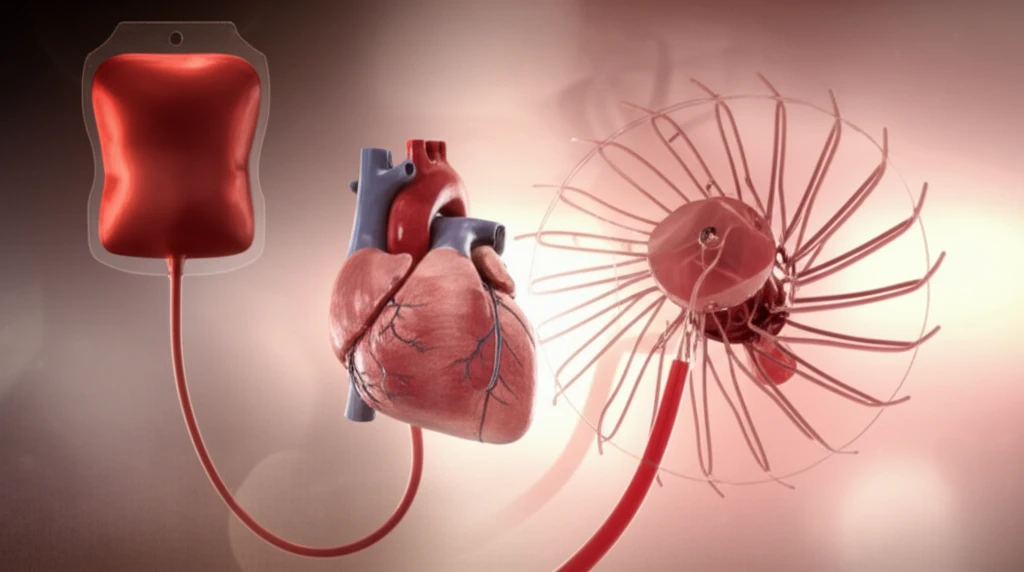
Blood Transfusions After TAVI: Are They Putting Your Heart at Risk?

"Unraveling the Link Between Blood Transfusions and Long-Term Mortality in Patients Undergoing Transcatheter Aortic Valve Implantation"
Transcatheter Aortic Valve Implantation (TAVI) has revolutionized the treatment of severe aortic stenosis, offering a less invasive option for many. Yet, as with any medical procedure, understanding the potential risks and complications is paramount. Recent research has shed light on a critical factor impacting patient outcomes: blood transfusions. This article explores the findings, providing a comprehensive overview of the relationship between blood transfusions and long-term mortality following TAVI.
The study, published in the International Heart Journal, investigated the association between blood transfusions and 12-month mortality in patients who underwent TAVI. The results reveal a significant link between the need for blood transfusions during or after the procedure and an increased risk of adverse outcomes. This information is crucial for both patients considering TAVI and healthcare providers striving to optimize patient care.
This article aims to break down the complex findings of the study, providing clear, actionable insights. We'll explore the impact of blood transfusions on patient outcomes, discuss the implications for clinical practice, and offer a better understanding of how these insights can improve the lives of those undergoing TAVI.
TAVI Growth and Transfusion Burden
Transcatheter aortic valve implantation (TAVI) has become a widely adopted procedure for patients with severe aortic stenosis, with growing patient volumes across centers worldwide. Bleeding requiring packed red cell transfusion remains a frequent complication during and after TAVI, particularly when performed through a transapical approach. Studies aim to determine whether red blood cell transfusion is a marker of patient fragility or an independent predictor of adverse outcomes. The clinical and resource implications of post-TAVI transfusion have prompted quality improvement initiatives at multiple institutions.
Vascular Complications and Access-Specific Risks
TAVI procedures carry inherent vascular and bleeding risks that vary by access method and procedural manipulation. The transapical approach has been associated with higher bleeding rates and worse prognosis compared with transfemoral access. Retrospective analyses of patients spanning 2008 to 2023 have documented the range of vascular complications encountered in clinical practice. Understanding these access-specific limitations is essential for refining patient selection and procedural planning.
From Concept to Clinical Reality
The history of TAVI traces back to visionary pioneers who developed the concept and prototype valves during a preclinical phase marked by significant skepticism. The first human TAVI procedure was performed in 2002, marking a watershed moment in interventional cardiology. The Netherlands emerged as an early adopter of the technology beginning in 2005, helping to establish its clinical and scientific credibility. The broader history of transfusion medicine, from early animal-to-human transfusions through the discovery of blood groups, provided the foundational knowledge that supports modern periprocedural blood management in TAVI.
The Study: Unveiling the Risks of Blood Transfusions After TAVI
The research, conducted on a cohort of 101 patients with severe aortic stenosis, focused on the outcomes following TAVI. Patients were carefully monitored, and data was collected on various factors, including the need for blood transfusions, complications, and mortality rates. The study's methodology involved a detailed analysis of patient characteristics, procedural details, and follow-up outcomes.
- Increased Mortality: The study revealed that patients who received blood transfusions had a significantly higher 12-month all-cause mortality rate compared to those who did not.
- Predictive Factor: Blood transfusion was identified as an independent predictor of increased mortality, even after adjusting for other factors.
- Prolonged Hospital Stay: Patients requiring transfusions also experienced longer hospital stays, indicating a more complex recovery process.
Evolving Evidence Base
Research on blood transfusion after TAVI continues to evolve, with multicenter registries and retrospective analyses seeking to clarify the relationship between transfusion and patient outcomes. The field is actively investigating optimal transfusion thresholds and strategies tailored to TAVI patients. However, much of the evidence remains observational, and definitive randomized data are limited. Ongoing studies are expected to provide stronger guidance on periprocedural blood management in the coming years.
Unresolved Questions and Limitations
Despite growing recognition that transfusion after TAVI is associated with worse outcomes, it remains debated whether transfusion itself causes harm or simply reflects the underlying severity of patient illness. Some analyses suggest that bleeding events, rather than transfusion per se, may be the primary driver of mortality. The lack of randomized controlled trials specifically addressing transfusion strategy in TAVI limits the strength of current recommendations. Additionally, institutional practices around cross-matching and transfusion thresholds vary widely, complicating cross-study comparisons.
TAVI Versus Alternative Valve Replacement Strategies
TAVI has demonstrated favorable clinical and hemodynamic results compared with surgical aortic valve replacement in intermediate- and high-risk patients, and its use is expanding to lower-risk populations. Sutureless and rapid-deployment aortic valves represent an alternative surgical approach, though direct comparisons with TAVI remain limited. Risks associated with the transfusion of various blood products have been documented in aortic valve replacement broadly, underscoring the importance of blood management across all approaches. More data are needed to identify optimal patient characteristics for each strategy and to balance their respective benefits and risks.
Moving Forward: Implications and Future Directions
The study's findings offer valuable insights for patients and healthcare professionals. For patients, understanding the risks associated with blood transfusions can help inform decision-making and promote a proactive approach to recovery. For healthcare providers, the research highlights the importance of careful patient selection, meticulous procedural techniques, and effective management of bleeding complications. Further research is needed to explore strategies for minimizing the need for blood transfusions and improving outcomes for patients undergoing TAVI. These could include exploring alternative antiplatelet regimens or refining techniques to reduce bleeding risks. With continued research and a focus on patient-centered care, we can strive to improve the lives of those affected by aortic stenosis.
Transfusion as a Risk Signal
Increasing evidence suggests a negative influence of blood transfusion on outcomes in patients with cardiovascular diseases, including those undergoing TAVI. Research has sought to evaluate the relationship between post-TAVI blood transfusion and mid-term outcomes to improve patient selection and periprocedural treatment. Quality improvement initiatives have focused on measuring transfusion rates, the number of units transfused, and the safety implications of revised cross-matching protocols. These efforts reflect a growing consensus that transfusion after TAVI should prompt careful reassessment of procedural and post-procedural care.
TAVI's Trajectory and Long-Term Outcomes
Temporal analyses from high-volume centers tracking patients from 2013 through 2025 are shedding light on evolving patient characteristics and long-term mortality trends following TAVI. Current narrative reviews emphasize the need to focus on prosthesis durability, valve-in-valve procedures, and lifetime management strategies beginning with the first implanted valve. International discussions are centering on how guidelines vary across countries and what the future landscape of TAVI may look like as it extends into lower-risk populations. A study published in the International Heart Journal has specifically investigated the association between blood transfusion and 12-month mortality in TAVI patients, reinforcing the clinical importance of this issue.
System-Level Considerations
The growing demand for TAVI procedures places increasing strain on healthcare systems, including blood bank resources and transfusion infrastructure. Standardizing cross-matching protocols and transfusion thresholds across institutions remains a challenge, as practices vary significantly between centers. Training requirements for achieving competency in TAVI are substantial, with some analyses suggesting that up to 190 cases may be needed to achieve clinical results comparable to those in randomized trials. These systemic factors shape the real-world effectiveness of blood management strategies in TAVI programs.
Real-World Outcomes and the Experience Curve
Real-world performance evaluations of TAVI have highlighted that achieving optimal clinical outcomes requires substantial institutional experience, with quality-control analyses suggesting approximately 190 procedures may be needed to match trial results. Studies exploring sex-based differences in the impact of red blood cell transfusion after TAVI are adding nuance to understanding how patient characteristics influence risk. Research on hemoglobin drop and bleeding complications continues to refine which patients are most vulnerable to transfusion-related adverse events. These findings underscore the importance of center volume, operator experience, and individualized patient assessment in optimizing TAVI outcomes.