
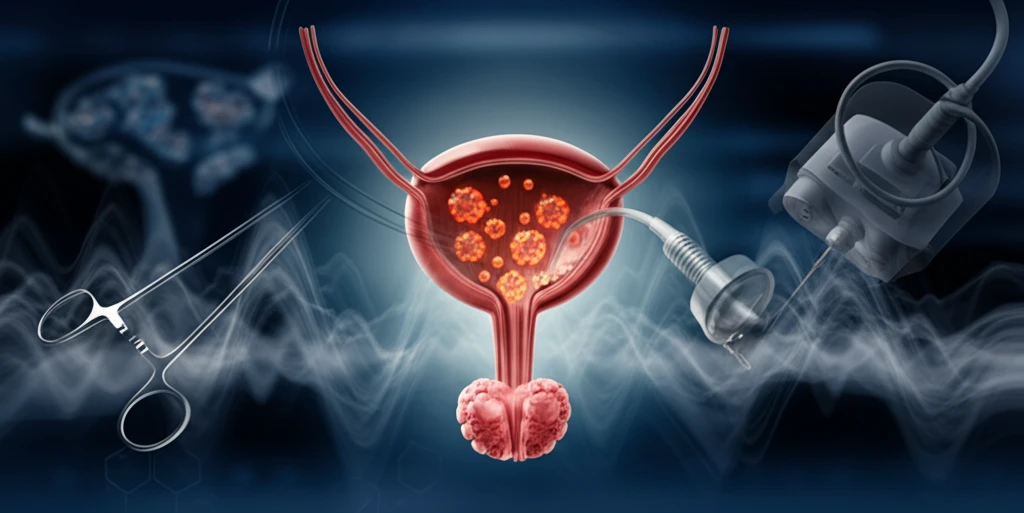
Bladder Cancer Breakthrough: New Ultrasound Tech and Surgical Advances

"Revolutionizing Diagnosis and Treatment: How cutting-edge ultrasound and surgical techniques are changing the landscape of bladder cancer care, offering hope for better outcomes."
Bladder cancer remains a significant health challenge, demanding continuous innovation in diagnostic and therapeutic approaches. Traditional methods often fall short in accurately staging the disease and ensuring complete tumor removal, leading to potential recurrence and poorer patient outcomes. However, recent research is paving the way for more precise and effective interventions, offering new hope for individuals affected by this condition.
This article delves into two promising advancements presented at a recent urology conference: the use of transurethral endoscopic ultrasound (TUEUS) for improved tumor staging and a novel en bloc transurethral resection technique employing a hybrid knife for primary non-muscle-invasive bladder cancer (NMIBC). These innovations represent significant strides toward personalized and less invasive bladder cancer management.
The information presented here aims to provide insights into these cutting-edge techniques, their potential benefits, and how they may shape the future of bladder cancer care. While always consult with healthcare provider for medical advice, you should use this information to be informed about your medical health, discuss potential treatment options with your medical provider.
A Devastating Diagnosis Made More Treatable
Receiving a bladder cancer diagnosis can be utterly devastating, according to physicians who treat the disease. Surgery, alone or in combination with other treatments, is used to treat most bladder cancers, which makes surgical advances central to patient care.
Stage-Driven Treatment and the Role of Imaging
Treatment options for bladder cancer depend on the stage of the cancer and other factors, and they can include surgery, alone or with other treatments. An ultrasound examination of the bladder can detect bladder tumors, making imaging a valuable step in evaluating the disease.
Classifying the Disease by Tissue and Type
Several types of bladder cancer affect different tissues in the bladder, which means patients may experience different symptoms and need different treatments depending on the type and stage. Understanding these distinctions is foundational to how clinicians diagnose and treat the disease.
Enhanced Staging with Transurethral Endoscopic Ultrasound (TUEUS)
Accurate staging is crucial for determining the most appropriate treatment strategy for bladder cancer. Traditional staging methods, such as CT scans and cystoscopy, may have limitations in assessing the depth of tumor invasion. Transurethral endoscopic ultrasound (TUEUS) emerges as a valuable tool to overcome these challenges, offering a more detailed and precise evaluation of the bladder wall.
- High Sensitivity and Specificity: TUEUS demonstrated 100% sensitivity and 97% specificity in distinguishing between MIBC and NMIBC.
- Excellent Negative Predictive Value: The negative predictive value of TUEUS was 100%, indicating its reliability in identifying patients without muscle invasion.
- Safe and Well-Tolerated: The study reported no adverse events associated with the use of TUEUS.
MRI and Ultrasound Join Forces in Urologic Imaging
Advanced MRI techniques now help find many bladder problems, giving a full view of bladder health by spotting both cancerous and non-cancerous issues. For related urologic conditions, MRI-guided transurethral ultrasound ablation uses real-time MRI thermometry to visualize treatment areas and boundaries during treatment.
Diagnosis Pitfalls and Limits of Emerging Tech
Treatments for bladder infection are very different from treatments for bladder cancer, so getting the correct diagnosis early is essential to ensure the right treatment for cancer while it is still early. The transurethral ultrasound ablation (TULSA) technology highlighted in the sources is currently described only for prostate cancer and an enlarged prostate, which shows that some advanced ultrasound techniques have not yet been established for bladder tumors.
Imaging Tools Versus Surgical Precision
Ultrasound examination of the bladder can detect bladder tumors, while advanced MRI offers a fuller view of bladder health by identifying both cancerous and non-cancerous issues. In the operating room, robotic surgery has been highlighted as a life-saving approach when a cancerous bladder tumor requires surgery. These complementary imaging and surgical tools work together in diagnosing and treating the disease.
The Future of Bladder Cancer Management
The advancements in bladder cancer care presented here—TUEUS for enhanced staging and hybrid knife resection for safer tumor removal—offer a glimpse into a future of more precise, less invasive, and personalized treatment strategies. As research continues and these techniques are refined, patients with bladder cancer can look forward to improved outcomes and a better quality of life. The move towards technologies can further improve health and minimize the amount of medical visits. Remember to always seek the advise of a healthcare provider for the best treatment suited for your health needs.
Why Surgical Advances Matter Most
Because surgery, alone or with other treatments, is used to treat most bladder cancers, advances that improve surgical precision have a meaningful impact on patient outcomes. Expert sources describe robotic surgery as a life-saving technique for patients whose bladder tumors require surgical removal.
Imaging-Guided Ablation Points Ahead
Transurethral ultrasound ablation (TULSA) is described as a breakthrough, nonsurgical procedure that treats prostate cancer and an enlarged prostate, using real-time MRI thermometry to visualize treatment areas and boundaries. This pairing of ultrasound energy with MRI guidance illustrates how imaging-directed ablation is expanding across urology and may point toward future directions for bladder cancer care.
The Stakes of Early, Accurate Diagnosis
Because bladder cancer and bladder infection can present with overlapping symptoms but require very different treatments, an accurate early diagnosis is essential. With several types of bladder cancer affecting different tissues, proper classification guides which symptoms to monitor and which treatment approach to follow.
The People Behind the Diagnosis
Physicians describe receiving a bladder cancer diagnosis as utterly devastating, and the emotional toll on patients is considerable. This human impact underscores why earlier detection and advances in surgical care matter so much to the people facing this disease.