
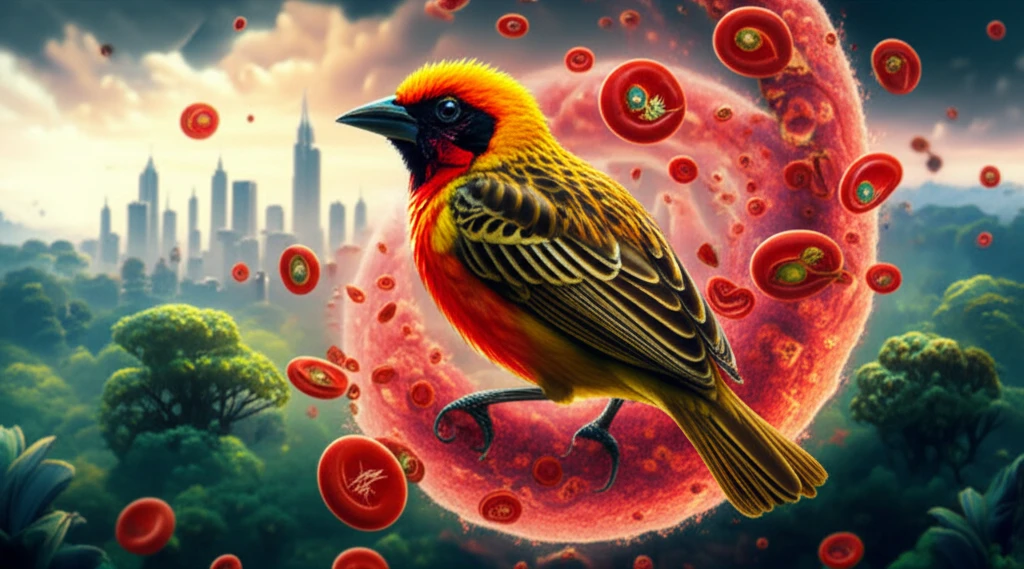
Bird Blood Parasites: The Silent Threat in Urban Birds

"New study reveals a surprisingly high prevalence of blood parasites in village weavers, raising concerns about urban bird health and potential risks to other animals and humans."
Birds, often admired for their beauty and song, play a crucial role in our ecosystems. But like all living creatures, they are susceptible to parasites. Among these, blood parasites, or hemoparasites, are a particularly concerning group. These tiny organisms can infect birds, potentially impacting their health and even affecting the delicate balance of local ecosystems.
A recent study conducted in Dschang, a city in western Cameroon, has shed light on the prevalence of these hemoparasites in village weavers (Ploceus cucullatus), a common urban bird species. The findings reveal a surprisingly high infection rate, raising questions about the health of urban bird populations and the potential risks these parasites may pose.
This article explores the key findings of this study, diving into the types of parasites discovered, the potential factors influencing their spread, and the broader implications for bird conservation and public health. Understanding these tiny threats is crucial for protecting both avian life and our own well-being.
Current Statistics & Impact
Urban bird populations face growing exposure to blood parasites, though comprehensive global prevalence data remain limited. Studies suggest infection rates vary widely across species and regions, with some urban areas showing elevated transmission due to vector abundance. The true population-level impact on bird health and survival is still being quantified.
Standard Approach, Accepted Methods & Their Limitations
Researchers traditionally rely on microscopy and PCR-based screening to detect hemoparasites in wild birds. These methods can miss low-level infections and often cannot distinguish between active disease and asymptomatic carriage. Standardized protocols across studies remain inconsistent, complicating meta-analyses.
Historical Perspective, Milestones, Foundational Discoveries
Systematic reviews have established that blood-borne parasites — particularly Plasmodium, Haemoproteus, Leucocytozoon, and Trypanosoma — are globally distributed in wild birds, with filarial worms reported less frequently. Despite decades of study, the impact of these parasites on host health remains poorly understood. Environmental change and emerging diseases continue to reshape host-parasite dynamics, underscoring the need for foundational ecological research.
What are Hemoparasites and Why Should We Care?
Hemoparasites are parasites that live in the blood of their hosts. In birds, these parasites can include protozoa like Plasmodium (the same group that causes malaria in humans), Haemoproteus, Leucocytozoon, and Trypanosoma. These parasites are typically transmitted by biting insects like mosquitoes, midges, and blackflies.
- Anemia (reduced red blood cell count)
- Weakness and lethargy
- Weight loss
- Reduced reproductive success
- Increased susceptibility to other diseases
Latest Research and Reviews
Recent systematic reviews emphasize that molecular tools have significantly advanced understanding of parasite diversity and host-parasite dynamics in wild birds. These studies identify persistent knowledge gaps regarding the ecological role of hemoparasites, particularly under environmental change. Researchers stress the urgent need for further investigation into emerging infectious disease risks.
Counter Arguments and Failures
Some researchers argue that many hemoparasite infections in wild birds are asymptomatic and may not significantly affect fitness. Others note that correlational studies often fail to establish causation between infection and population declines. Methodological inconsistencies across studies have also hindered definitive conclusions.
Comparative Analysis
The 2025 systematic review published in Animals provides a comprehensive synthesis of hemoparasite ecology and clinical implications across wild bird species globally. It serves as a key reference point for comparing regional prevalence patterns and identifying taxonomic biases in research coverage.
Protecting Our Feathered Friends: What Can Be Done?
The study in Dschang underscores the importance of monitoring hemoparasite prevalence in urban bird populations. Further research is needed to fully understand the factors driving infection rates and the potential consequences for bird health and ecosystem stability. By understanding these threats, we can take proactive steps to protect our feathered friends and ensure the health of our shared environment.
Synthesis & Expert Commentary
A systematic review consolidates all scientific findings on hemoparasites in wild birds, emphasizing their implications for host health. The first global reference on haemosporidian prevalence highlights the need for standardized surveillance methods. A four-year nocturnal bird survey found 35.1% overall hemoparasite occurrence, dominated by Leucocytozoon (32.1%) and Haemoproteus (11.2%). Comparative work shows Plasmodium lineages are more generalist while Haemoproteus and Leucocytozoon tend to be specialist parasites.
Future Outlook & Next Frontiers
Future research must prioritize longitudinal studies linking parasite dynamics to urbanization gradients. Integrating genomics with ecological modeling could clarify how vector shifts drive emerging infections. Standardized global monitoring frameworks are needed to detect range expansions in real time.
Broader Context & Systemic Challenges
Blood parasites in urban birds reflect broader ecosystem disruption from habitat fragmentation, pollution, and climate change. These stressors may alter vector communities and host immunity in ways that favor parasite transmission. Addressing the threat requires cross-disciplinary approaches spanning veterinary science, urban ecology, and public health.
The Human Element & Real-World Impact
Urban residents encounter infected birds daily, yet public awareness of avian blood parasites remains low. Citizen science initiatives could expand surveillance while fostering stewardship. Understanding these silent threats helps gauge ecosystem health in cities where humans and wildlife increasingly overlap.