
Beyond Touch: How Multi-Touch Interfaces Are Reshaping Our Digital World

"Explore the evolution of multi-touch screen technology and its impact on user experience, from smartphones to interactive displays."
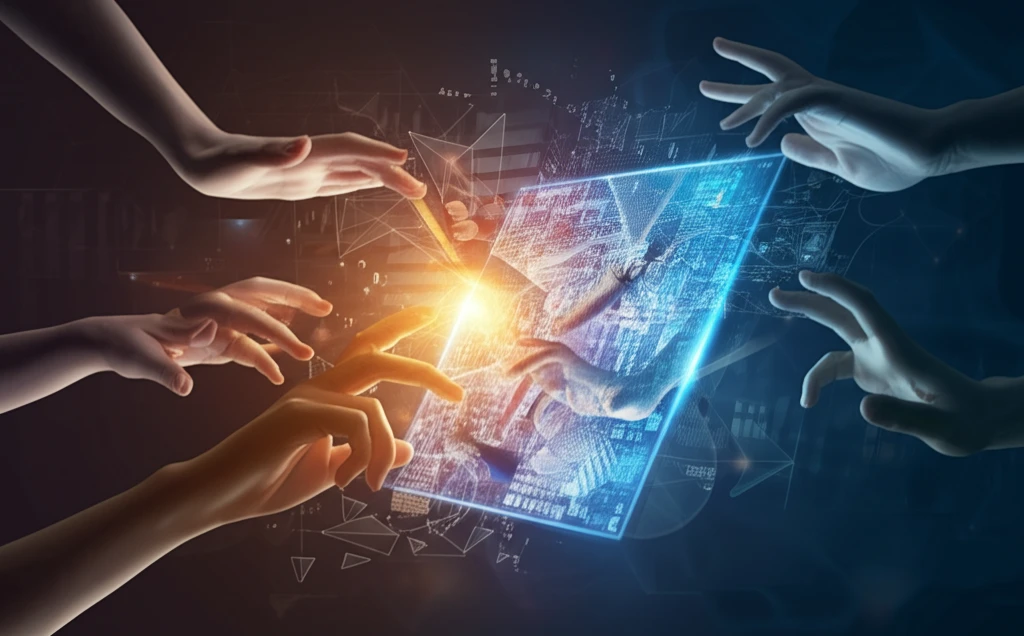
The way we interact with computers is undergoing a profound transformation. Gone are the days when our interaction was limited to a mouse and keyboard, as modern technology promises a more seamless and instinctive experience. Multi-touch interfaces are at the forefront of this revolution, poised to become the primary means through which we engage with digital devices.
The growth of touch screen hardware and applications signals a significant shift in user expectations and technological capabilities. This evolution demands innovative methods for detecting user inputs, moving beyond traditional clicks and scrolls to embrace on-screen gestures.
This article delves into the core of multi-touch screen interfaces, focusing on the gestures that define them, the methods employed to detect these gestures, and how these interactions are translated into actions within various applications. Understanding these elements is crucial for anyone seeking to grasp the future of human-computer interaction.
Defining Multi-Touch and Its Reach
In computing, multi-touch is technology that enables a surface to recognize the presence of more than one point of contact at the same time, with origins traced to CERN, MIT, the University of Toronto, Carnegie Mellon University, and Bell Labs in the 1970s. In everyday use, it involves one or more fingers on a screen or touchpad performing special gestures that manipulate lists or objects without a mouse, buttons, scroll wheels, or keys. The term also carries an analytics meaning: one help resource describes multi-touch as a data analysis tool that reports unlimited touchpoints for each attributed activity, such as installs or reattributions. Beyond devices and analytics, multi-touch systems have been used to sonify real-time weather data, turning surface temperature readings into audio through a tangible, multi-touch interface.
Gestures as the Standard Method
The standard approach treats multi-touch as a multi-finger, multiuser interface: users can sort and rearrange pictures or documents using proper zoom in/out options, done simply by dragging the picture with their fingertips. The accepted interaction model is gestural, as multitouch interfaces allow multiple spatial transformations - translating, rotating, and scaling digital objects - within a single interaction. The technical method itself has been described as high-resolution, low-cost, and very scalable, the qualities that made the approach viable. The main limitation is sensory: because touch interfaces cannot perfectly recreate physical feedback, acknowledging those constraints opens opportunities for more thoughtful interaction design, with successful products embracing unique digital capabilities while compensating for sensory limits.
From Single-Touch Roots to TED2006
One of the first and most significant inventions relative to the creation of multi-touch technology was the development of a touch screen able to recognize a single touch. Later milestones include the University of Toronto group, featuring Bill Buxton, which built a multi-touch tablet using capacitance rather than bulky camera-based optical sensing, with 1985 marking its use for point-of-sale systems. By 2006, before the earliest filing date on Apple's multi-touch patent applications, Jeff Han of NYU's Media Research Lab demonstrated a multi-touch computer interface at the Adobe-sponsored TED2006. The resulting technology allows a user to control a device through the simultaneous use of multiple fingers or touch points, enabling gestures such as pinching, swiping, and tapping.
The Foundations of Multi-Touch Technology
Multi-Touch technology relies on sophisticated methods to interpret simultaneous inputs from multiple fingers. Unlike traditional single-input systems, multi-touch interfaces can process a multitude of concurrent events, limited only by the hardware's capabilities. This capability not only enhances responsiveness but also opens doors to more complex and intuitive interactions.
- FTIR (Frustrated Total Internal Reflection) is a widely used multi-touch implementation.
- It relies on trapping infrared light within a transparent medium.
- Touch disrupts the internal reflection, which an IR camera detects.
- This allows precise identification of touch points on the surface.
Cheaper Hardware, Persistent Software Gaps
Recent work has focused on making the technology better and cheaper, including a new pressure-sensitive pad reported to improve both large and small touch screens. Jeff Han's TED talk similarly showcased a cheap, scalable multi-touch and pressure-sensitive computer screen interface that he suggested may spell the end of point-and-click. Research reviews note a persistent gap: extensive work on multi-point and tangible hardware has not been replicated in common standard graphics libraries, prompting proposed solutions for integrating multi-touch interaction into ordinary graphical applications. Design challenges also remain, with one paper exploring the limitations of current multitouch screens, particularly in representing 3D interactions.
Hype, Niche Demos, and Unkept Promises
Press coverage of the technology has not always held up to scrutiny: one BusinessWeek article drew objections for not limiting its 'multi-touch' accolades to the screen itself, with the author dismissing the criticism as 'splitting hairs' and the coverage called sloppy journalism. High-profile demonstrations could also emphasize spectacle over adoption, as when a multi-touch table brought the interface from the James Bond film Quantum of Solace to life at a British Film Institute event in London. The difficulty of translating design criticism into action is itself acknowledged in academia, where a module on user interface cultures notes that critical perspectives on the failure of design are mirrored by troubles making ethnographic insights actionable. Even on mature platforms, multi-touch support can feel incomplete, as third-party apps exist to add and customize more multitouch gestures on macOS trackpads and Magic Mouse devices.
Benchmarking Against Traditional Interfaces
Head-to-head comparisons show the technology's advantages in specific tasks: preliminary usability tests of a proposed multitouch interface for audio mixing, which emphasizes spatial mixing with 3D positional controls, indicated faster performance than traditional mixers. Designers have also compared interaction patterns, building a first multi-touch tagging interaction using a two-point concept as an alternative to the standard interface's pop-up window and as a simple way to employ two-touch input to control two interface elements at once. General-purpose comparison platforms now let users evaluate devices side by side with detailed specifications across categories. For validation, online testing tools allow users to check whether any touchscreen device can sense multiple points of contact at the same time.
The Future is at our Fingertips
Multi-touch interfaces are more than just a technological advancement; they represent a fundamental shift in how we interact with digital content. They offer the strength and potential to dynamically alter how we engage with data and applications, resulting in more dynamic interactions around content. As technology evolves, multi-touch interfaces will likely become even more pervasive, shaping our experiences across various devices and platforms. Embracing these interfaces will be key to unlocking new possibilities and enhancing user engagement in the digital age.
A Versatile Force for Organizational Change
A case study analyzing multitouch devices verified their importance in society, concluding that while there are a few disadvantages, the devices remain useful. The same analysis highlights the capability of multitouch to transform organizations and how businesses are operated. Expert commentary also points forward: the Cubtile is described as the first multi-faces and multi-touch tactile device, sized for bi-manual interaction, positioning 3D multitouch as the next expression of the technology.
Multi-Touch Meets Augmented Reality
Market analysis of the Germany multi-touch screen monitor market identifies future opportunities in integrating multi-touch interfaces with augmented reality (AR) and heads-up displays (HUDs). The report reports that these integrations would enhance driver experience and safety, framing such developments as the sector's future outlook and emerging trends. As the source's analysis covers, this points to multi-touch expanding beyond the desktop and handheld screen into ambient and in-vehicle environments.
From EMI Interference to Attribution Blind Spots
Reliability remains a systemic hardware challenge: phantom touches caused by EMI interference complicate touch interfaces, and one display maker's approach is rooted in the understanding that a display is a system within a system, requiring practical electromagnetic compatibility expertise. On the software side, touch driver software such as UPDD supports multiple touch interfaces across Windows, macOS, Linux, and Android, with touch functionality usable at the native operating system level or at the application level. In the separate analytics domain that shares the name, multi-touch attribution models can leave calls effectively invisible - vanishing into what one analysis calls the 'Attribution Black Hole' - a gap that the analysis says has directly misled strategy and wasted resources due to systemic challenges.
From Vending Machines to a Technological Renaissance
One assessment identifies the most intriguing part of the multitouch interface as its versatility, crediting it with initiating a technological renaissance. The technology traces its roots to the mere touchscreens widely used in money vending machines and airport kiosks before expanding into consumer devices. That arc from utilitarian kiosk input to a broadly adopted interface illustrates how the human connection to digital systems was fundamentally reshaped.