
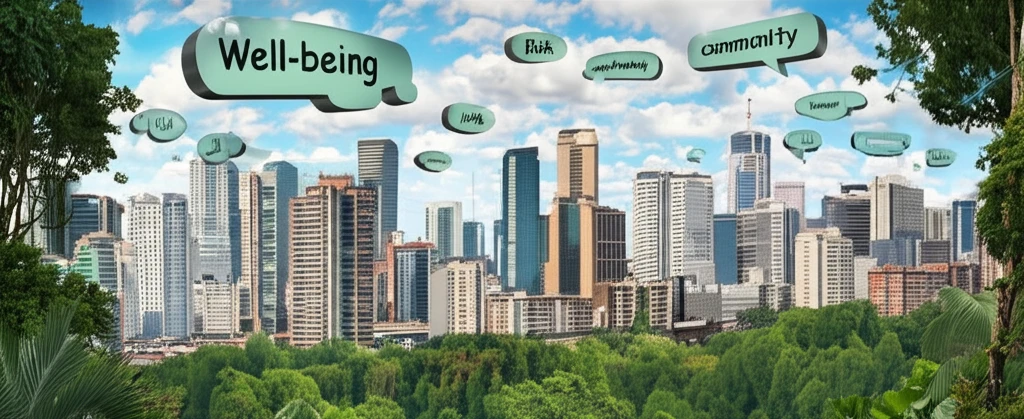
Beyond the Numbers: How Subjectivity, Quality of Life, and Risk Shape Latin America's Future

"Explore the surprising ways Latin American intellectuals and scientists are redefining development through the lens of personal experience and environmental consciousness."
For decades, progress has been measured by economic indicators, often overshadowing the human element. However, a growing movement across Latin America is challenging this paradigm, urging us to consider the less tangible aspects of development: subjectivity, quality of life, and the perception of risk. This shift recognizes that true progress must extend beyond mere economic growth to encompass the well-being and lived experiences of individuals.
This article delves into the intellectual currents driving this transformation, exploring how Latin American thinkers are reframing the conversation around development. They are integrating insights from sociology, environmental studies, and other disciplines to create a more holistic and human-centered approach.
By examining the work of key figures and research institutions, we'll uncover how this new perspective is not only reshaping academic discourse but also influencing policy decisions and grassroots initiatives across the region. The aim is to understand the nuances of this evolving landscape and its potential to foster a more sustainable and equitable future.
Measuring Lives Beyond GDP
Modern rankings of Latin American countries increasingly blend objective measures with perceptions of wellbeing. Quality of life, as World Population Review notes, is a broader concept that incorporates health outcomes, personal safety, environmental conditions, social wellbeing, and overall life satisfaction. Regional rankings such as the Numbeo Quality of Life Index compile these dimensions by country, revealing patterns that raw economic numbers alone obscure.
The Limits of Standard Metrics
The dominant approach to comparing countries relies on standardized indices, yet these methods carry inherent limitations because they reduce lived experience to aggregate scores. The World Health Organization defines quality of life as an individual's perception of their position in life in the context of the culture and value systems in which they live and in relation to their goals, a definition that is difficult to capture in a single number. Such definitions remind researchers that rankings reflect perceptions shaped by context, and that background, identities, and biases inevitably influence how results are interpreted.
Old Questions, New Lens
Long before contemporary indexes, scholars treated as problematic certain questions and observations that had previously been ignored or taken for granted, consulting the anthropological record for data and theoretical perspectives. This tradition, exemplified by foundational work such as Woman, Culture, and Society, helped establish the idea that social structures and cultural context shape individual wellbeing. It laid groundwork for today's insistence that development be judged not only by output but by how people actually experience their lives.
The Intellectual Roots: Reclaiming Subjectivity
The movement to prioritize subjectivity and quality of life in Latin America draws upon a rich intellectual history. Thinkers are revisiting classical sociological theories, particularly those of Max Weber and Pierre Bourdieu, to understand how individuals make sense of their world and how social structures shape their experiences. This involves recognizing the importance of 'habitus,' the ingrained habits and dispositions that influence our actions, and 'campo,' the social fields in which we operate.
- Acknowledging the limitations of purely economic indicators.
- Employing qualitative research methods to capture lived experiences.
- Recognizing the influence of social structures on individual well-being.
- Promoting interdisciplinary approaches to address complex issues.
Family and Adjustment Findings
Recent research points to environmental and family factors as decisive for wellbeing. A systematic review of third culture kids found that family cohesion significantly predicts both quality of life and sociocultural adjustment in expatriate children, with strong correlations between sociocultural adjustment and overall quality of life. Such findings emphasize that relational and environmental contexts, not just material conditions, drive how individuals fare.
When Indices Miss the Point
Critics argue that composite indices can obscure as much as they reveal, folding safety, health, and satisfaction into scores that flatten local realities. Because the WHO frames quality of life as a personal perception situated within a culture and value system, any ranking that treats countries as uniform units risks misrepresenting how individuals actually judge their own lives. Biases embedded in data collection and interpretation further undermine claims that such rankings are neutral.
Regional Comparisons
Comparing Latin America against other regions requires looking beyond economic indicators to geography, languages, cultures, and economic diversity, which reveal the deeper context behind regional perceptions. Quality of life rankings by country, such as Numbeo's index, allow side-by-side comparisons but must be read with the caveat that indices blend subjective and objective elements. These contrasts show that a country's position in rankings is the product of many interacting dimensions rather than any single statistic.
Toward a More Human Future
By placing subjectivity, quality of life, and risk perception at the center of the development agenda, Latin American intellectuals and scientists are paving the way for a more equitable and sustainable future. This approach challenges conventional wisdom and encourages a more nuanced understanding of progress, one that values human well-being alongside economic indicators. As this movement gains momentum, it promises to reshape not only academic discourse but also policy decisions and grassroots initiatives across the region, offering a compelling vision for a more human-centered world.
Numbers Need Context
Commentators converge on a central point: statistics become meaningful only when interpreted through the cultural and value systems in which people live. The WHO's definition anchors this view, treating quality of life as fundamentally perceptual rather than purely measurable. Similarly, Latin America is best understood through its geography, languages, cultures, and economic diversity, which supply the context that rankings alone cannot convey.
The Long View of Humanity
Speculative futures, such as the extended evolutionary timeline in All Tomorrows, push thinking about what humanity might become over millions of years, a reminder that today's indicators capture only a moment in an unfolding trajectory. Applied to the region, this perspective suggests that current quality-of-life measurements are snapshots rather than final verdicts. The challenge ahead is to develop measures that remain meaningful as societies, environments, and human identities evolve.
Systemic Constraints
Regional improvement efforts are constrained by structures that extend beyond individual countries. Understanding Latin America's definition and list of countries clarifies the boundaries and diversity of the region within which these challenges play out. Intervening to enhance quality of life for individuals and their families therefore requires attention to the systemic conditions that shape opportunity and security across this varied landscape.
Lived Experience Above All
Behind every index are individuals whose own sense of wellbeing ultimately defines success. Research on expatriate families shows how concrete social bonds, such as family cohesion, translate directly into measurable gains in quality of life. Initiatives aimed at enhancing the quality of life for individuals and their families succeed to the degree they respect the personal, cultural, and relational realities that aggregate data can only approximate.