
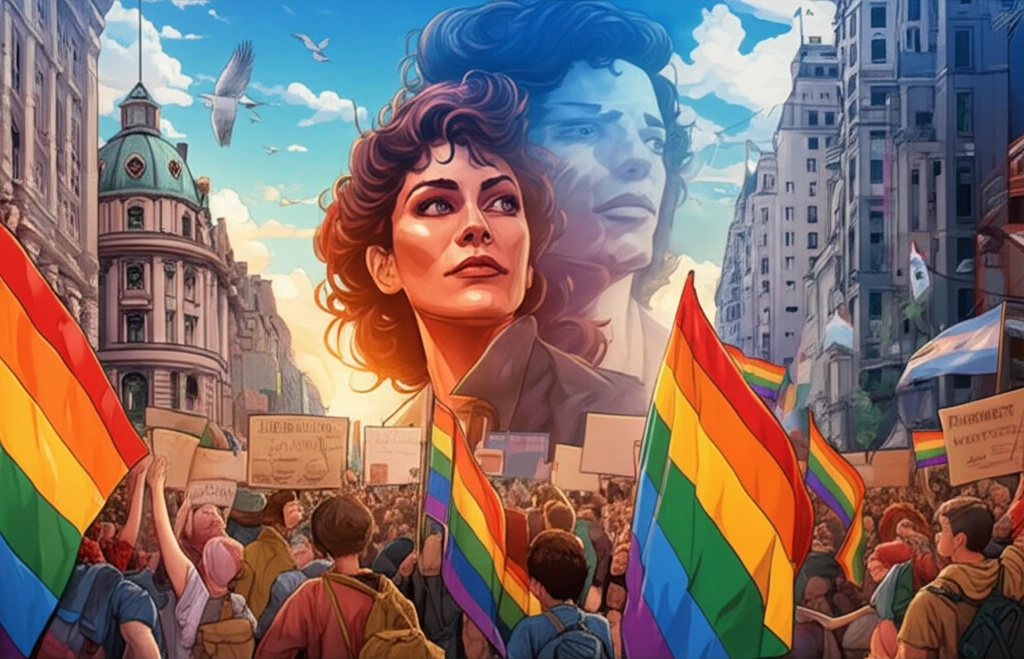
Beyond the Closet: Remembering Hilda Rais and the Evolution of Lesbian Visibility

"Explore the legacy of Hilda Rais, a pivotal figure in Argentinian feminism, and her fight for lesbian rights, identity, and acceptance in a changing society."
In November 1984, Hilda Rais, a poet and feminist activist, concluded her essay “LESBIANISMO. Apuntes para una discusión feminista” with a powerful vision: a future where stating one's sexual preference would no longer be necessary, a world beyond the need for feminism itself. This declaration marked a significant moment in the fight for LGBTQ+ rights, especially for lesbians who often found themselves confined to the shadows of societal norms.
Rais's essay offered a critical lens through which to view the challenges faced by lesbians in Argentina during a time when the only safe space seemed to be the 'closet' or a close-knit 'ghetto' of like-minded individuals. Her work not only provided a voice for the marginalized but also challenged the prevailing patriarchal structures that defined women solely as reproductive entities.
This article revisits Rais's groundbreaking work, exploring her perspectives on lesbian identity, the societal pressures faced by lesbians, and her contributions to feminist discourse. It also reflects on her enduring legacy in shaping a more inclusive and understanding world, honoring her memory as a true pioneer in the fight for equality.
LGBTQ+ Data Gaps and Persistent Disparities
Since January 20, 2025, hundreds of federal data collections have removed questions about sexual orientation and gender identity, threatening the ability to track LGBTQ+ disparities across key policy areas. LGBTQ+ discrimination persists across school, work, healthcare, and community life, with mental health impacts closely tied to policy realities such as anti-discrimination protections, conversion therapy bans, and limits on family rights. Organizations like the Human Rights Campaign continue to produce research on LGBTQ+ health, civic engagement, consumer attitudes, and demographics that shape LGBTQ+ lives.
Feminist and Queer Methodological Frameworks
Feminist methodologies in LGBTQ+ research emphasize standpoint theory and intersectional approaches that include women's and other marginalized genders' perspectives into legal reasoning and research practice. Queer autoethnographic methods have been proposed as ways to avoid objectifying research subjects by enabling non-hierarchical research relations that disturb the researcher/researched binary. While these frameworks have gained traction, scholars note that feminist and queer methodological approaches remain contested terrain within academia, requiring ongoing refinement to address power dynamics and ethical concerns.
Foundational Shifts in Visibility
The history of lesbian visibility within feminist movements is complex and difficult to capture in full, with milestones ranging from early 20th-century activist networks to contemporary legal protections. Foundational shifts in LGBTQ+ visibility often emerged from grassroots organizing rather than institutional recognition, though exact timelines and turning points remain subjects of scholarly debate. This overview draws on general historical knowledge where specific sourced claims were not available for this section.
Deconstructing Heteronormativity: Rais's Critique of Patriarchal Standards
Hilda Rais meticulously dissected the patriarchal norms that defined women's roles in society. She argued that heterosexuality, as an institution, perpetuated the idea of women as reproducers, sexual objects, and laborers within the family unit. This framework left little room for lesbian identity, often relegating it to the fringes of societal acceptance.
- The 'denier,' who invalidates lesbian existence by claiming that without a penis, there is no sex, thus reducing lesbians to mere spinsters.
- The 'tolerant,' who accepts lesbians only if they achieve professional success or views lesbianism as a mere erotic game for the amusement of heterosexual men.
- The one who 'positions lesbianism between criminality and psychopathology,' sanctioning it through religion, labor markets, and familial affections.
Evolving Scholarship on Intersectional Visibility
Contemporary scholarship on lesbian visibility and feminist-LGBTQ+ intersections continues to evolve across multiple disciplines, including gender studies, sociology, and public health. Recent research has increasingly focused on intersectional frameworks and lived experiences, moving beyond earlier approaches that treated gender and sexuality as discrete categories. The field remains dynamic, though robust, systematically sourced findings specific to this topic were not available for inclusion in this section.
Liberal Feminism's Shortcomings for LGBTQ+ Advocacy
Liberal feminism, which emphasizes individual rights and legal equality under the law, has faced criticism for failing to address systemic inequities faced by LGBTQ+ communities at the intersection of multiple marginalized identities. Critics argue that its focus on formal legal protections sometimes comes at the expense of more comprehensive approaches that grapple with the realities of individual lived experiences. Some feminist frameworks have even been accused of creating tensions with LGBTQ+ rights movements, though other scholars contend that feminist advocacy has simultaneously been essential to advancing gender and sexuality-based equality in political activism.
Cross-Movement and Cross-Context Comparisons
Comparative analyses of feminist approaches to LGBTQ+ visibility vary significantly across geographic, cultural, and institutional contexts, limiting broad generalizations. While intersectional frameworks have gained traction in academic discourse, systematic cross-national or cross-movement comparisons remain scarce, making definitive conclusions difficult. This section acknowledges that further research is needed to draw robust comparisons between different feminist and LGBTQ+ advocacy strategies.
Remembering Rais: A Lasting Impact on Feminism and LGBTQ+ Rights
Hilda Rais's passing marked the loss of a significant figure in Argentinian feminism. Her contributions, from her early activism to her insightful writings, have left an indelible mark on the fight for LGBTQ+ rights and social justice. Her legacy serves as an inspiration to continue challenging societal norms and advocating for a more inclusive and equitable world, where individuals can live authentically without fear of prejudice or discrimination. Her words continue to resonate, urging us to reflect on the progress made and the work that still lies ahead.
Intersecting Perspectives on Progress
Experts in gender studies and LGBTQ+ activism have increasingly called for intersectional approaches that center the voices of the most marginalized within feminist and queer movements. The synthesis of historical and contemporary perspectives suggests that progress in lesbian visibility has been uneven, shaped by both institutional advocacy and grassroots organizing. A growing consensus emphasizes the need for inclusive frameworks that transcend binary understandings of gender and sexuality.
Emerging Challenges and Advocacy Trajectories
The future of lesbian visibility and feminist-LGBTQ+ advocacy will likely be shaped by ongoing policy changes, including the removal of sexual orientation and gender identity data from federal collections that limits evidence-based policymaking. Emerging challenges around legal recognition, healthcare access, and community support systems demand continued vigilance and adaptive strategies from both researchers and advocates. The trajectory of these movements suggests that grassroots organizing and intersectional advocacy will remain critical frontiers in the push for equitable representation.
Navigating Complex Movements and Legal Hurdles
The relationship between feminism and the LGBT rights movement remains complex and ever evolving, with the 1960s and 1970s witnessing parallel but distinct social movements—second-wave feminism demanding gender equality and the LGBT rights movement fighting for acceptance and legal protections. Transgender individuals face unique systemic challenges, including legal recognition of gender identity, which in many countries still requires invasive procedures or diagnoses of mental illness. LGBTQ+ voices within the feminist movement increasingly challenge traditional gender roles and advocate for moving beyond the binary to include a broader spectrum of identities and experiences.
Case Studies of Activism and Institutional Change
Archival research at Harvard's Radcliffe Institute has examined the relationship between second-wave feminism and the gay rights movement, evaluating the legal and activist legacies of the feminist reproductive justice movement and their effect on the achievement of foundational Supreme Court decisions. Case study approaches across organizations like the World Social Forum illustrate how feminist and women's rights activists have worked to integrate gender justice into broader visions of social change. These examples demonstrate that individual and institutional efforts, when aligned across movements, can produce tangible impacts on LGBTQ+ rights and visibility.