
Beyond the Battlefield: How 19th-Century Religious Art Challenged Military Service

"Uncover the surprising anti-war messages hidden within popular religious woodcuts and lithographs, revealing a forgotten critique of military life."
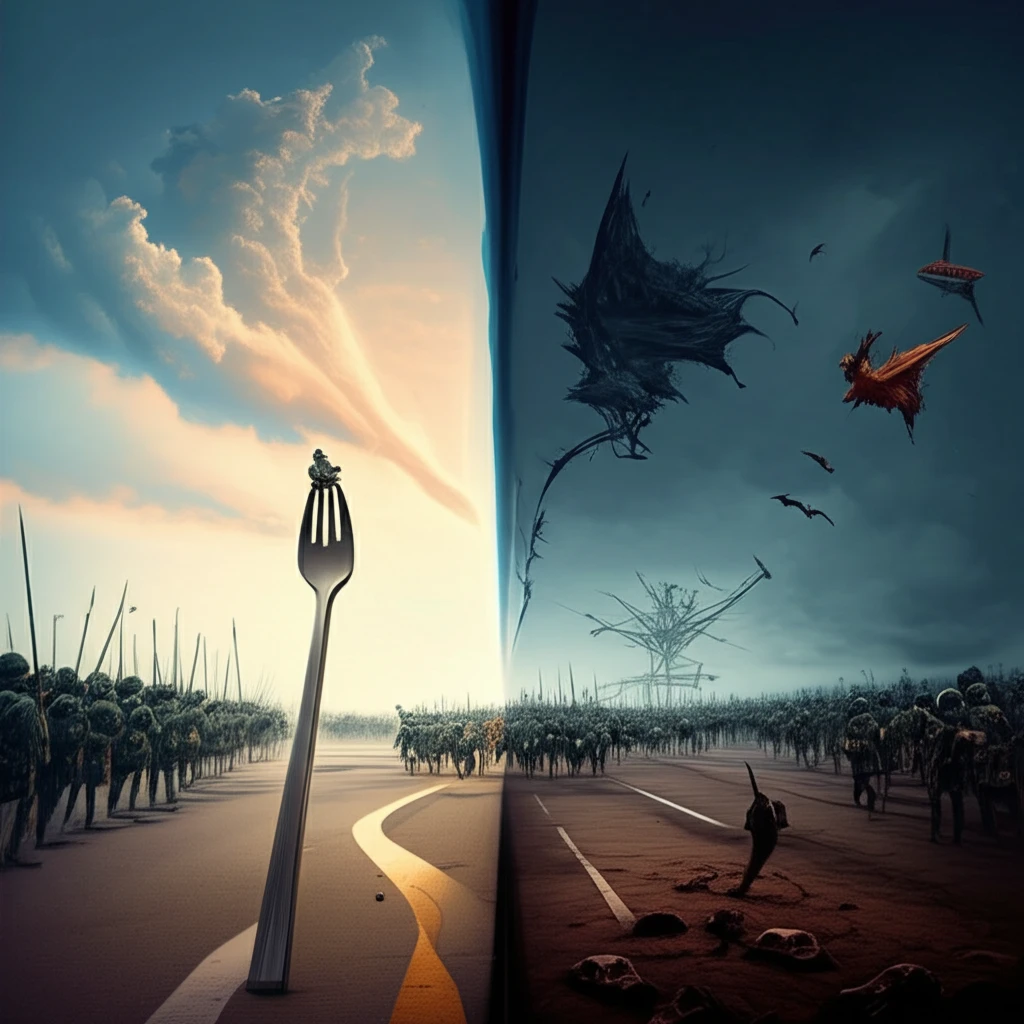
Devotional prints, including engravings, woodcuts, and lithographs, often seen as conservative expressions of religious belief, can also contain surprisingly radical social commentary. One recurring theme in this art form is the "Two Paths" motif—the broad road leading to damnation and the narrow path to salvation. This motif wasn't merely a moral lesson; it became a canvas for exploring complex societal issues.
The concept of the two paths, with roots in antiquity and biblical teachings, experienced a resurgence during the Renaissance and continued to evolve through the 16th and 18th centuries. Visual interpretations of this motif were embraced by humanists, Catholics, Calvinists, and Lutherans. Though a Lutheran lithograph by Charlotte Reihlen from the late 19th century is perhaps the most well-known example, the theme appears in diverse forms across various religious traditions.
This article delves into the representation of soldiers within these religious artworks, specifically focusing on Catholic and Protestant examples. By examining these images, we aim to demonstrate that interpretations of these works as purely conservative are incomplete. These works also offered precise social critiques, reflecting the concerns and values of the communities that produced and consumed them. We will analyze two key artworks: François Georgin's 'Les trois chemins de l'éternité' (1825/1830) and Charlotte Reihlen's 'Der breite und der schmale Weg' (1867), alongside a related anonymous Swiss drawing from 1800.
Measuring the Toll in Numbers
Live statistics portals such as Worldometer provide daily and weekly updated counts of COVID-19 cases, recoveries, and deaths, presented with cumulative charts and historical data. The handbook Statistics in a Nutshell cautions that data presented by others must be critiqued carefully, since statistics are easily misused. That same volume borrows a military metaphor to argue that efficient data management for large projects requires establishing a clear hierarchy of people responsible for different aspects of the process. Meanwhile, the World Bank's Open Data portal offers free, internationally comparable development statistics covering global poverty and development indicators.
Every Method Has Its Limits
Standard approaches and accepted methods are typically bounded by explicit limitations, as the Boeing 737 demonstrates with its documented crosswind limit of roughly 33–35 knots. Even routine tasks, such as powering off a Samsung A56, can be accomplished through several accepted methods, including hardware buttons and alternative procedures. The Grin-published study of armed conflict in Nigeria critiques existing international and governmental conflict resolution approaches, pointing to weapons availability and environmental factors that undermine them. Privacy-focused search engine Qwant presents an alternative method built on not storing or selling user data, illustrating how "standard" approaches can be challenged by different values.
Milestones of War and Memory
Lewis Milestone, born Leib Milstein, directed Two Arabian Knights (1927) and All Quiet on the Western Front (1930), both earning him the Academy Award for Best Director. His 1930 adaptation of the anti-war novel remains a milestone in cinematic treatments of armed conflict. American historical memory preserves figures like Molly Pitcher, the Revolutionary War military figure, as part of foundational narratives about service. The U.S. State Department's retired "Milestones" series documents turning points in U.S. foreign relations, including the Spanish-American War of 1898.
The Soldier's Place: Analyzing Georgin and Reihlen’s Works
Let's begin by pinpointing where soldiers appear in these artworks. Both complete works are included at the end of this article for your reference. It's helpful to first understand the structure of each piece:
- Soldiers are entirely absent from the narrow path leading to salvation in both Georgin’s and Reihlen’s depictions.
- In Georgin’s woodcut, five figures are on the path to hell.
- Reihlen's lithograph shows twenty-one individuals on the path to salvation.
- Both artists adhere to biblical models: Georgin emphasizes thorns along the path and figures carrying crosses, while Reihlen references the virtues in Matthew 25 and alludes to practices of penance and charity. However, soldiers are not shown engaging in these faith-based practices.
New Research, Recurring Debates
Voice of America reports that most Taiwanese men are required to complete military service, learning basic defense skills with the aim of assisting Taiwan's professional military in the event of war, and that the government has weighed lengthening that service. Psychology news outlet PsyPost covers recent research findings, such as evidence that a common response to negative emotions is worse for people in certain countries. Associated Press, founded in 1846, remains a major source of breaking news, with more than half the world's population encountering its journalism daily. Platforms like Critique Circle reflect a parallel trend in research practice, where writers continuously improve manuscripts by critiquing others' work.
Critique Beyond Fault-Finding
Merriam-Webster defines a critique as an act of criticizing, especially a critical estimate or discussion, distinguishing it from simple fault-finding. As Espresso English notes, to criticize something is to identify its faults or negative aspects, whereas a critique offers a more structured evaluation. A YouTube explainer examines whether military service can be deferred for students in open education faculties, how long deferment processing takes, and whether those enrolled through a second university qualify. These materials illustrate that counter-arguments to military service obligations are often framed around procedural questions of deferment and evaluation.
Weighing Service Side by Side
Versus is a comparison platform covering more than 100 categories, allowing users to compare anything side-by-side with detailed specifications, filters, and data visualizations. Comparison content extends to military matters, as shown by a YouTube reaction video analyzing the military power of India versus Turkey. On TikTok, the "Don't Join The Military" topic explores the real reasons not to enlist, the realities of military life, and alternatives to service. Such comparative and cautionary materials show how audiences weigh the costs and benefits of military service against other options.
Final Thoughts: A Subversive Message?
The question “Where are the soldiers?” led us to a consistent answer across distinct religious and national contexts: soldiers, regardless of allegiance, are portrayed as heading down a destructive path, leading to self-destruction and eternal damnation. This message challenges simplistic interpretations of these artworks as merely conservative. Instead, they reveal a deep-seated critique of military service and its impact on individuals and society.
From Reports to Commentary
The Southfront map update for August 13, 2026 reports that the Yemeni army attacked Mokha port with FPV drones and struck Saudi coalition bases near Marib. Outlets such as The Defense Post synthesize such developments, providing breaking news, in-depth coverage, analysis, and commentary on national defense and international security. Peer-reviewed literature likewise offers expert commentary on complex issues, as illustrated by a PNAS critique of the literature on the etiology of eating disorders. Specialist journals, including Expert Opinion on Drug Delivery, publish critical commentary across applied fields.
Signals of What Comes Next
Google Trends tracks the level of interest in queries and topics over time, by location and popularity, and is used by news agencies and organizations around the world. Tools like Trendsee scan millions of viral videos and convert them into ready scenarios for brands, pointing toward AI-driven trend forecasting. Research on global poultry production published in the World's Poultry Science Journal assesses the current state, future outlook, and challenges of the industry. Even routine workplace issues, such as Outlook automatically marking shared emails as read, reflect growing attention to how tools will be refined for the future.
Challenges Built Into the System
An independent study on systemic challenges in basic military training during Ukraine's full-scale war found that one in five service members cited insufficient training in tactical first aid and casualty evacuation; the findings were presented to the General Staff, the Ground Forces Command, the National Guard, training units, and the Ministry of Defence. NATO, for its part, issued a communique declaring that China presents "systemic challenges" for the transatlantic security alliance. Southfront reports that Ukrainian conscripts face significant training challenges since the beginning of the conflict. Technical systems face analogous demands: military computing designed for aircraft must withstand extreme temperatures that can reduce performance and reliability during critical missions.
Personas, Voice, and Lasting Influence
Jonathan Swift's use of fictional personas and pseudonyms — such as Lemuel Gulliver and M. B. Drapier — allowed him to present his ideas from different perspectives, giving his critiques an added layer of complexity and engagement. According to World History Edu, Swift's satire has had a lasting impact on public consciousness. This model of veiled, persona-driven critique shows how the human voice can shape public debate, whether about politics or war. Educational research portals, such as the one at the University of Surrey, continue to study how such communication and statistics are taught and applied.