
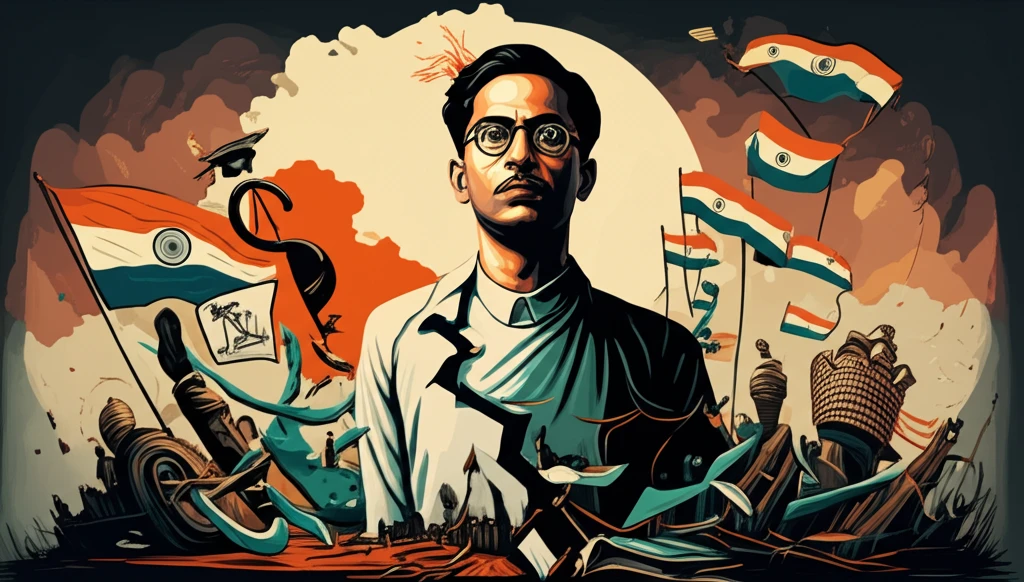
Beyond Politics: Discovering the Untold Legacy of Dr. Syama Prasad Mookerjee

"Uncover the multifaceted contributions of Dr. Mookerjee, from education reform to championing individual rights, and his enduring impact on Indian society and politics."
In the vast landscape of Indian history, certain figures stand out not only for their political involvement but for their profound impact on society. Dr. Syama Prasad Mookerjee is one such individual. While often remembered for his role in politics, Dr. Mookerjee's contributions extend far beyond the realm of government. His dedication to education, his unwavering commitment to individual rights, and his vision for a unified and prosperous India left an indelible mark on the nation.
Dr. Mookerjee's journey began in the sphere of education, where he recognized the transformative power of learning and its ability to shape the future of individuals and society. His efforts to reform the education system reflected his belief in the importance of providing access to quality education for all. However, his path soon led him into the tumultuous world of politics, driven by a desire to address the pressing issues of his time and to advocate for the rights of all citizens.
This article delves into the comprehensive legacy of Dr. Syama Prasad Mookerjee, exploring his multifaceted contributions and shedding light on the values and principles that guided his actions. By examining his work in education, his role in politics, and his vision for India, we gain a deeper understanding of this remarkable figure and his lasting impact on the nation.
Mookerjee's Legacy in Contemporary Bengal Politics
The 2026 West Bengal Assembly Election marked what organizers described as a transformation 'exactly 75 years in the making' for the state's political landscape. The BJP government in Bengal organized a grand event in Kolkata to commemorate Mookerjee's 125th birth anniversary. PM Narendra Modi paid tribute, calling Mookerjee 'one of India's most remarkable nation-builders' whose life was defined by scholarship, courage, and commitment to national service. During Suvendu Adhikari's swearing-in ceremony, the PM touched the feet of Makhanlal Sarkar, an aide of Mookerjee who has been associated with the BJP since its inception in 1980.
Curriculum Reform and Institutional Commemoration
West Bengal's Chief Minister Suvendu Adhikari announced that Mookerjee's contributions would enter the state's school and university curriculum from the 2027 academic year. The decision emerged from the first meeting of a special committee constituted to plan programmes for the 125th birth anniversary. The broader anniversary plan encompasses publications, a memorial, and restoration of Mookerjee's ancestral home. PM Modi noted that Mookerjee was born into circumstances that could have assured him a protected life, being the son of Sir Ashutosh Mookerjee, one of the foremost educationists of his age.
Kashmir Integration and Political Career Beginnings
Mookerjee is remembered for his tireless work to integrate Kashmir into India, famously stating that 'a single country can't have two constitutions.' His political trajectory during World War II began with his resignation from the Congress in 1939. Born in 1901 into an illustrious family, his grandfather was Gangaprasad Mookerjee. Some accounts characterize his death as not natural but rather a conspiracy, though this remains contested in historical discourse.
From Education to Political Activism
Dr. Mookerjee's foray into politics was sparked by a disagreement with the Congress party's policy to boycott the Legislature in 1938. This pivotal moment led him to resign and successfully run as an independent candidate. From that point forward, he dedicated himself to political activism until his death in 1953. A significant part of his struggle involved opposing the Muslim League in Bengal, particularly their communal approach to education, as seen in the Secondary Education Bill. He believed in protesting the defilement of Hindu images, the molestation of Hindu women, and discrimination in government employment.
- The formation of the Progressive Coalition with the Krishak Praja Party under Fazlul Haq in December 1941.
- Dr. Mookerjee's appointment as Finance Minister in the new coalition cabinet.
- His emergence as a leading voice for the Hindu cause, challenging the communal policies of the previous Haq Ministry.
Curriculum Inclusion and Article 370 Connection
Both Economic Times and The Hindu reported that West Bengal's education department will incorporate Mookerjee's contributions into the curriculum from school to university levels beginning the next academic session. PM Modi stated that the abrogation of Article 370 fulfilled Mookerjee's dream, quoting him: 'Congress divided the country, and I divided Pakistan.' Modi emphasized that Mookerjee 'mobilised public opinion, fought political battles and ensured that Bengal remained an integral part of India.' The Dr. Syama Prasad Mookerjee Research Foundation has been actively promoting his educational vision alongside comparisons with other Bengali icons like Subhas Chandra Bose.
Complexity Beyond Simplified Narratives
The Week reported that Mookerjee 'was never a blind follower of Hindutva,' suggesting his ideological positions were more nuanced than often portrayed. He expressed willingness to meet Gandhi in jail during the Quit India Movement but was denied permission, indicating potential for cross-ideological engagement. As India's first Industry Minister, his economic vision for Bengal has been cited by critics who argue the state underwent 'systematic degeneration' by abandoning his ideals during decades of subsequent misrule. These perspectives highlight the gap between Mookerjee's comprehensive vision and selective political appropriation of his legacy.
Nation-Building Legacy in Contemporary Discourse
PM Modi's tribute on Mookerjee's 125th birth anniversary praised his 'nation-building legacy, unity efforts, educational vision, and contributions.' Leaders across India honoured him as a figure whose work transcended partisan boundaries. The commemoration positioned Mookerjee within a broader narrative of post-independence nation-building that emphasized national unity and institutional development. This framing contrasts with narrower political interpretations that focus primarily on his role in Kashmir politics or party formation.
A Lasting Impact
Dr. Syama Prasad Mookerjee's life was marked by his unwavering commitment to his principles and his tireless efforts to advocate for the rights of all citizens. His contributions to education, his role in shaping post-independence India, and his dedication to preserving the nation's unity continue to inspire generations. While his political journey was often fraught with challenges, his legacy as a champion of individual rights and a visionary leader remains firmly etched in the annals of Indian history.
Post-Independence Policy Engagement
A letter from Prime Minister Nehru dated June 1, 1949, reveals Mookerjee's continued engagement in national policy discussions after independence. Nehru wrote to Mookerjee regarding the Premier of Orissa's request for establishment of a steel plant in the state. The correspondence indicates Mookerjee's role as a conduit between state premiers and the central government on industrial development matters. This documentary evidence places him within the inner circles of early Nehruvian economic planning, despite their later political divergence.
Research Foundation and Educational Expansion
The Dr. Syama Prasad Mookerjee Research Foundation hosted a discussion on the future of infrastructure finance in India and the Global South in November 2025. The Foundation actively promotes Mookerjee's vision of education as a tool for national development. Chief Minister Adhikari confirmed that Mookerjee's 'far-reaching and development-oriented vision in independent India' and 'constructive works' will be included in the syllabus from school to university levels. This educational expansion represents a systematic effort to embed his contributions in institutional memory.
Early Political Career and Institutional Navigation
Mookerjee entered Bengal's Legislative Council from the Calcutta University constituency on a Congress ticket in 1929, demonstrating his early engagement with mainstream nationalist politics. He subsequently stepped down after the Congress party chose to boycott the legislature, indicating a principled stance that sometimes put him at odds with party decisions. This trajectory illustrates the tension between institutional participation and ideological purity that characterized much of Indian political life during the independence movement.
Beyond Myths and Political Symbolism
The Telegraph India noted that unlike Subhas Chandra Bose or C.R. Das, Mookerjee 'remained for the greater part just a name' with 'no trailing cloud of anecdotes, nothing good or bad or damning.' Born in 1901 in Kolkata, his public life 'did not begin in the heat of mass politics' but rather 'in the world of ideas, institutions, and education.' Born into an illustrious intellectual family, he inherited a deep respect for learning and public service that shaped his approach to politics. This biographical grounding suggests his contributions were rooted in scholarly traditions rather than charismatic populism.