
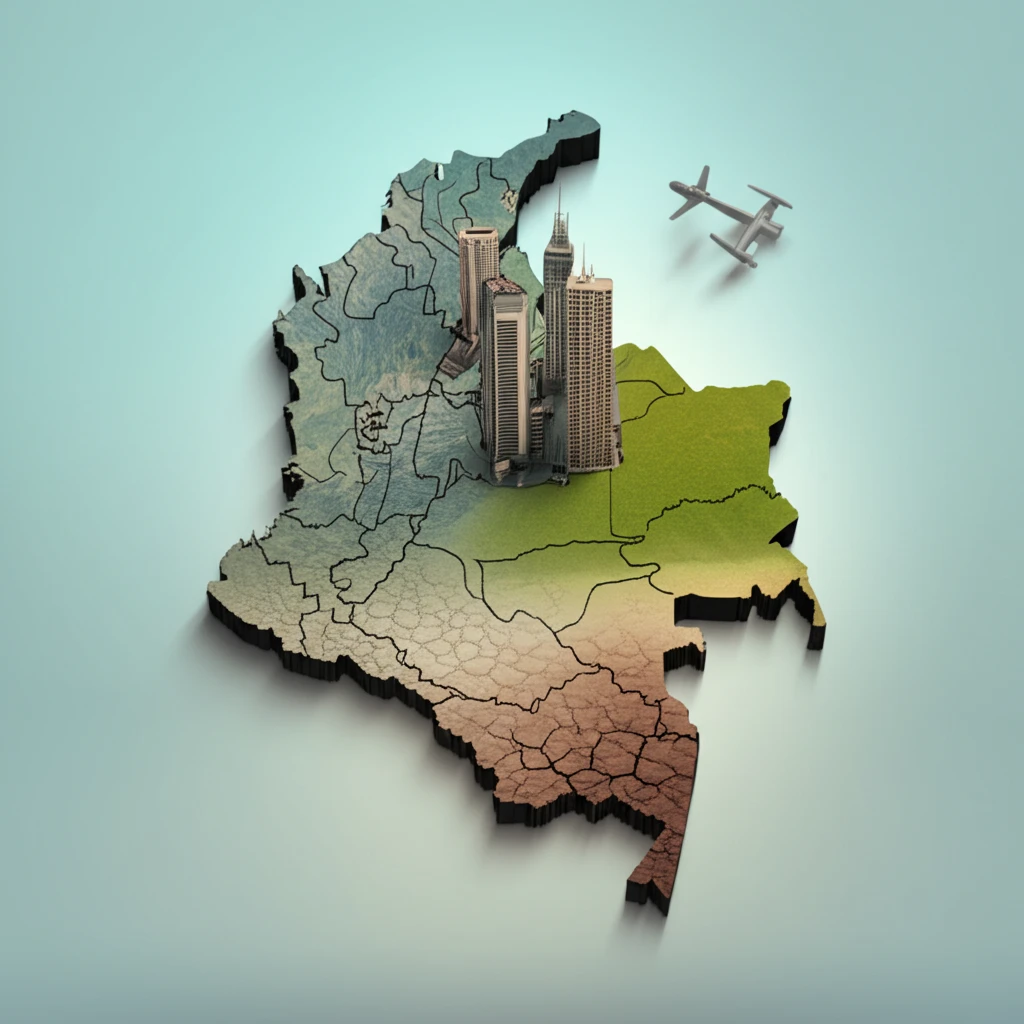
Banking Deserts: How Uneven Access Affects Colombia's Financial Landscape

"Discover the impact of banking concentration on regional economies in Colombia, and what it means for financial inclusion."
In an increasingly interconnected world, the uneven distribution of financial resources remains a significant challenge. Access to banking services, a cornerstone of modern economies, is not uniformly spread across all regions. This is particularly evident in Colombia, where geographical and institutional factors create 'banking deserts' – areas with limited access to financial services.
The concentration of financial institutions in specific regions can lead to disparities in economic growth and stability. While some departments thrive with a vibrant banking sector, others struggle with limited access to credit and investment. This imbalance affects everything from small business opportunities to individual savings and economic resilience.
Recent research delves into the departmental analysis of banking activity in Colombia, shedding light on these critical disparities. By examining the concentration of banking resources and the types of financial services available, this study offers valuable insights into the challenges and opportunities for promoting financial inclusion and balanced economic development in Colombia.
Profit Surges and Sector Growth
Colombia's banking sector saw profits rise by 71% in 2025, reflecting strong consolidation even amid economic headwinds. The sector continues to serve as a critical intermediary between surplus and deficit agents in the economy. Rebounding economic activity and historically low interest rates have been credited with bolstering both deposits and credit growth across the country.
Established Systems Under Pressure
Colombia's banking system is considered mature and well-regulated, with established methods of payment and oversight frameworks. However, the sector faces new pressures: accumulated losses in prior years forced a dramatic recovery in 2025, and the government's decision to raise the minimum wage in 2026 is expected to create further headwinds for earnings and asset quality. These pressures highlight how even accepted regulatory and operational methods can be strained by macroeconomic policy shifts.
From 19th-Century Roots to Modern Innovation
Colombia's banking system dates back to the 19th century and has evolved into a robust financial sector that blends tradition with innovation. The private banking sector has taken on a growing role, with the government modifying the legal framework to make investment easier and more attractive, making billions of dollars available through private institutions. Today, the sector encompasses established domestic banks, subsidiaries of international groups, and a rapidly expanding fintech ecosystem.
Concentration and Its Consequences: A Regional Analysis
The study meticulously calculates and analyzes concentration indicators across Colombia's departments, focusing on: Banking Captations: The distribution of deposits in various financial products, including checking accounts, savings accounts, and certificates of deposit. Entity Types: The market share of different financial institutions, such as commercial banks, financial corporations, and cooperative financial institutions.
- Regional Disparities: The concentration indicators highlight the vast differences in financial access across Colombia. While some departments enjoy a competitive banking landscape, others face limited options and higher costs.
- Dominance of Major Players: A few large banks exert considerable influence over the Colombian banking sector, particularly in key financial products. This dominance can stifle competition and limit innovation in underserved regions.
- Impact on Economic Development: The study suggests that uneven access to banking services may hinder economic development in less concentrated departments. Limited access to credit, investment, and financial expertise can create barriers to growth for local businesses and entrepreneurs.
Sector Homogeneity and Climate Risk Testing
Research has noted that Colombia's banking sector exhibits significant homogeneity, with low "distance" between banks in terms of structure and strategy — a factor that, while not currently placing the sector at risk, raises questions about resilience. In a landmark effort, the World Bank and Colombia's Financial Superintendence conducted the first comprehensive climate-risk stress test in any emerging market, examining how flood exposure and mitigation targets could affect the banking system. These studies signal a growing focus on both structural diversity and environmental vulnerability in the sector.
Concentration and the Competition Gap
Despite its growth and maturity, Colombia's banking sector has been criticized for its near-oligopolistic grip on the local market. Even finance ministry officials have acknowledged that competition remains insufficient, with sector concentration limiting the range of choices available to consumers and businesses. This structural consolidation, while a source of stability, raises concerns about whether the sector truly serves all segments of the population equitably.
Efficiency Benchmarks Across Institutions
Studies using data envelopment analysis have assessed the relative efficiency of Colombian banks, finding that the sector reported solid results with profit increases of around 17% over prior periods. The participation of efficient banks in the market has been tracked as a measure of sector health. However, available source material for this subsection is limited in breadth, and broader comparative data on how Colombian banks stack up against regional or global peers was not sufficiently detailed in the provided references.
Bridging the Gap: Towards a More Inclusive Financial System
The departmental analysis of banking activity in Colombia underscores the urgent need for policies that promote financial inclusion and balanced regional development. By addressing the challenges posed by banking deserts and fostering greater competition, Colombia can unlock the economic potential of its underserved regions and create a more equitable and prosperous future for all its citizens.
Balancing Profitability and Access
Colombia's banking sector has demonstrated impressive profitability and resilience in recent years, yet questions remain about whether this growth translates into equitable access across the country's diverse regions. The tension between sector consolidation and competitive breadth suggests that structural reforms may be needed to complement the financial gains achieved. While no single expert commentary was available for direct citation in this subsection, the broader evidence base points toward a sector at a crossroads — strong in aggregate, but uneven in reach.
Shifting International Exposure
Credit rating agency outlooks suggest that international banking groups are recalibrating their exposure to Colombia, with some institutions expecting their Colombian banking sector exposure to decrease to around 10% over the coming years. This trend, combined with a stable long-term credit rating outlook, indicates that while Colombia remains an important market, global banks are diversifying their regional commitments. The implications for local credit availability and investment are still emerging.
Measuring Systemic Risk
Research applying multiple methodologies to measure systemic risk in the Colombian banking sector has found that the system did not experience a systemic crisis in at least 60% of the assets managed, helping to avoid compromising overall financial stability. The studies highlight the importance of robust measurement tools as alternatives for monitoring risk in banking systems. These findings suggest that while individual banks may face challenges, the systemic infrastructure has proven resilient over time.
Climate Exposure and Workplace Dynamics
The Colombian banking sector faces tangible exposure to climate-related financial risks, particularly from floods, which could affect both institutional portfolios and the communities they serve. Within banks themselves, research on workplace climate and performance — including case studies of institutions like Bancamía — underscores that employee well-being and organizational culture are critical to operational success. Additionally, mergers and acquisitions activity in the financial sector has shaped efficiency outcomes, though the human cost of consolidation remains an area warranting further study.