
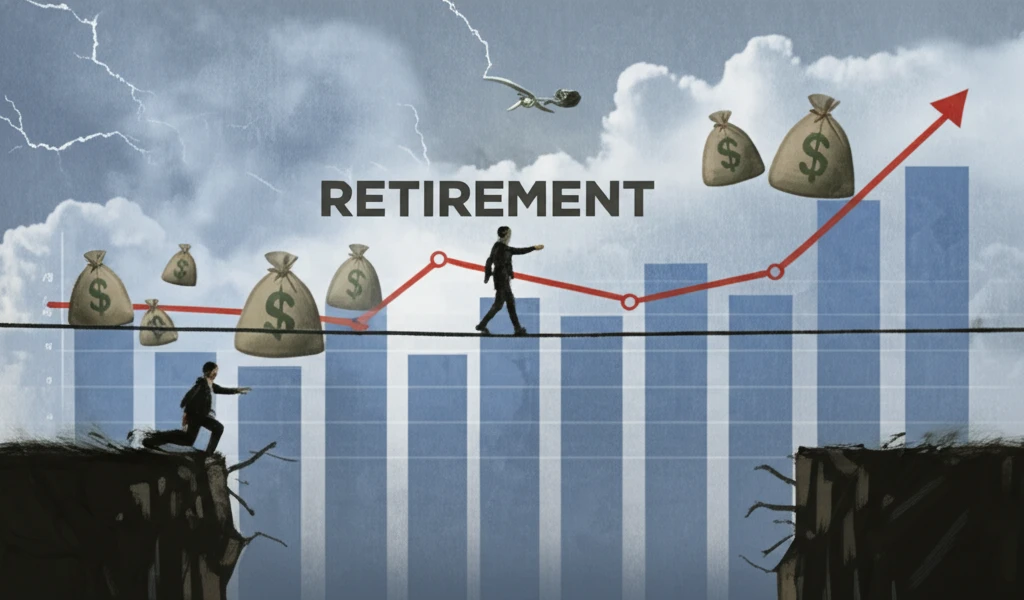
Are You Saving Enough? Unmasking the Retirement Savings Myth

"New research challenges the idea that Americans universally undersave for retirement, revealing surprising truths about financial preparedness."
For years, we've been told a consistent story: Americans are terrible at saving. The media, financial experts, and even government policies often paint a picture of a population hurtling toward a retirement crisis, weighed down by debt and a lack of planning. But what if this narrative isn't entirely accurate? What if the idea that we all need to be saving more is, in some cases, simply a myth?
The idea that consumers systematically undersave is frequently used to justify the application of nudge policies. Behavioral economics suggests that people will systemically err when saving less that they desire, and thus 'nudges' are used to change default rules so people will save more for retirement. However, new research is challenging this widespread assumption, suggesting many Americans are actually well-prepared for their golden years. It encourages a deeper look at the numbers, and also, at the basis for 'nudging' people to save more.
This article dives into a new study that dares to question the conventional wisdom. It explores whether Americans are truly undersaving, examines the reasons behind saving habits, and considers the ethical implications of policies designed to “nudge” people toward specific financial behaviors. Get ready to rethink everything you thought you knew about retirement planning.
The Retirement Savings Gap in Numbers
Current data paints a sobering picture of retirement readiness. The Federal Reserve reported that the median retirement savings for Americans aged 55 to 64 was just $185,000 as of 2022, while Vanguard puts the median value of the 401(k) accounts it oversees at only $107,269. The gap is not just generational but also economic: OECD data shows U.S. retirement income inequality is higher than the OECD average, with the top 20% of retirees earning about 4.5 times more than the bottom 20%. For many households approaching retirement age, those median balances fall far short of what a multi-decade retirement would require.
Conventional Catch-Up Strategies and Their Limits
The standard playbook for building retirement savings centers on disciplined, tax-advantaged saving: Ramsey Solutions argues that getting back on track is possible if you are willing to invest a meaningful share of your monthly income to reach a roughly $1 million goal, while other advisors emphasize tax-advantaged vehicles as a core tool. GOBankingRates likewise suggests that even with bills competing for your paycheck, strategies such as catching up on your 401(k) can make the process easier. Yet the conventional approach has clear limits: Wealth manager Murphy Wealth's research warns that a common pension mistake could be costing thousands of Britons up to £400,000 in retirement savings. In other words, how you save matters as much as how much you save, and a single structural misstep can quietly erase years of disciplined contributions.
From the 15% Rule to Real-Life Testimony
A long-standing rule of thumb, reported by the Los Angeles Times, has been to save close to 15% of your pay in a retirement account, including any employer match. However, the amount actually needed varies widely by geography: as Yahoo Finance notes, the required nest egg differs state by state due to cost-of-living differences, and in some areas a bit more than $500,000 may support a 25-year retirement. The lived experience shows why benchmarks are only part of the story. One woman in her late years saw her financial stability tested despite holding $600,000 in retirement savings and a $50,000 emergency fund, drawing $2,500 a month from savings plus $500 from her business. Her situation illustrates that even a sizable balance can feel fragile once the paycheck stops and withdrawals begin.
The Great Savings Debate: Are We Really Doomed?
According to the original study, most people save enough or more than they need for retirement, and undersaving for retirement was a problem for only about 15% of American households. Moreover, those who saved less than their optimal amount only deviated by a small amount from their desired level (only saving $5,620 less than desired on average on average). This paints a vastly different picture than the impending crisis often portrayed.
- Examine your motivations for saving: Are you saving for specific goals or a general sense of security?
- Consider your individual circumstances: Factors such as expected lifespan, potential inheritances, and future healthcare costs can all influence how much you need to save.
- Don't blindly follow conventional wisdom: Do your research and create a plan that aligns with your unique needs and goals.
- Factor in Social Security: Understand how much income you can expect from Social Security.
New Research Turns Attention to the Spending Phase
FinanceBuzz reports on the average and median retirement savings for 68-year-olds, giving near-retirees a concrete benchmark for how their balances compare. Yet new research covered by CBS News suggests that many people are far less prepared for what happens once the paycheck stops than they are for the accumulation phase. Vanguard's research outlines four principles for retirement income planning, beginning with starting with purpose and covering the essentials. The finding reframes retirement planning: decades of saving are only half the challenge, and the transition from accumulating to withdrawing deserves the same level of discipline and strategy.
When the 401(k) Playbook Falls Short
The 401(k) is often hailed as the cornerstone of retirement savings for American workers, offering convenient payroll deductions and employer matching, but critics argue it carries critical limitations that savers rarely examine closely. The fragility of relying on such accounts was on stark display in a case reported by 24/7 Wall St.: a $2,400 water heater repair bill nearly pushed a 61-year-old worker to claim Social Security early. The episode highlights the promise of the new 401(k) "sidecar" emergency accounts, which were built specifically for such surprise expenses, allowing workers to confirm balance limits, withdrawal processes, and how contributions interact with the employer match. It also underscores the importance of comparing Social Security estimates at 62, full retirement age, and 70 before making a claim under financial pressure.
Benchmarks Versus Reality at Midlife
Common benchmarks offer a useful starting point: as FinanceBuzz reports, Fidelity usually suggests having about six times your annual salary saved by age 50, while cautioning that the target is not a one-size-fits-all rule. The gap between such benchmarks and real-world planning can be substantial, as a SmartAsset case study demonstrates. A 50-year-old who felt hopelessly behind ran the actual numbers and found that by increasing annual retirement savings to 25% of income, retiring at 67, and waiting to claim Social Security, projected wealth at retirement could rise to roughly $2.81 million. The comparison suggests that late-career changes in savings rate and claiming strategy can matter more than an early head start.
The Bottom Line: A Personalized Approach to Financial Security
Ultimately, the question of whether you're saving enough is deeply personal. There's no one-size-fits-all answer, and blindly following conventional wisdom can be just as detrimental as ignoring financial planning altogether. By understanding your own circumstances, challenging assumptions, and focusing on what truly matters to you, you can create a financial plan that leads to a secure and fulfilling future.
What the Experts Say About Retiring on Your Savings
Experts converge on one practical first step for anyone wondering whether they can retire on their savings: Money.com advises starting with a detailed analysis of your actual spending over the last six months to a year, rather than guessing at monthly expenses, per Hymiller. From there, the math becomes personal. In a case examined by iNews, an individual with £200,000 in savings asked whether retirement in five years was possible; the experts' analysis hinged on the income her private pension and ISA savings could generate, with a combined £20,000-a-year income rising with inflation as a reference point. On a broader psychological level, personal-finance expert Morgan Housel argues that the real obstacles are behavioral, pointing to the psychology behind saving, spending, and success. The consistent message is that retirement readiness is less about a magic number and more about spending discipline matched to realistic withdrawal math.
Projecting Forward: Calculators and 2026 Trends
Retirement calculators are becoming the standard tool for converting today's numbers into tomorrow's outlook, with typical models asking for current savings, expected investment return, how much can be withdrawn after retirement, and the amount needed at retirement age to project future savings. Looking at population averages offers a comparative lens, and Retirable's 2026 analysis of average retirement income encourages savers to see where their finances stand relative to others. The firm identifies the biggest trend of 2026 as one that has actually been building for a while, suggesting that the near-term evolution of retirement income is a continuation rather than a break with the past. For individual savers, the practical frontier is using these projection tools to stress-test whether their withdrawal rates and returns assumptions hold up over a long retirement.
A Retirement System Under Strain
Widely shared commentary on social media frames the problem in stark terms, with discussions around the hashtag claiming the retirement system is "broken" and emphasizing struggles that range from working in retirement to the mental health impact of aging and the financial challenges facing seniors. Analysts at Issues In Perspective argue that these problems sit atop deeper systemic pressures, noting that heavy spending, tax cuts, and rising wages carry a significant inflation risk, one of the reasons the stock market has been falling. The implication is that retirement insecurity is not purely a personal-savings failure but a product of the broader economic environment in which savings and investments must perform. Seen this way, individual planning happens against a backdrop of inflation risk and market volatility that no personal budget alone can fully control.
Real People, Real Consequences
Real-world case studies show how high-stakes decisions play out in practice. In one case detailed by ER Wealth, a couple worth $2.4 million discovered they were sitting on a "tax bomb" set to explode into over $1.7 million in taxes, with a strategy of Roth conversions and withdrawal planning projected to save them $2.2 million. Planning failures are not the only threat to retirement balances; Yahoo Finance reports that caregiving can blow a hole in retirement savings, and a large percentage of retirees leave the workforce earlier than planned regardless of whether they are caregivers. The three biggest reasons for those early exits are their own health, a job loss, or caregiving for a family member. Together these examples underscore that both tax structures and life events, not just savings rates, shape how much money people ultimately retire with.