
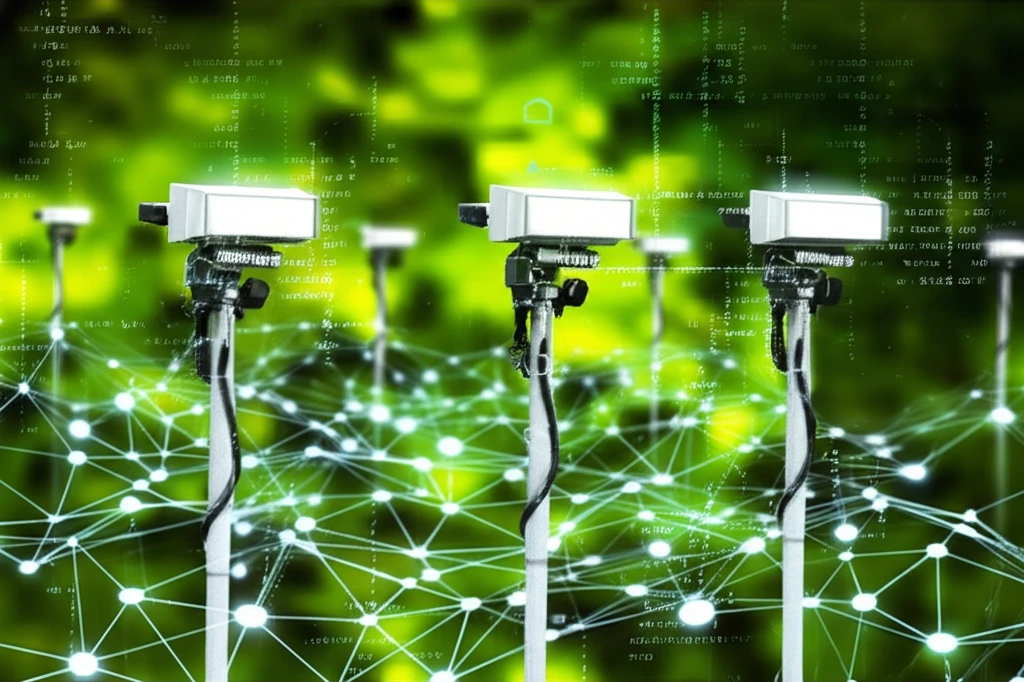
Are We Safe? Unveiling Hidden Dangers in Environmental Radiation Monitoring

"Advanced Techniques Expose Critical Malfunctions in Radiation Detection Systems, Ensuring Public Safety"
In a world increasingly aware of environmental risks, the presence of radioactive or nuclear facilities demands constant vigilance. Radiation surveillance networks act as silent guardians, tirelessly working to ensure the safety of workers and the public. These networks, often mandated by regulatory agencies, provide a crucial layer of protection, offering reassurance to communities living near potentially hazardous sites.
These networks consist of strategically placed detectors that continuously measure environmental dose rates, accumulating vast amounts of data. Traditional analysis focuses on ensuring that radiation levels remain below established safety thresholds. However, a more nuanced approach is needed to guarantee the reliability and accuracy of the monitoring systems themselves. This is where advanced analytical techniques, like covariance matrix analysis, come into play.
Covariance matrix analysis offers a deeper look into the performance and data quality of radiation detection systems. By examining the relationships between different detectors in a network, this method can uncover subtle malfunctions that might otherwise go unnoticed. This proactive approach ensures that monitoring systems function correctly, providing a robust defense against potential radiological hazards.
A Market, a Mandate, and a Measurement Burden
The Environmental Radiation Monitoring Station (ERMS) market is described as playing a pivotal role in ensuring public safety and environmental protection through the monitoring of radiation levels in various ecosystems. Market research underpinning this assessment relies on extensive primary and secondary research to guarantee the reliability and accuracy of its findings. Next-generation approaches are advancing beyond simple dose readings to integrate sensors, data analytics, earth system models, and early warning systems. National programmes illustrate the scale of the effort, with India's Environmental Radiation Monitoring Network undertaking continual assessment of the gamma absorbed dose rate in outdoor air attributable to natural radiation, including a dedicated study in Kolkata, West Bengal.
Proven Methods With Persistent Blind Spots
Ambient gamma radiation is a key component of environmental radiation monitoring and is strongly modulated by atmospheric and meteorological processes, meaning readings fluctuate with weather as well as source activity. Standard practice includes methods to simultaneously determine ambient dose equivalent rate and radioactivity concentration in air, using instruments such as a newly developed CeBr3 scintillation spectrometer. A notable limitation is that the space-weather radiation threat to aviation has historically received less attention than the space sector, despite its implications for aircrew dose management, aircraft routing, and avionics reliability. Global networks of advanced, interconnected sensors now aim to close such gaps by feeding readings into real-time monitoring platforms.
Decades of Continuous Vigilance
The Hong Kong Observatory launched its Environmental Radiation Monitoring Programme (ERMP) in the 1980s to track environmental radiation levels, including the monitoring of tritium. By 2007 the programme had entered its twenty-first year, with monitoring work continuing to operate smoothly on a sound basis. Across such long-running efforts, monitoring stations continuously track radiation levels in various settings, providing real-time data that informs safety protocols and regulatory decisions. The broader history of environmental radiation monitoring is documented in scholarly databases such as J-GLOBAL, preserving foundational context for current practice.
The Power of Covariance Matrix Analysis
The CIEMAT's Radiological Network, composed of several sensors, was used to evaluate the use of covariance matrix. The detectors are located in the same facility, so the detectors measurements are often very similar, because they share the same environmental and weather conditions. The records show high correlation as can be observed into covariance matrix.
- Enhanced Accuracy: Detects subtle malfunctions that traditional methods miss.
- Cost Efficiency: Minimizes economic consequences by identifying issues early.
- Improved Security: Strengthens radiological protection, ensuring regulatory compliance.
- Data Quality: Provides quality assurance of records from radiation detector networks
Collaboration and Regional Reviews
Recent research output includes a peer-reviewed poster describing a collaboration between Waterford Institute of Technology and the Environmental Protection Agency on environmental radiation monitoring. In parallel, the Ukrainian journal "Meteorology. Hydrology. Environmental monitoring" has published work addressing the radiation state of environmental components within the exclusion zone. These contributions reflect a shift toward cross-institutional partnerships and region-specific radiological assessment as the field's current research frontier.
Where the System Falls Short
Criticism of current arrangements includes a watchdog group's charge that the federal government scaled back its radiation monitoring while simultaneously planning to raise allowable radiation release levels in food, water, and soil after a nuclear incident. Independent assessments identify specific technical gaps: the limited range of monitoring, the inability to detect certain types of radiation, and dependency on external power sources are cited as key limitations of existing stations. Industry vendors counter these constraints by offering broad sensor ranges and turnkey network solutions for gamma dose rate measurement, spectroscopic analysis, and air monitoring.
Verification Through Inter-Comparison
Reliability is pursued through routine calibration and cross-laboratory checks, as illustrated by the Hong Kong Observatory, which conducts regular instrument calibration, follows internal quality assurance procedures, and participates in radiation measurement inter-comparisons to ensure dependable results. Comparable vigilance applies wherever radiation is a concern, since detecting radiation supports monitoring of environmental contamination, assessment of the impact of nuclear incidents, and implementation of remediation strategies. Across jurisdictions, the pattern that emerges is that trust in monitoring data rests less on any single instrument than on disciplined, transparent verification practices.
Protecting Our Future
Advanced analytical techniques offer a proactive approach to environmental radiation monitoring, ensuring the reliability and accuracy of detection systems. By embracing these innovations, we can enhance our ability to safeguard communities from potential radiological threats, building a safer and more secure future for all.
A Mature Field With Uneven Coverage
Taken together, the record suggests that environmental radiation monitoring is mature in its core methods yet uneven in coverage, capability, and scrutiny. Systems range from long-running national programmes to emerging networked sensors, and credible critiques of gaps and limitations persist alongside steady technical progress. Because much of the supporting material is scattered and partial, these conclusions should be read as an outline rather than a settled verdict. The common thread is that transparency, independent verification, and sustained investment separate meaningful monitoring from procedural compliance.
National Baselines and Public Maps
Forward-looking developments include FANR's launch of the UAE's first National Environmental Radiation Monitoring programme, through which the authority independently verifies environmental monitoring results, measures radiation levels across different environmental media, and supports the establishment of a national baseline of environmental radioactivity. Public-facing tools are expanding access to data, with websites such as SaveEcoBot displaying the locations and readings of radiation monitors across Ukraine. Together these initiatives point toward a future of more complete baselines, independent oversight, and greater public transparency.
From Baltic Waters to Deep Space
Environmental radiation monitoring constitutes a fundamental component of radiological protection and emergency preparedness, as recognized within the Baltic Sea region's offshore surveillance efforts. A major systemic challenge is background variability: a complete understanding of both the steady-state and transient background measured by Radiation Portal Monitors is essential to predictable system performance and maximum detection sensitivity, with rain-induced rises in background radiation as a real-world example. Beyond the atmosphere, space radiation presents a distinctly different threat, being comprised of atoms stripped of their electrons rather than the familiar terrestrial forms. These contrasts underscore that no single monitoring approach fits every environment.
Connecting Data to People
New digital layers are changing how radiation data reaches and affects people, but they also create fresh vulnerabilities: a study evaluating cloud computing in radiation detection systems examined associated cybersecurity threats, mapping attack vectors to cloud components and identifying threats through real-world case studies. On the public side, platforms such as the Geiger Counter World Map provide real-time radiation and radon world maps, while dashboards like World Monitor stream raw global signals and flag when events converge into something consequential. The human element, in short, cuts both ways: technology makes radiation more visible and more attackable at the same time.