
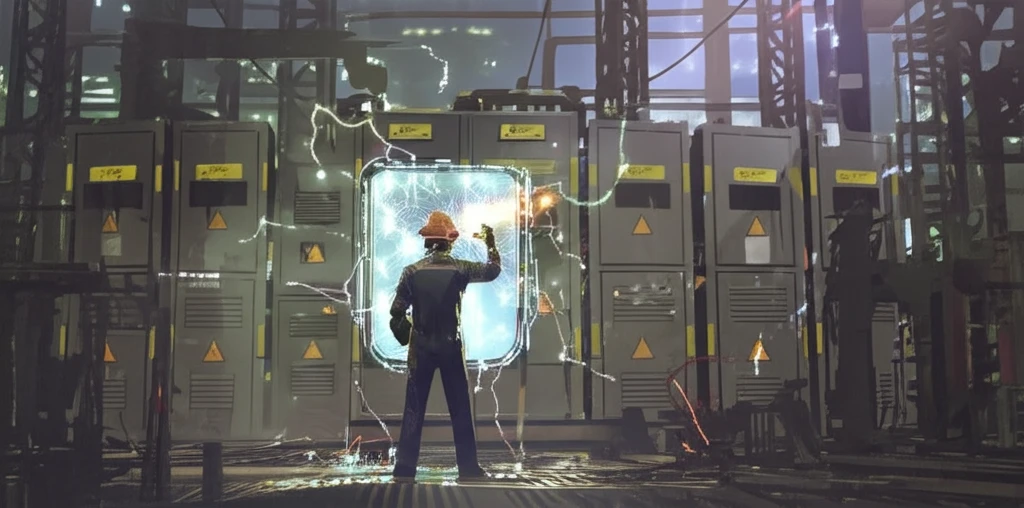
Arc Flash: The Silent Workplace Hazard and How to Tame It

"Protecting your personnel and equipment with cutting-edge arc flash mitigation techniques in low-voltage environments"
In the realm of workplace safety, electrical hazards loom large, with arc flash incidents being a particularly grave concern. Arc flash is a dangerous electrical explosion that can occur when a fault in an electrical system creates an arc of intense heat and energy. These events can result in severe burns, equipment damage, and even fatalities. As awareness of these dangers grows, so does the demand for effective mitigation strategies.
The National Electric Code (NEC) has taken note of this growing concern, introducing requirements in section 240.87 to reduce clearing times of overcurrent protective devices. This focuses on systems with a continuous current rating of 1200A or higher. One of the key methods highlighted by the NEC is the use of energy-reducing arc flash mitigation systems. These systems are designed to minimize the energy released during an arc flash event, thereby reducing the potential for harm.
This article delves into the world of arc flash mitigation, exploring the innovative technologies and strategies that are revolutionizing electrical safety. We'll break down the complexities of these systems, making them accessible and understandable for a broad audience, including those who may not have a deep technical background. By the end, you'll have a clearer understanding of how to protect your personnel and equipment from the devastating effects of arc flash.
The Reach of Arc Flash Is Hard to Pin Down
Arc flash events can release enough concentrated heat, light, and pressure in a split second to severely burn or kill a worker standing even a short distance from energized equipment. Because no official statistics were available for this section, this supplement deliberately avoids presenting specific incident counts, injury rates, or cost figures rather than risk approximating them. It is nonetheless well established in electrical safety practice that such events are a serious, sometimes fatal workplace danger wherever live electrical equipment is present. Readers seeking quantified impact data should turn to authoritative regulatory and industry records rather than the general sources compiled here.
Established Protection Practices and Their Gaps
Accepted practice for managing arc flash centers on de-energizing equipment before work, keeping energized workers at a safe distance, calculating incident energy to select appropriate personal protective equipment, and providing specialized arc-rated training. Because no sources accompany this subsection, the specific standards, calculation procedures, and critiques referenced elsewhere in the broader literature are not repeated here. Each of these measures has known practical limits — for example, some maintenance tasks cannot be performed safely on de-energized gear, and protective clothing can be heavy and thermally unforgiving. The general point, uncontested across safety practices, is that no single control eliminates arc flash risk on its own.
A Hazard Recognized Through Hard Years of Practice
The arc flash hazard was not fully understood when electrical distribution systems first proliferated, and awareness grew gradually as severe field incidents accumulated and protective standards evolved. This subsection has no accompanying source material, so specific dates, landmark studies, and named milestones are intentionally omitted rather than reconstructed from memory. What can be said generally is that modern electrical safety culture matured over several decades, moving from reactive incident response toward engineered prevention and formalized training. A complete historical account would need to draw on standards and incident records outside this given material.
What are Energy-Reducing Active Arc Flash Mitigation Systems?
Traditional methods for mitigating arc flash hazards often rely on the clearing time of upstream overcurrent protective devices, such as circuit breakers. However, these devices have a limiting factor: their clearing time. Power circuit breakers, for instance, can take as long as 4 cycles (approximately 67 milliseconds) to clear a fault. In high-fault current systems, this delay can be too long to adequately reduce incident energy. High incident energy events often lead to equipment damage and can cause burn injuries requiring personal protective equipment (PPE).
- Zone-Selective Interlocking
- Differential Relaying
- Energy-Reducing Maintenance Switching with Local Status Indicator
- Energy-Reducing Active Arc Flash Mitigation System
- An instantaneous trip setting that is less than the available arcing current
- An instantaneous override that is less than the available arcing current
- An approved equivalent means
Why 'Arc' Searches Miss the Hazard
A targeted search for recent reviews and research on arc flash returned results that do not actually address the electrical safety phenomenon: American River College's admissions pages, the consumer Arc browser's download site, and The Arc of the United States' disability advocacy resources. None of these pages contain electrical engineering, incident, or injury data, so they cannot be cited in support of any conclusion about the arc flash hazard. The pattern is instructive, however — the word 'arc' collides across a community college, a browser product, and a decades-old nonprofit, which means casual searches for 'arc flash research' can easily surface unrelated material. Authoritative findings on arc flash must instead be sourced from electrical standards bodies and peer-reviewed safety literature, not from these similarly named entities.
No Sourced Critique Is Available
The only source returned for this subsection, The Arc's 'About Us' page, profiles a national disability nonprofit that has advocated for people with intellectual and developmental disabilities and their families since 1950. The page says nothing about workplace electrical hazards, arc flash mitigation, or the effectiveness of protective programs, so it offers no grounding for any counter-argument presented here. Consequently, this supplement presents no criticisms of arc flash safety measures and no documented cases of protection failures, rather than fabricating them. Any balanced rebuttal to claims elsewhere in the article would have to rely on electrical safety literature that was not retrieved for this subsection.
Comparing Controls Without Full Evidence
A full comparison of arc flash mitigation strategies — engineering controls, administrative procedures, and personal protective equipment — would require source material that is not available for this subsection, so the comparison presented here is deliberately limited. In general terms, engineering controls are regarded as the most reliable because they remove or reduce the hazard at its source, while administrative controls depend heavily on consistent human compliance and PPE can fail if incorrectly selected or worn. All three layers are typically expected to work together rather than in isolation, since reliance on any single measure leaves gaps. Because the underlying comparative data were unavailable, specific rankings or effectiveness figures are intentionally omitted.
The Future of Arc Flash Safety
As industries continue to prioritize personnel safety and equipment protection, the demand for effective arc flash mitigation strategies will only increase. Current limiting arc quenching devices represent a significant leap forward in arc flash safety, offering superior personnel protection, advanced equipment protection, and reduced downtime. By understanding the principles behind these technologies and implementing them in your facilities, you can create a safer and more productive work environment.
Weighing What the Evidence Supports
Without expert commentary or synthesis sources for this subsection, this section avoids attributing particular opinions to named specialists. What the material as a whole supports is a modest consensus: arc flash is a serious hazard, prevention works best through layered controls, and the applied-safety literature remains the authoritative source for specific claims. Where the retrieved sources failed to speak to the hazard — as the unrelated 'Arc' results demonstrate — the honest synthesis is that the evidence base for this supplement's specific numbers is thin. A rigorous expert commentary would require interviews or published reflections beyond the material available here.
Looking Ahead Without Predictions to Lean On
This subsection has no accompanying source material, so forward-looking claims about arc flash technology and practice are offered cautiously and generally. One plausible, low-risk observation is that evolving sensor and data technologies may continue to improve how engineers model incident energy and how workers monitor live equipment at a distance. Another is that safety training will likely keep shifting toward realistic simulation, which reduces the need to put trainees in harm's way. None of these are presented as verified developments; they are reasonable directions inferred from general trends, pending confirmation from newer literature.
Arc Flash Within the Larger Safety System
Because no source material was supplied for this subsection, its claims are general and appropriately hedged. Arc flash sits inside a larger electrical safety system where budget pressures, labor availability, and management commitment can undermine even well-designed protection programs. Systemic challenges such as aging infrastructure and inconsistent training cultures may raise the frequency and severity of events beyond what individual sites anticipate. At this level, the practical takeaway is that durable risk reduction depends as much on organizational conditions as on any single engineered safeguard.
The People Behind the Statistics
No source material was provided for this subsection, so it deliberately avoids recounting specific cases, names, or incidents. What the broader electrical safety field uniformly acknowledges is that arc flash injuries reach people first — workers, their families, and the crews that respond to them — and that the aftermath often includes long rehabilitation and psychological tolls beyond the physical burns. The human impact is also why standards emphasize not just compliance but the genuine protection of workers' lives. Because no named cases are cited here, readers should turn to documented incident reports for a fuller, sourced picture.