
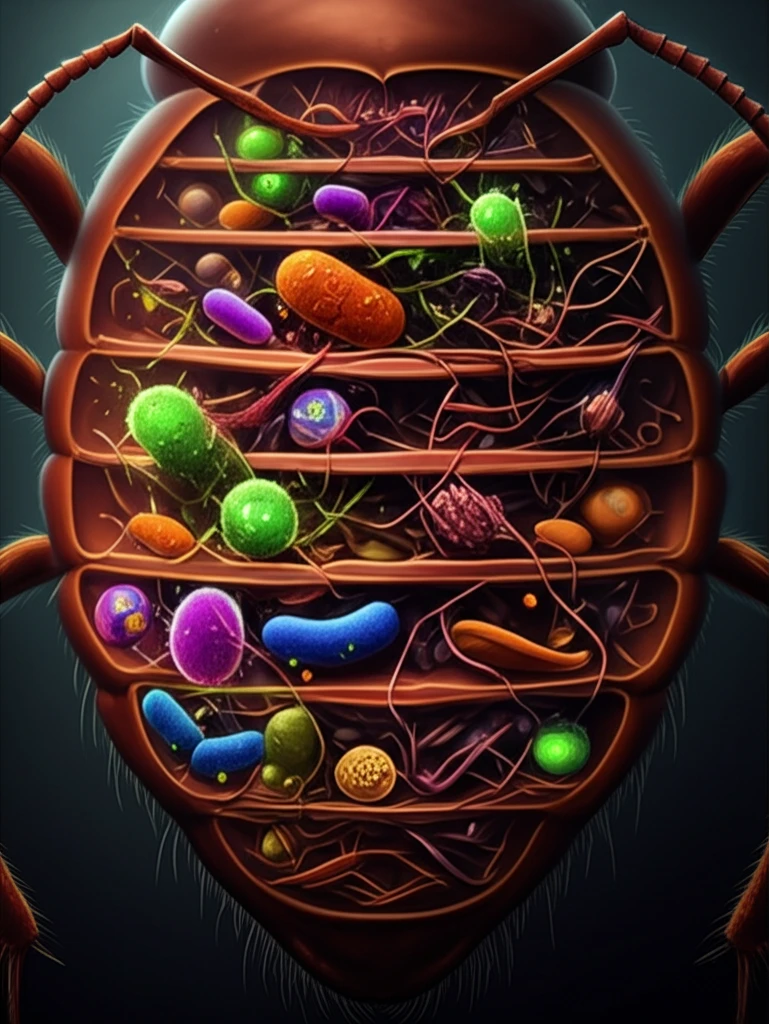
Ant Abdominal Microbiomes: The Unseen World Shaping Fungus-Growing Civilizations

"Delve into the hidden universe of bacteria living within ants and how they drive the evolution of complex fungus-farming societies."
For millions of years, ants have cultivated fungi, creating intricate agricultural systems that rival human innovation. While we often marvel at the visible aspects of these societies – the bustling workers, the carefully tended gardens – a hidden world thrives within: the abdominal microbiomes of these fascinating creatures. These bacterial communities, residing within the ants' digestive systems and associated organs, are not merely passive inhabitants; they actively shape the evolution, health, and social dynamics of these fungus-growing civilizations.
New research has illuminated the crucial role these microscopic partners play in the ants’ success. By studying the abdominal microbiomes of 17 Panamanian ant species, scientists have uncovered how these bacterial communities have evolved alongside ant agriculture, influencing everything from their dietary habits to their defense mechanisms. This is the wild west of biology-a look into the most unexpected creatures playing vital roles.
Prepare to journey into the unseen world within ants, where bacteria are the unsung heroes driving the evolution of complex fungus-farming societies.
The Scale of Ant Microbiome Diversity
Ants host a wide range of microbes with diverse functions and are emerging as a key model for studying the evolution of insect microbiomes. Research shows ant microbiomes are distinct from their surrounding soil environments, yet vary dramatically across colonies—a variation largely driven by the relative abundance of Lactobacillus, a genus frequently associated with hymenopteran diets. Databases like MANTA (Microbiota and Phenotype correlation analysis platform) now catalog these microbial communities, supported by funding from Marie Sklodowska-Curie Actions. Evidence also suggests a strong host ant signature in associated microbiomes, pointing toward vertical inheritance of bacterial communities.
Microbiome Standards and Methodological Frameworks
Microbiome research relies on established standards and controls to ensure reproducibility across studies. Zymo Research's Microbiomics Standards & Controls Initiative (M-SCI) provides benchmarking tools that have been recognized in over 1,000 publications and cross-validated with multiple quantification methods. Standard methods for examining biological and environmental samples, such as those published by the American Public Health Association, offer protocols for solid analysis that underpin microbiome sampling. These frameworks aim to address the challenge of comparing results across different laboratories and sequencing platforms.
Fifty Million Years of Ant Agriculture
Fungus-farming ants have practiced agriculture for approximately 50 million years, making them one of the oldest known farming lineages. When a queen leaves her original nest to establish a new colony, she carries part of the fungus in her mouth, tending it underground while waiting for her workers to mature. This ancient mutualism between ants and their cultivated fungi has persisted through dramatic environmental changes. The ant microbiome is distinct from surrounding soil, yet varies dramatically across colonies, driven largely by Lactobacillus abundance—a genus frequently associated with hymenopteran diets.
A Symphony of Microbes: The Ant Abdomen Orchestra
Imagine an ant's abdomen not as a simple biological compartment, but as a bustling metropolis teeming with microbial life. This is the reality of the ant microbiome, a complex ecosystem dominated by a few key bacterial players: Mollicutes, alpha-Proteobacteria, gamma-Proteobacteria, and Actinobacteria. These aren't just random squatters; they form intricate relationships with their ant hosts, influencing their biology in surprising ways.
- Mollicutes
- Alpha-Proteobacteria
- Gamma-Proteobacteria
- Actinobacteria
Ant Microbiomes as Models for Symbiosis Research
Ants are ideal models for studying microbiome and host symbiosis due to their global distribution and habitat diversity, according to researcher Manuela Ramalho. A 2025 research review suggests the intricate microbiome of fungus-farming ants could harbor insights or tools for combating agricultural or human diseases. Nature's microbiome research portal continues to aggregate findings across kingdoms, recognizing the microbiome as all genetic material within a microbiota. The study of ant-associated microbes is increasingly interdisciplinary, drawing from entomology, microbiology, and medicine.
Colony-Level Variation and Methodological Challenges
Research on Trachymyrmex septentrionalis reveals that ant microbiomes differ strongly between colonies but less so within colonies, complicating generalized conclusions. Microbiomes of different castes and those following lab adaptation also differ in a colony-specific manner, suggesting environmental context matters enormously. In experimental applications, researchers collected red wood ants from colonies in Denmark and Bulgaria, characterizing their microbiomes using 16S rRNA gene sequencing and culture methods. These findings highlight that conclusions drawn from single colonies may not generalize across species or geographic regions.
Colony-Driven Variation in Ant Microbiome Composition
Comparative studies reveal that the ant microbiome is distinct from soil microbiomes, but contrary to initial predictions, varies dramatically across colonies. This inter-colony variation is largely driven by the relative abundance of Lactobacillus, a genus frequently associated with hymenopteran diets. Such findings challenge assumptions that ant microbiomes are uniform across a species, suggesting instead that local conditions and colony history shape microbial community assembly. The pattern indicates that Lactobacillus may play a particularly significant role in defining colony-level microbiome identity.
A New Lens on Ant Societies
The study of ant microbiomes is still in its early stages, but it is already revealing a wealth of information about the intricate relationships that underpin these complex societies. By understanding the roles these bacteria play, we can gain new insights into the evolution of agriculture, social behavior, and the delicate balance of ecosystems. While the research highlights the importance of these symbiotic relationships, it also suggests the need for caution as these microbial interactions are disrupted by human actions. As we continue to reshape the planet, understanding and protecting these vital partnerships will be crucial for ensuring the health and resilience of these fascinating societies.
Social Partnerships Shape Microbial Communities
Emerging evidence suggests that ants' microbiomes are possibly shaped by their social partnerships, not just host genetics alone. Ants that farm the same trophobionts share strains of sugar-processing Acetobacteraceae bacteria, a pattern also documented in other insect systems. This finding implies that behavioral ecology—specifically which organisms ants interact with—directly influences their internal microbial communities. The research opens new questions about how social networks propagate microbial strains across ant populations.
Roadmaps for Inclusive Ant Microbiome Research
A recent systematic review builds on previous work from 2017 and provides a roadmap for future ant microbiome research. The review calls for more inclusive sampling across geographic regions, interdisciplinary approaches, and attention to underrepresented ant lineages. Researchers continue to ask whether phylogenetically related ant species have formed distinct and stable microbiomes—a question central to understanding microbiome evolution. These priorities reflect recognition that current datasets skew heavily toward certain well-studied species and temperate ecosystems.
From Ant Cuticles to Antibiotic Discovery
The microbiome found on the cuticles of leafcutter ants is a rich source of actinomycete bacteria, a family that produces diverse natural products. Notably, half of all antibiotics already in clinical use originate from this bacterial family. Research scientist Manuela Ramalho, who grew up in Brazil's insect-rich ecosystems, has turned ant research into a specialization in their microbiome functions. The connection between ant-associated microbes and pharmaceutical discovery underscores the untapped potential of insect microbiomes for human health applications.
Symbiosis, Dysbiosis, and Horizontal Exchange
Studies comparing ant and fungus garden combinations reveal important differences between symbiotic and dysbiotic states. Researchers examined the impact of horizontal exchange on bacterial microbiome structure, finding that the direction and nature of microbial transfer matters significantly. These comparisons between healthy and disrupted symbioses provide frameworks for understanding what happens when ant-fungal partnerships break down. Such research has implications for understanding dysbiosis more broadly, including in agricultural and potentially human microbiome contexts.