
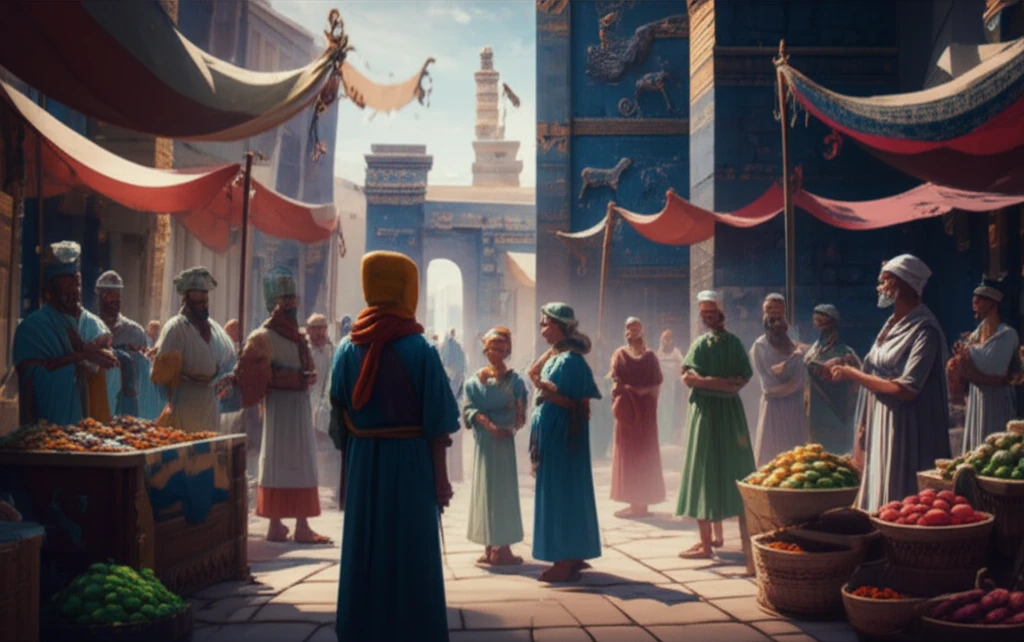
Ancient Babylon's Melting Pot: Uncovering the Stories of Foreigners in Nebuchadnezzar's Era

"Explore how economic opportunities, war, and political maneuvering drew diverse populations to Babylon, shaping its vibrant culture during Nebuchadnezzar II's reign."
Imagine walking through the ancient city of Babylon during the reign of Nebuchadnezzar II (605-562 B.C.E.). A bustling metropolis, it was home to not only native Babylonians but also a significant number of foreigners from various lands. These individuals, hailing from the Levant, Egypt, Anatolia, and the Jazira, added unique flavors to the city's cultural and economic landscape.
Historical texts reveal that these foreigners weren't a homogenous group. They included prisoners of war, diplomatic envoys, skilled laborers, and merchants, each with their own reasons for being in Babylon. Their presence reflects the city’s central role in regional power dynamics, trade, and warfare.
This article explores the stories of these foreigners, drawing on historical records to paint a picture of their lives, roles, and integration (or lack thereof) within Babylonian society. By examining their experiences, we can gain a deeper understanding of Babylon's complex social structure and its interactions with the wider ancient world.
The Neo-Babylonian Empire's Reach
Nebuchadnezzar II ruled the Neo-Babylonian Empire from 605 BC to 562 BC, making him one of ancient history's most significant monarchs. The Neo-Babylonian Empire, historically known as the Chaldean Empire, represented the last polity ruled by monarchs native to ancient Mesopotamia. Nebuchadnezzar II was the second and greatest king of the Chaldean dynasty, renowned for his military might and the splendor of his capital Babylon.
Challenges in Studying Ancient Babylon
Studying ancient Babylonian civilization relies heavily on archaeological evidence, cuneiform inscriptions, and biblical texts, each with inherent limitations. Archaeological records are often fragmentary, with only portions of monuments and texts surviving millennia of decay. Cuneiform tablets, while numerous, frequently require specialized interpretation and may reflect biases of their scribes. Biblical sources provide valuable perspectives but represent a particular theological viewpoint that must be contextualized. These methodological challenges make comprehensive understanding of Babylonian society, especially regarding foreign populations, an ongoing scholarly endeavor.
Nebuchadnezzar's Rise and Conquests
The Neo-Babylonian Empire flourished from 626 to 539 BCE in Mesopotamia, with Nebuchadnezzar II rising to power after his father Nabopolassar expelled the Assyrians. Nebuchadnezzar solidified his reign through military conquests, including the defeat of the Egyptians and the subjugation of Judah, culminating in the destruction of Jerusalem. His era marked a significant period of Babylonian power and cultural achievement, establishing the city as a dominant force in the ancient Near East.
Who Were These Foreigners in Babylon?
The reign of Nebuchadnezzar II was marked by extensive military campaigns, which inevitably led to an influx of prisoners of war. These captives, primarily from regions west and northwest of Babylon, formed a significant portion of the foreign population. While their lives were undoubtedly difficult, their labor and skills contributed to Babylon's infrastructure and economy.
- Prisoners of War: Captured during Nebuchadnezzar's military campaigns, these individuals were often employed in construction and other manual labor projects.
- Diplomatic Envoys: Representatives from neighboring kingdoms, fostering political and cultural exchange.
- Skilled Laborers: Craftsmen, artisans, and scribes from various regions who brought valuable skills and expertise to Babylon.
- Merchants and Traders: Individuals involved in commerce, facilitating the exchange of goods and ideas.
- Religious Figures: Priests and other religious personnel who maintained cultural and spiritual connections to their homelands.
New Archaeological Discoveries at Kish
In January 2026, archaeologists published findings of two inscribed clay cylinders that provide direct textual evidence of Nebuchadnezzar II's restoration work at the ziggurat of Kish. For generations, his involvement at the ancient city was inferred from scattered stamped bricks, but no formal building inscription had confirmed his hand in restoring the city's monumental ziggurat. The study revealed that Nebuchadnezzar linked his rule to Babylon's sacred past through this restoration project, highlighting how history is shaped by competing narratives.
The Empire's Decline After Nebuchadnezzar
Nebuchadnezzar I (1124-1103 BCE) was the most famous ruler of the Second Dynasty of Isin, who defeated the Elamites and recovered the sacred statue of Marduk. However, the Babylonian Empire suffered major blows when Nebuchadnezzar II's sons lost a series of wars with Assyria, and their successors effectively became vassals of the Assyrian king. Babylonia descended into a period of chaos in 1026 BCE, demonstrating the empire's vulnerability despite earlier military successes.
Comparing Babylon's Great Rulers
Hammurabi, the sixth king of the First Babylonian Dynasty in the early 18th century BCE, is best known for creating one of the earliest written law codes. Nebuchadnezzar II transformed the Neo-Babylonian Empire from a regional power into a dominant force in the ancient Near East through military campaigns and architectural projects. While both rulers were pivotal in Babylonian history, Nebuchadnezzar I and II shared a royal moniker yet experienced vastly different levels of historical recognition and legacy.
The Lasting Impact of Foreigners on Babylonian Society
The presence of foreigners in Babylon had a profound and lasting impact on its society. These individuals not only contributed to the city's economic and infrastructural development but also enriched its culture through the introduction of new ideas, customs, and technologies. While their integration into Babylonian society was not always seamless, their presence undeniably shaped the city's identity as a cosmopolitan center in the ancient world. By understanding their stories, we gain valuable insights into the complexities of ancient migration, cultural exchange, and the formation of urban societies.
Nebuchadnezzar's Complex Legacy
Nebuchadnezzar II looms large in the biblical books of Jeremiah and Daniel, where he constructed a golden statue 90 feet high and nine feet wide in the plain of Dura near Babylon. His building activities extended beyond military conquest, with inscribed bricks and cylinders documenting restoration projects across the empire. Scholars examine how his narrative tested the capacity of exemplarity to absorb singular biblical texts into reformed theologies, revealing the complexity of his historical and religious portrayal.
Babylon's Enduring Legacy Today
In modern Iraq, the ruins of ancient Babylon have witnessed epochs of historic turmoil and now face an uncertain future, but still have the power to amaze visitors. Restoration efforts are helping to draw tourists back to Iraq, with the ancient city's archaeological remains serving as a testament to its former glory. A spectacular blue-glazed gate Nebuchadnezzar II built gradually disintegrated after the fall of the Babylonian Empire in the sixth century BC, but ongoing preservation work aims to protect what remains.
Understanding Ancient Civilizations
Understanding ancient civilizations like Babylon requires grappling with incomplete historical records and preservation challenges. Archaeological sites face threats from environmental degradation, urban development, and political instability in their host regions. Scholarly interpretation must navigate biases inherent in source materials, whether cuneiform tablets, biblical texts, or classical accounts. These systemic challenges underscore the importance of continued research and international cooperation in preserving humanity's shared cultural heritage.
Babylon's Cultural Significance
Babylon was a small port town situated on the Euphrates River that grew to become one of the most prosperous cities within Mesopotamia, located in modern-day Iraq roughly 50 miles south of Baghdad. Today, Babylon functions as a cultural touchstone, with its ruins representing the physical manifestation of ancient human achievement and ambition. The city originally dated to around 2,000 BCE and evolved into the main cultural and political center of the Akkadian-speaking region of Babylonia, demonstrating the enduring human impulse toward community and civilization.