
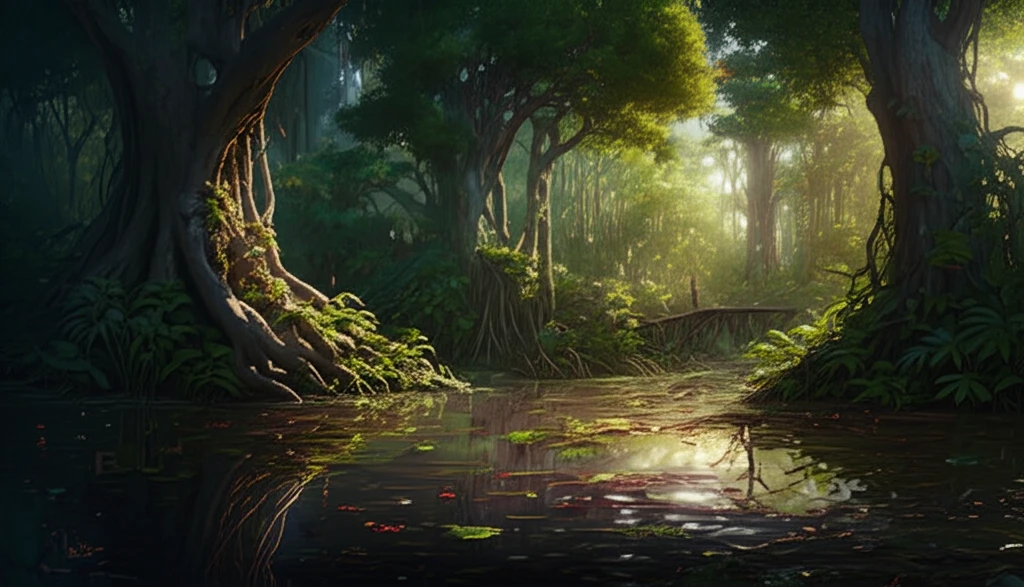
Amazon's Hidden Forests: Unlocking the Secrets of the Igapó

"Discover the unique tree species thriving in the flooded forests of the Negro River and the challenges of preserving this vital ecosystem. Understanding Igapó Forests Species Diversity."
The Amazon rainforest, a name synonymous with biodiversity, holds secrets within its flooded depths. These aren't your typical rainforest floors; they're the igapó forests, a realm where the Negro River's dark waters dictate life's rhythms. Characterized by high species richness in generally uniform habitats, the Amazon's complex ecosystems have intrigued scientists for decades. Yet the specific ecological dynamics of its seasonally flooded forests are still being unraveled.
Scientists estimate that the Amazon is home to between 30,000 and 50,000 species of woody plants, a number recently updated to around 16,000 tree species. This incredible diversity has spurred numerous theories, with the ‘museum model’ suggesting climatic stability allows species to accumulate over time due to low extinction rates. However, this theory doesn't fully account for the region's past climatic shifts.
An alternative theory proposes that the Amazon's diversity is a result of more recent speciation events, driven by allopatric differentiation, where populations evolve separately in isolated refuges. Geological events like the uplift of the Andes and the formation of the Panama Isthmus also contributed to this diversification. However, if understanding the plant life of mainland forests is a challenge, the seasonally flooded forests present an even more intricate puzzle.
Blackwater Forests at the Heart of the Amazon
Igapó forests are blackwater-flooded forests found in the Amazon biome, typically existing around freshwater lakes and the lower reaches of rivers. This ecosystem generally receives at least six months of rainfall annually, and is considered an incredible and essential part of the Amazon's freshwater landscape.
Mapping Species Through Environmental Filters
Researchers analyze environmental factors and their correlations to understand differences in the composition and richness of tree species between forest types. This approach is an efficient way to reveal how variation in flooding and water chemistry shapes which species grow where, though it reflects only part of the complex dynamics of the igapó ecosystem.
A First Dedicated Volume
The publication of the first volume devoted exclusively to igapó forests marked a milestone in Amazonian research. It enriched scientific understanding of the interactions between all aspects of this unique ecosystem, establishing a dedicated foundation for future study.
The Blackwater Enigma: Life in the Igapó
Igapó forests, also known as blackwater forests, are distinctly shaped by the long, predictable flooding periods that dramatically influence the structure and composition of plant species. This continuous change poses unique challenges and opportunities for the flora that call these forests home. Alfred Russel Wallace, a pioneering naturalist, first categorized the Amazon's waters into three limnological systems: white water, clear water, and black water. The black water rivers, draining the ancient Paleozoic and Pre-Cambrian soils of the Guiana Shields and Central Brazil, owe their color to the decaying leaves, roots, and other plant materials present in the water.
- Habitat Richness: Igapó forests boast a complex mosaic of micro-environments, each supporting distinct plant communities.
- Geohydrological Stability: The relative stability of the Amazon basin over millions of years has allowed for the evolution of highly specialized species.
- Nutrient Dynamics: The unique water chemistry of blackwater rivers influences nutrient availability, shaping the flora that can thrive in these conditions.
- Adaptations to Flooding: Trees have developed ingenious strategies to cope with prolonged submersion and oxygen-deprived soils.
Networks Beneath the Flood
Recent research into ant-plant interactions shows that obligate interactions remained nested and modular in both flooded and non-flooded forest types. This stability persisted despite substantial reductions in species richness in seasonally flooded igapó forests, offering insight into how specialized partnerships survive environmental stress.
Seasonal Floods Take a Toll
Not every measure of the igapó ecosystem is robust: seasonally flooded igapó forests show substantial reductions in species richness compared to other forest types. Environmental filtering in these flood-prone habitats constrains which species can persist, even as obligate interactions hold their structure.
Igapó Among the Amazon's Ecosystems
Igapó forests stand apart from other Amazonian ecosystems as forests on the blackwaters of the Amazon River, typically surrounding freshwater lakes and lower river reaches. While the wider Amazon is the world's richest and most-varied biological reservoir, the distinctive dark-water igapó is defined by its unique flooding regime and blackwater environment.
Conserving the Amazon's Submerged Treasures
The igapó forests of the Amazon represent a unique and vital ecosystem, harboring specialized tree species adapted to the region’s seasonal flooding. Understanding the distribution patterns and ecological factors is essential for conservation efforts. As the Amazon basin faces increasing pressures from deforestation and climate change, preserving these submerged treasures becomes ever more critical for maintaining the region’s rich biodiversity and ecological integrity. Through continued research and conservation, we can ensure these unique forests thrive for generations.
Critical to a Shared Human Future
Experts describe igapó forests as a common part of the Amazon whose ecosystems are critical to our shared human future. Their structure, function, and dynamics are now addressed together in a single dedicated volume, emphasizing how interconnected all aspects of this unique ecosystem truly are.
Directions for Research and Action
The dedicated volume on igapó forests includes explicit suggestions for further research and future action, pointing researchers toward the gaps still unexplored in these flooded forests. Future work is expected to deepen understanding of how the ecosystem's components interact and how conservation can respond.
Flooded Forests Under Pressure
Rainforests play an invaluable role in sustaining life, yet every year large portions are cut down for logging, mining, and cattle ranches. These pressures threaten not only the igapó but the broader Amazonian landscape they depend on.
Life at the Water's Edge
The igapó's dark rivers are home to some of the Amazon's most formidable predators: black caimans wait in the shadows while giant otter packs challenge apex rulers, green anacondas strike with pressure around ninety pounds per square inch, and electric eels release high-voltage shocks. This richness is part of why the Amazon Rainforest is regarded as the world's richest and most-varied biological reservoir, holding several million species of insects, plants, birds, and other life forms.