
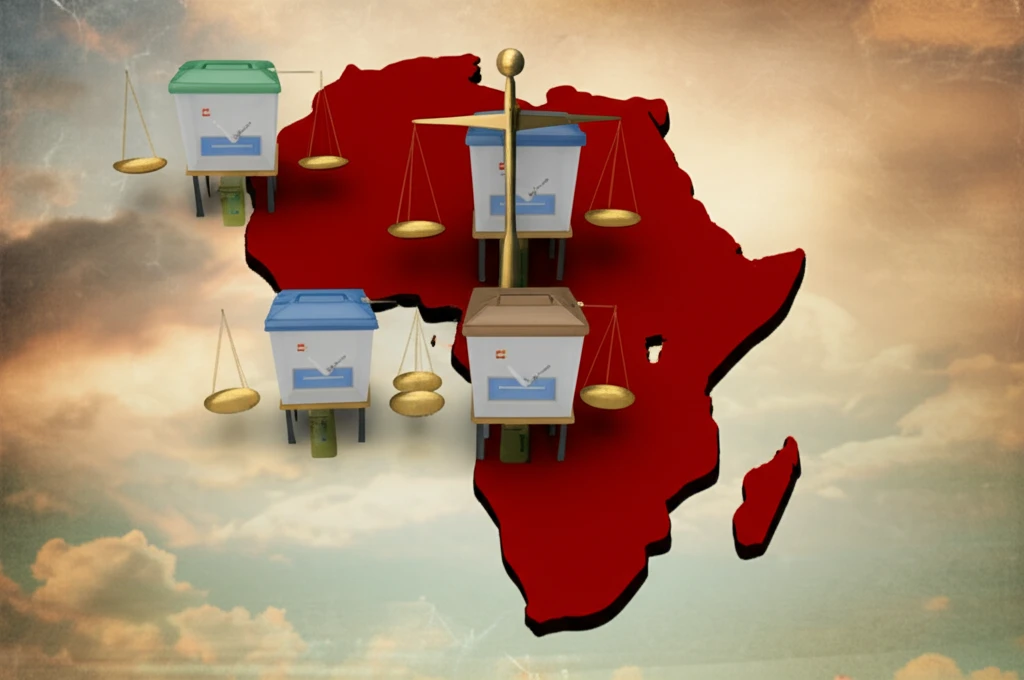
Africa's Political Pulse: Elections, Power Plays, and the Fight for Democracy

"A deep dive into recent elections and political shifts in Mauritania, Nigeria, and Rwanda, revealing trends in governance, opposition, and democratic processes across the continent."
Across Africa, the political landscape is constantly shifting, with elections serving as crucial barometers of governance, stability, and democratic progress. Recent months have seen significant electoral events in Mauritania, Nigeria, and Rwanda, each presenting unique challenges and outcomes that reflect the broader trends shaping the continent.
This article delves into the details of these elections, examining the key players, the issues at stake, and the controversies that have arisen. By analyzing these case studies, we gain a deeper understanding of the complexities of African politics and the ongoing struggle for democratic ideals.
From allegations of fraud and political maneuvering to the resilience of opposition movements and the dominance of ruling parties, the narratives unfolding in these nations offer valuable insights into the state of democracy and governance in Africa today.
Africa's Electoral Landscape at a Critical Juncture
Africa's democratic landscape remains dynamic and contested. In 2024, South Africa held its seventh general election under universal adult suffrage since the end of apartheid, electing a new National Assembly and provincial legislatures across all nine provinces. Meanwhile, organizations such as Stears Open Data are tracking upcoming elections across the continent in 2026 and 2027, providing comprehensive data on democracy metrics and political trends. These developments underscore that elections remain the primary mechanism through which African citizens seek to shape governance outcomes, even as the quality and integrity of those processes vary widely.
Electoral Systems, International Oversight, and Institutional Gaps
South Africa's electoral system operates as a closed-list proportional representation model in which Parliament comprises 490 seats, with general elections held every five years and seats distributed in proportion to party support nationally. In the 2024 election, the ruling African National Congress secured only 40.18 percent of the vote, falling well short of a majority for the first time since 1994. International platforms like Meta have established elections operations centers with fact-checking networks covering multiple South African languages to counter misinformation in real time. However, these measures have proven insufficient elsewhere: the African Union declared Tanzania's October 2025 general elections failed to meet AU principles and international democratic standards, citing violence, opposition suppression, and structural flaws.
Decades of Electoral Violence and Structural Fragility
Scholarly literature on African elections has long documented the prevalence of electoral violence, highlighting how the precariousness of institutional frameworks and the high stakes of political power create conditions for conflict. Kenya's electoral history exemplifies this pattern, shaped by successive contests involving figures such as Daniel arap Moi, Raila Odinga, and Mwai Kibaki, alongside the recurring fragmentation of opposition movements. Critical perspectives argue that many African elections function less as genuine democratic exercises than as corporate-style auditions for managing state resources, with entrenched elites controlling the process regardless of voter preferences. These foundational observations continue to frame contemporary analysis of democratic governance across the continent.
Mauritania: A Contested Victory
In Mauritania, the ruling Union for the Republic (UPR) party secured a sweeping victory in legislative, municipal, and local elections, solidifying its dominance ahead of the upcoming presidential poll. The UPR gained an additional 22 seats in the parliament, bringing its majority to 89 in the 157-seat body. This victory extended to the regional councils, where the UPR claimed all 13 seats, and the municipal level, where it won 162 out of 219 communes.
- The UPR's win gives it a strong advantage heading into the next presidential elections.
- The opposition parties are claiming “shameless fraud” in the nationwide polls.
- Notably, the UPR victory in the capital Nouakchott was very slim in the municipal polls.
- The president still remains tight lipped about his political plans and aspirations.
AI, Uncertainty, and the Challenge of Electoral Analysis
Recent research indicates that artificial intelligence can enhance the efficiency of African elections, though significant concerns about trust in such technologies persist. In Zambia, the unpredictability of election outcomes has been underscored by the difficulty researchers face in forecasting winners, a challenge amplified by the death of President Michael Sata and the resulting by-election dynamics. Academic work presented at UNU WIDER has examined elections and African electoral systems, offering analysis of challenges and perspectives specific to countries like Mozambique. Together, these findings suggest that while technological tools are advancing, the political and institutional complexities of African elections continue to confound straightforward analysis.
AI-Generated Deception and International Accountability
With 19 African countries having held elections in 2024 and 10 more scheduled for 2025, the continent faces growing threats from AI-generated misinformation, including deepfakes designed to mislead voters and damage candidate reputations. South Africa's Electoral Commission (IEC) is preparing for upcoming local government elections, with voter registration deadlines reinforcing the ongoing administrative challenges of maintaining inclusive electoral processes. International accountability mechanisms have also been deployed: in 2016, the United States withdrew $472 million in aid funding for a Tanzanian electricity project after the Millennium Challenge Corporation determined that elections in Zanzibar were neither inclusive nor representative.
Regime Security, Ethnicity, and Electoral Fragility
A comparative analysis of African and U.S. electoral systems through the lens of electoral security reveals that both face rising polarization, declining trust, and intense post-election contestation, though the manifestations differ significantly. Research published in Frontiers in Political Science examines how regime security concerns shape electoral fragility across Africa. Challenging the conventional wisdom that African elections are merely ethnic headcounts, exit poll data from Ghana's 2008 election suggests that voter behavior is more nuanced than simple ethnicity-based models predict. These findings complicate reductive narratives while acknowledging that ethnic dynamics remain an important factor in many African electoral contexts.
Looking Ahead
As Africa continues to navigate its political future, these recent elections in Mauritania, Nigeria, and Rwanda serve as critical case studies. They highlight the ongoing challenges related to electoral integrity, political competition, and the balance of power between ruling parties and opposition movements. Understanding these dynamics is essential for fostering greater transparency, accountability, and democratic progress across the continent.
Political Technologies and AI's Expanding Role
South Africa's proportional representation system means the winning party appoints its leader as President, and parliamentary seats are distributed pro rata based on national election support—a structure that concentrates power within party hierarchies. At least 25 African countries conducted national elections in 2016-2017, placing significant scrutiny on election management bodies, with Ghana earning recognition as an 'African beacon of democracy' after electing Nana Akufo-Addo. AI has also enhanced electoral data analysis and predictive analytics, capable of identifying patterns, trends, and potential irregularities in voter behavior and election results. These technological capabilities are increasingly being integrated into election observation and monitoring frameworks across the continent.
AI Governance, Data Ethics, and Electoral Integrity
Between March 2016 and December 2017 alone, Africa's electoral landscape encompassed at least 52 presidential or parliamentary elections, illustrating the sheer volume of democratic activity the continent must sustain. In response to emerging threats, the African election observation ecosystem is establishing an Africa Working Group on AI in elections to advance AI's role while advocating for multi-layered regulatory frameworks to study future impacts. The involvement of firms like Cambridge Analytica in African elections dates back to South Africa's landmark 1994 election that ended apartheid and brought Nelson Mandela to the presidency, raising enduring concerns about data-driven manipulation of democratic processes.
Structural Failures and the AI Misinformation Threat
Mozambique's electoral process has degenerated into tensions, conflicts, and post-electoral crises, illustrating how systemic weaknesses undermine democratic outcomes across the continent. Nigeria faces what Prof. Attahiru Jega, former INEC chairman, describes as structural, systemic challenges and problematic value orientations that bedevil its electoral integrity. The proliferation of AI-generated deepfakes and fake news bots compounds existing challenges including electoral fraud, voter intimidation, logistical failures, and corruption. Meanwhile, South Africa's dominant party system has produced governance legacies from the ANC that have negatively impacted the quality of democratic accountability despite the country's formal democratic structures.
Violence, Manipulation, and the Fragility of Democratic Gains
Research demonstrates that electoral gains in Africa are not irreversible, and democratic consolidation through elections remains poorly entrenched in political systems and institutions susceptible to economic and political pressures. Cambridge Analytica's influence extended to African elections well before its role in the 2016 Brexit vote and U.S. presidential election, with conflict-driven violence preceding some of those contests. As Africa navigates what has been called a 'super year' of elections, election integrity, information integrity, and voting rights face pressure from the zero-sum nature of the continent's politics. The COVID-19 pandemic further disrupted electoral schedules, prompting ECOWAS national electoral commissions to convene emergency discussions about the feasibility of conducting elections during the crisis.